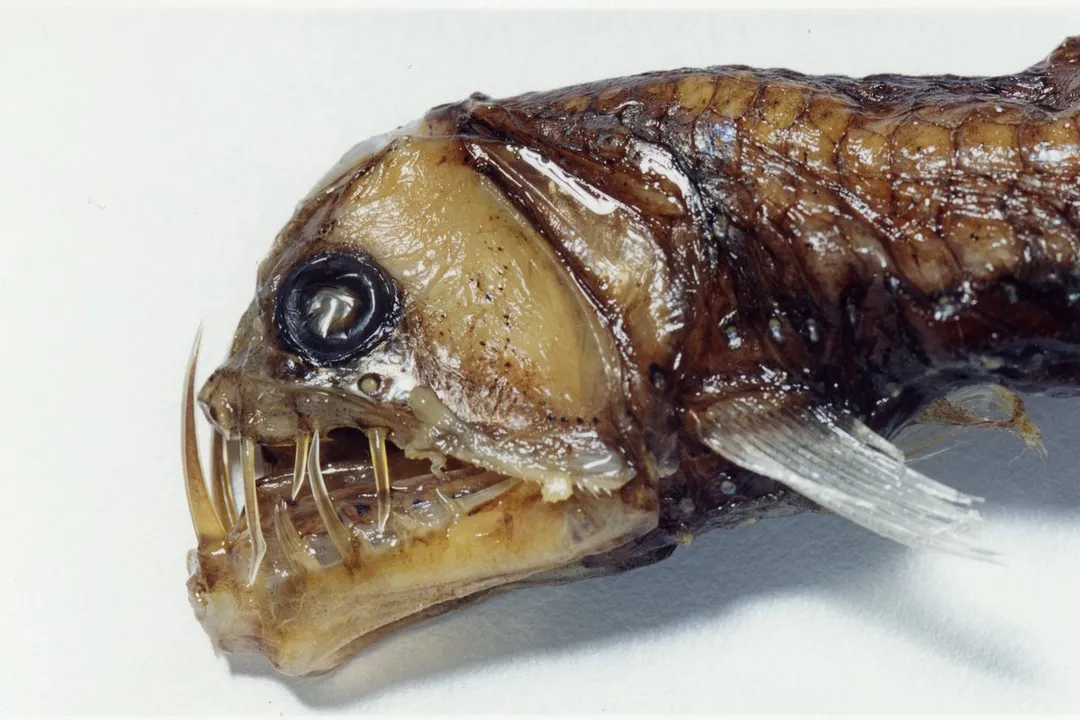
Why can the teeth of a Chauliodus sloani not fit inside its mouth when closed?
Answer
They are disproportionately long and must fit into grooves on the roof of the mouth
The teeth of Chauliodus sloani are exceptionally long and needle-sharp to ensure they can secure rare, large prey in a resource-scarce environment. Because these fangs are too long to be contained within the oral cavity when the mouth is shut, they are accommodated by specialized grooves located on the roof of the mouth. In some cases, these teeth even pierce through the upper jaw, reflecting an evolutionary prioritization of feeding efficiency over having a streamlined, closed-jaw profile.
Related Questions
Why can the teeth of a Chauliodus sloani not fit inside its mouth when closed?What is the primary evolutionary function of the ventral photophores on a viperfish?Which anatomical features enable the viperfish to consume prey larger than itself?To which scientific order does the genus Chauliodus belong?Where is the Pacific Viperfish primarily located?What is the predatory purpose of the barbel photophore found on the chin?In which ocean zones do modern viperfish species typically reside?Why does the viperfish typically display a black or dark brown body color?Why does a viperfish often suffer damage when brought to the surface?What trade-off did the viperfish make regarding its hydrodynamic efficiency?