What specific visual trait defines the dorsal surface of *Potamotrygon leopoldi*?
Answer
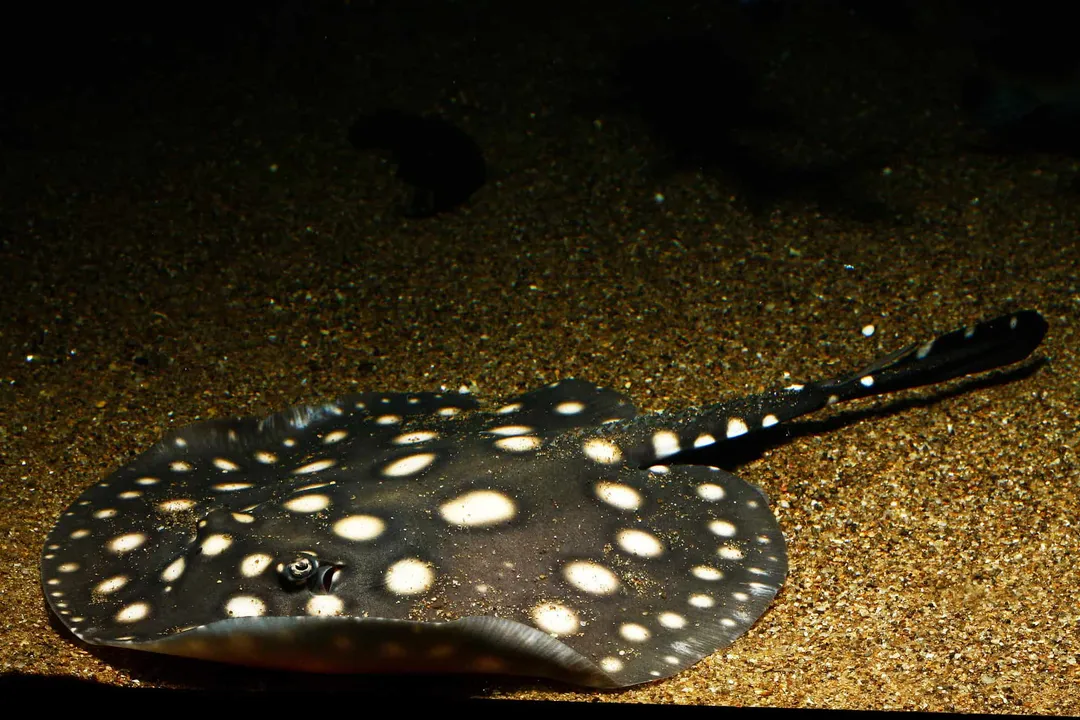
Dark brown to black surface covered in bright white or yellowish spots
The physical characteristics, or morphology, are intrinsically linked to the scientific classification and common naming of the ray. *Potamotrygon leopoldi* is visually striking due to its high-contrast pattern on the dorsal side. This pattern consists of a dark base coloration, typically described as dark brown to black, which is overlaid with bright white or sometimes yellowish spots. These spots have the potential to coalesce or merge together, forming larger blotches, which directly explains why one of its common names is the 'White-blotched river stingray,' serving as a key identifier separate from closely related species.
Related Questions
What distinguishes the Family Potamotrygonidae of the Xingu River Ray?What do the Greek roots *potamos* and *trygon* summarize in the Genus name *Potamotrygon*?Which Class groups the Xingu River Ray with sharks based on skeletal composition?What profound ecological implication arises from *Potamotrygon leopoldi*'s endemism to the Xingu River?What historically used name served as an abbreviation for *Potamotrygon leopoldi* before formal species description?What morphological characteristic defines the Order Myliobatiformes to which *P. leopoldi* belongs?What specific visual trait defines the dorsal surface of *Potamotrygon leopoldi*?What key feature characterizes the Phylum Chordata that the Xingu River Ray belongs to?What disc width can mature specimens of *Potamotrygon leopoldi* typically attain?How does the species designation *P. leopoldi* typically differ morphologically from other Amazonian *Potamotrygon* species?