What morphological characteristic defines the Order Myliobatiformes to which *P. leopoldi* belongs?
Answer
Pectoral fins fused to the head, giving them a flattened, disk-like body shape
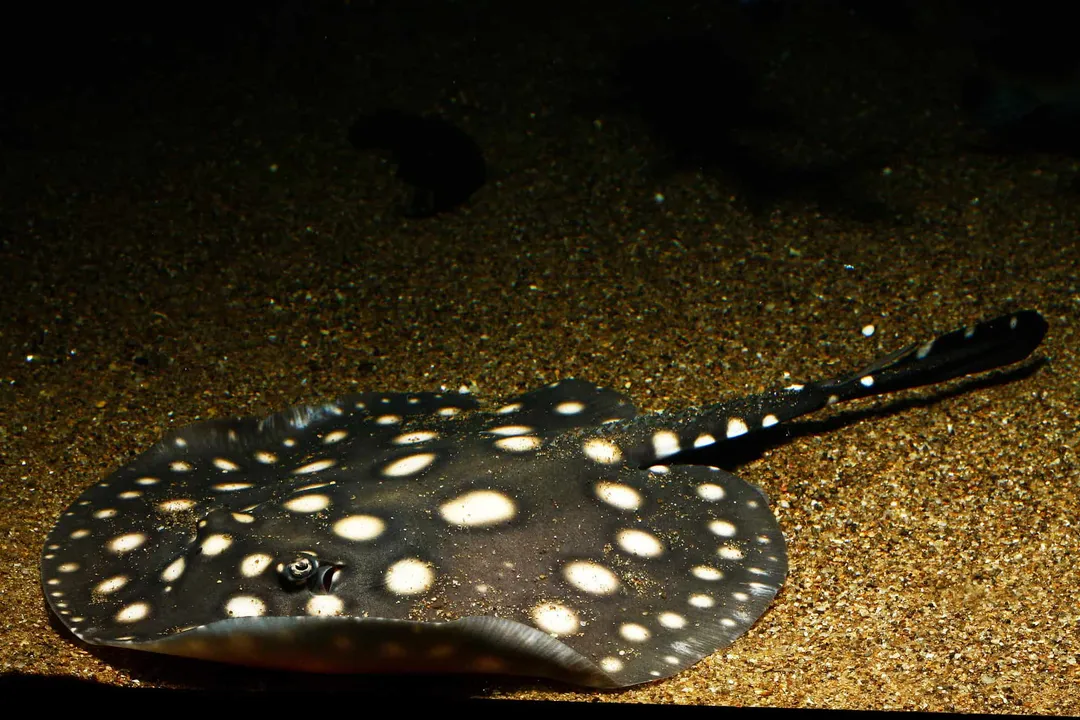
The specific Order assigned to the Xingu River Ray is *Myliobatiformes*, which groups together the stingrays. This classification is based on a key defining physical trait related to their locomotion and body plan. Members of this order are characterized by their pectoral fins being fused extensively to the sides of their head, which results in the flattened, distinctively disk-like body shape commonly associated with stingrays. This morphology contrasts with other cartilaginous fish and is essential for their bottom-dwelling lifestyle.
Related Questions
What distinguishes the Family Potamotrygonidae of the Xingu River Ray?What do the Greek roots *potamos* and *trygon* summarize in the Genus name *Potamotrygon*?Which Class groups the Xingu River Ray with sharks based on skeletal composition?What profound ecological implication arises from *Potamotrygon leopoldi*'s endemism to the Xingu River?What historically used name served as an abbreviation for *Potamotrygon leopoldi* before formal species description?What morphological characteristic defines the Order Myliobatiformes to which *P. leopoldi* belongs?What specific visual trait defines the dorsal surface of *Potamotrygon leopoldi*?What key feature characterizes the Phylum Chordata that the Xingu River Ray belongs to?What disc width can mature specimens of *Potamotrygon leopoldi* typically attain?How does the species designation *P. leopoldi* typically differ morphologically from other Amazonian *Potamotrygon* species?