Xingu River Ray Physical Characteristics
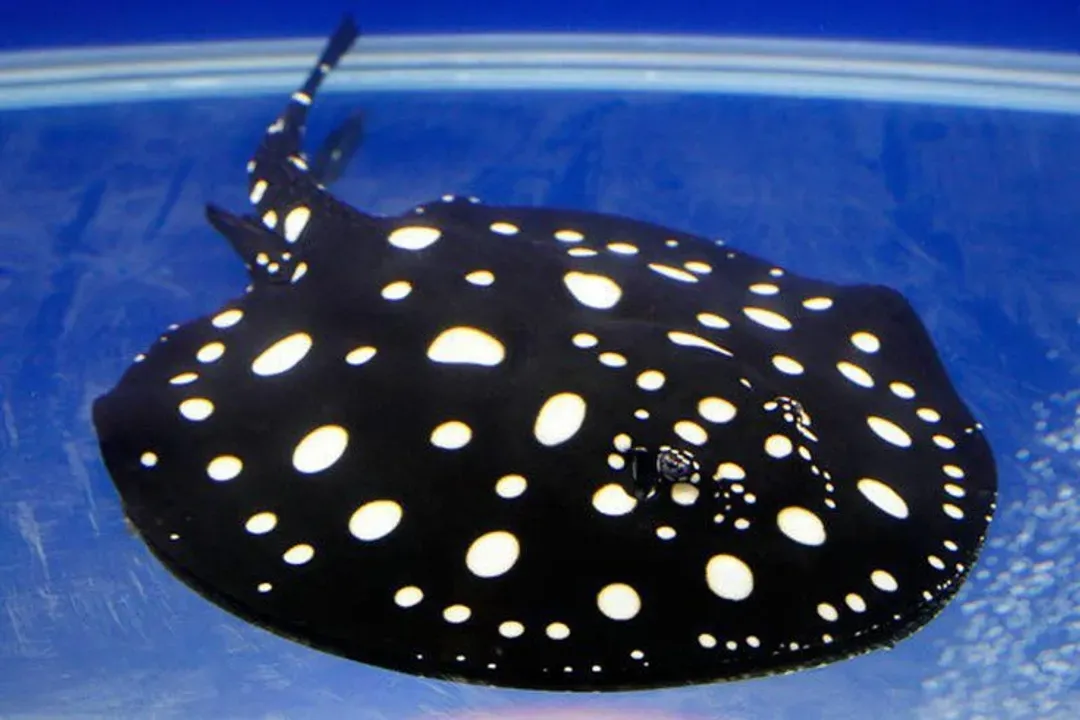
The Xingu River Ray, scientifically classified as Potamotrygon leopoldi, possesses a suite of physical traits that make it one of the most visually striking freshwater inhabitants of the Amazon Basin. [2][5][3] Often referred to by common names such as the White-blotched River Stingray or the Polka-dot Stingray, its appearance is instantly recognizable, setting it apart from many of its riverine relatives. [8] As a member of the Potamotrygonidae family, it shares the fundamental characteristics of its group: a cartilaginous skeleton, placing it in the same class as sharks, and a flattened body structure adapted for life on the riverbed. [2][3]
# Disc Shape
The primary feature defining the ray’s silhouette is its pectoral disc, which is characteristically flat and generally described as nearly circular or oval. [5][2] More precisely, the disc is thick and only very slightly longer than it is wide, contributing to its overall pancake-like appearance as it rests on the bottom. [2] Unlike some marine relatives, the Xingu River Ray’s pectoral fins are not broadly expansive but rather thick and subcircular, allowing it to undulate the edges near the substrate to search for food or to settle firmly onto the river bottom. [3] This benthic lifestyle dictates much of its physical form, enabling it to bury itself in the sediment during periods of inactivity. [5]
# Size Metrics
Size data for P. leopoldi reveals a clear sexual dimorphism, with females consistently growing larger than their male counterparts. [4][5] Maximum recorded disc widths vary in literature, ranging from approximately 40 cm (about 16 inches) [4] up to a maximum of 72 cm. A more commonly cited average disc width hovers around 46 centimeters, or 18 inches. [2] When considering total dimensions, a mature ray can achieve a total length approaching 75 cm (30 inches) and a considerable weight of up to 20 kilograms (44 pounds). [4][7] The difference in adult size is quite pronounced, with reports indicating females reaching disc widths up to about 70 cm while males max out closer to 50 cm. [5] This range in reported maximum sizes highlights the difficulty in capturing the absolute upper limits of wild specimens, as sampling efforts might favor a certain sex or age group, meaning the true potential size is likely at the higher end of the reported figures, reserved for the largest adult females. [3]
# Coloration Pattern
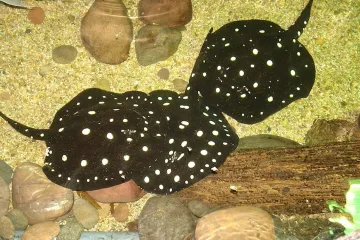
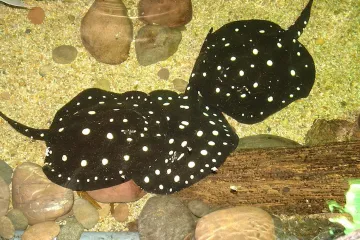
The Xingu River Ray earns its common names from its striking dorsal coloration. The upper surface, or dorsum, is characterized by a deep, dark background, often described as black, blackish-brown, or charcoal. [5][8] Scattered across this dark canvas are numerous white spots or blotches. [5] These markings are not uniform; they can be round, lunate (crescent-shaped), or irregular in form. [5]
As the ray matures, the nature of these spots evolves. Young individuals tend to display a more basic black, white, or gray pattern, with the distinct blotching developing over time. [3] In adults, the solid white spots often transition into circles, which can eventually break apart into clusters of irregular white flecks. While the spots are widely spaced, they are densely distributed across the disc. Interestingly, some individuals may also exhibit splashes of yellow or orange coloration near the forehead. Towards the disc margin, the spots generally become smaller.
In stark contrast to the complex dorsal display, the ventral (underside) surface is typically a pale, brownish-dusky color. [5] While similar species like P. henlei are noted for a large white center on their underparts, the Xingu ray’s ventrum remains predominantly dark, save for small white spots around the disc margin and near the mouth area. [4] This remarkable contrast—a complex, spotted dark top and a simpler pale bottom—is fundamental to its appearance, and one might observe that while this pattern effectively disrupts its outline against the clear, often rocky river bottoms it favors, it would stand out dramatically against the uniformly pale sediment beds preferred by some other benthic dwellers. [5][8]
# Tail Structure Venom
A feature common to many stingrays, yet crucial for the P. leopoldi, is the specialized tail structure. The tail is broad at the base and relatively shorter than the disc width. It is equipped with one or more dentine spines, or barbs, which are a primary defense mechanism and can also be employed in subduing prey. [3][8][7] These spines are located on the dorsal side of the tail, with studies noting three or more irregular rows of small thorns leading up to the venomous tip.
The venom itself is complex, and while the composition remains consistent throughout the ray’s life, its toxicity actually decreases as the ray ages. [4] Furthermore, the ray has a regenerative cycle concerning its defense organ; it periodically sheds its sting, approximately every six months. [3]
# Specialized Morphology
Beyond coloration and defense, the Xingu River Ray displays physical characteristics linked directly to its diet. One significant adaptation is the maturation of its jaw structure. [3] As the ray ages, its jaws become more rigid and stronger, a trait known as durophagy. [5] This enhanced biting power allows mature individuals to successfully consume hard-shelled prey, such as freshwater snails and crabs, giving them a competitive advantage over other organisms unable to process such tough food items. [3][5]
The ray also possesses keen sensory capabilities. It has relatively large and bulging eyes, positioned dorsally, which provide a view of what is passing overhead even when the ray is settled on the bottom. [3] However, its primary tool for locating hidden meals is not visual; the species has unique electroreceptor organs. These allow the ray to detect the faint electric fields generated by living organisms buried in the sediment or hidden nearby, acting as a natural, built-in detection system. [3]
# Comparison with Relatives
The isolation of the Xingu River basin has resulted in distinct physical characteristics that differentiate P. leopoldi from its close relatives found in neighboring river systems. [4] For instance, when compared directly with Potamotrygon henlei from the Tocantins River basin, the Xingu River Ray presents a deeper black coloration on its back. [4] Additionally, P. leopoldi generally features fewer and larger yellowish-white spots than P. albimaculata, which inhabits the Tapajós River Basin. [4] These subtle but consistent differences in spot size, number, and ventral color confirm the morphological distinctness of this species, shaped by the unique hydrographic and substrate conditions of its home waters. [4][5]
Related Questions
#Citations
Xingu River Ray Fish Facts - Potamotrygon leopoldi - A-Z Animals
Xingu River ray - Wikipedia
Xingu River Ray Facts & Photos | Wowzerful
Xingu River stingray | Space for life
Xingu River ISRA - Important Shark Ray Areas
Xingu River ray - Grokipedia
Xingu River Stingray - Potamotrygon leopoldi - Sharks and Rays
White-blotched River Stingray - Sedgwick County Zoo