What primary characteristic of prey drives the necessity for the wolffish's heavy dental apparatus?
Answer
The structural resilience and hardness of their shells
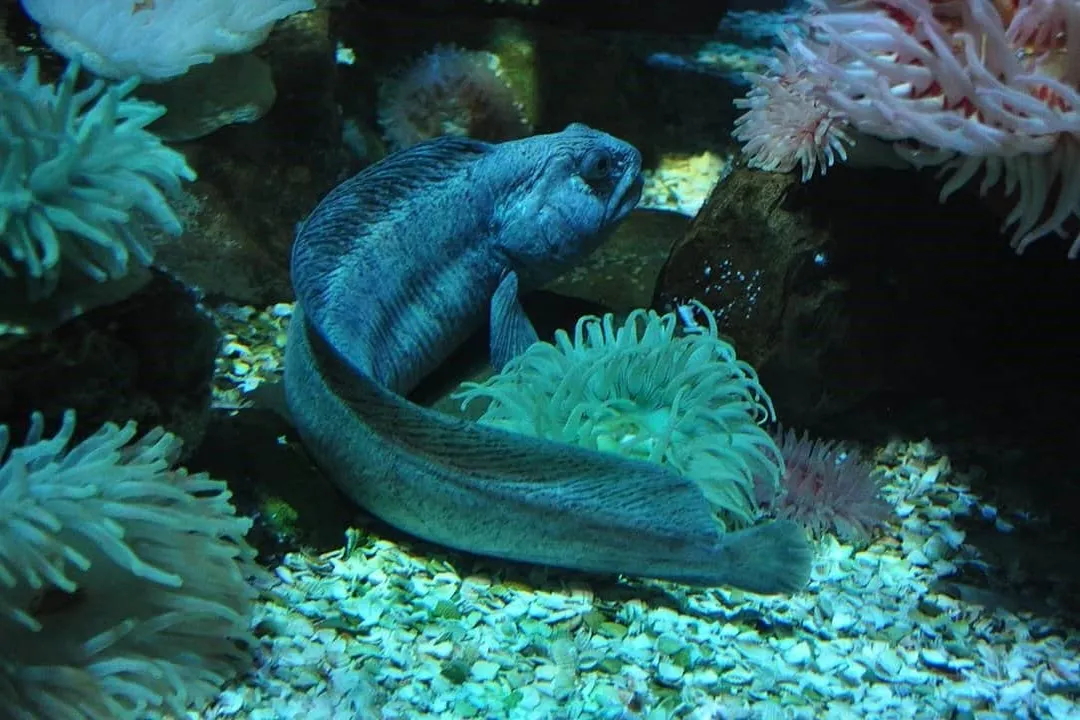
The entire dental configuration of the wolffish—from the capturing canines to the pavement-like molars—is an adaptation calibrated to exploit prey items that possess significant structural resilience, specifically the shells of marine invertebrates. Consistent access to high-energy food sources like crabs, sea urchins, and clams necessitates overcoming the physical barrier presented by their hard exoskeletons and shells. This evolutionary optimization solves an energy balance problem: the cost of developing and maintaining heavy dental structures is justified only by the reliable energetic rewards yielded from crushing these protected organisms.
Related Questions
What taxonomic order contains the specialized fish family *Anarhichadidae*?What specific dental structure in wolffishes is adapted for pulverizing hard shells?What pair of fins is structurally absent in the wolffish body plan due to its benthic specialization?What primary characteristic of prey drives the necessity for the wolffish's heavy dental apparatus?What substance covers the scaleless skin of wolffishes for protection?Which genus, *Anarhichas*, includes the Atlantic Wolffish, known for commercial relevance?Wolffishes typically inhabit cold, demersal zones down to what maximum depth mentioned in the text?What specific fishing activity makes the slow-growing Atlantic Wolffish highly susceptible to population decline?How is the wolffish body plan described in terms of shape, often compared to another type of fish?How many recognized genera make up the entire family *Anarhichadidae*?