What mistake results from infants confusing fruit scrubbing with self-anointing?
Answer
Infants develop itchy skin from abrasive fruit residue.
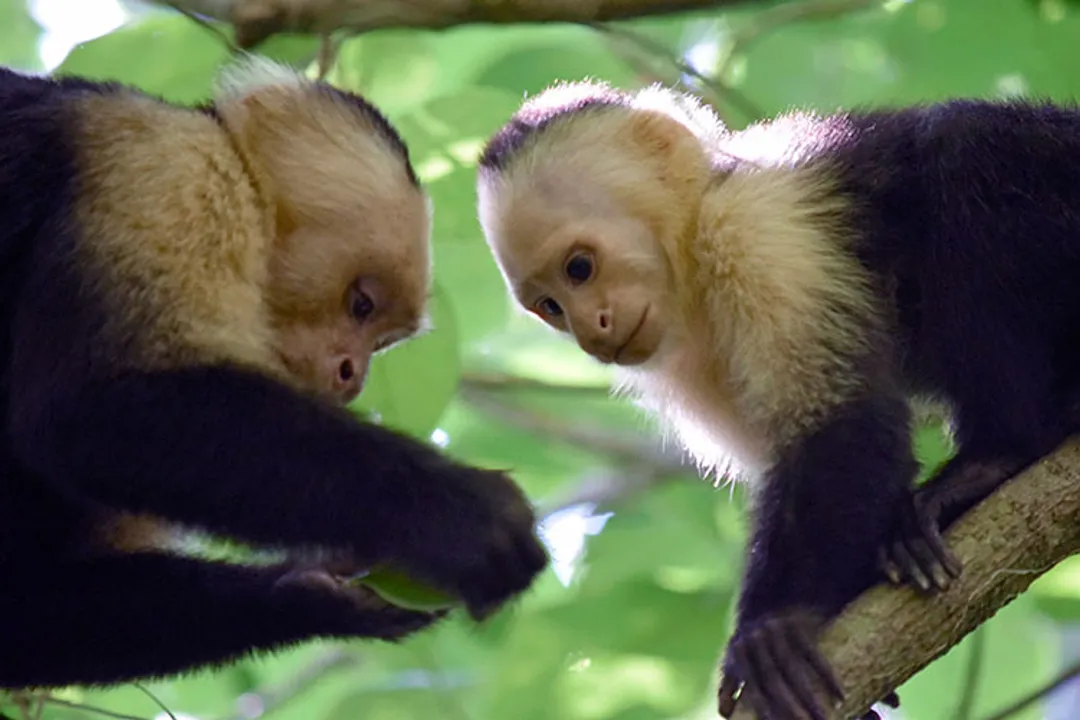
Social learning is vital for young capuchins to acquire complex survival skills by watching adults. However, this observational learning is not flawless, leading to notable errors in infancy. One documented instance involves the confusion between two distinct behaviors: the adult practice of self-anointing, which involves rubbing medicinal or repellent plant substances onto the fur, and the act of scrubbing abrasive fruit against a branch, which is done to remove irritating hairs. When infants incorrectly mimic the scrubbing behavior believing it to be self-anointing, the abrasive residue remains on their fur, resulting in them experiencing discomfort and itchiness.
Related Questions
What pattern on the Cebus head inspired the "Capuchin" name?Which sex in white-faced capuchin troops is philopatric?Which items do Cebus capuchins use as hammers and anvils?What percentage range of calories do ripe fruits constitute for capuchins?What is the IUCN status listed for the Colombian white-throated capuchin?What is the primary role of the semi-prehensile tail in arboreal life?What mistake results from infants confusing fruit scrubbing with self-anointing?How does the lifespan of white-faced capuchins in captivity compare to the wild?What is the typical average size range for a white-faced capuchin troop?Why are rituals like prying open another's mouth seen as powerful trust expressions?