White-Faced Capuchin Locations
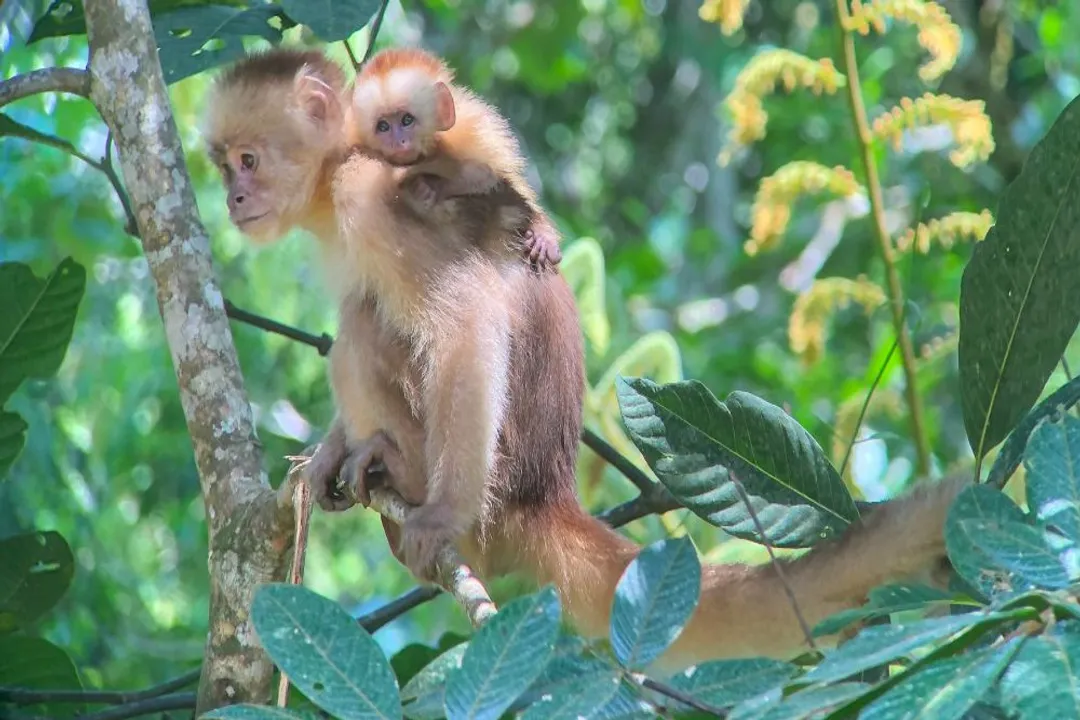
The geographical spread of the white-faced capuchin, primarily referring to Cebus capucinus (the Panamanian white-faced capuchin), covers a substantial swath of territory linking Central and South America. [6][9] These monkeys are not confined to a single country but instead inhabit a band of tropical environments stretching from the southern parts of Central America well into northwestern South America. [1][5][9] Generally, their known distribution begins in Central America and extends south through countries like Panama and into Colombia. [1][2][9]
# Central Span

Tracing the distribution northward, the range of this capuchin species includes several Central American nations. [5] Specifically, the species has been documented in countries such as Honduras and Nicaragua. [4][9] Moving further south, their presence is well-established in Costa Rica. [2][5] In these northern regions, the types of environments they occupy are quite varied, which speaks to their ecological flexibility. [2]
# Southward Reach
The southern boundary of the white-faced capuchin's range sits firmly in Colombia. [1][9] While they inhabit parts of Central America, their continuous presence extends into the northwestern regions of South America. [1][9] The specific region in Colombia where they are found often borders the Pacific coast, overlapping with the Chocó region. [2] It is worth noting that while the primary focus here is C. capucinus, the related but distinct Andean white-fronted capuchin (Cebus albifrons) occupies a much broader area across the northern continent, including Venezuela, Ecuador, Peru, and extending eastward. [3][7] This contrast helps define the specific, more western and northern niche of the white-faced variety. [1][7]
# Habitat Preference
The types of locations the white-faced capuchin chooses are diverse, suggesting they are adaptable to various forest structures, provided they offer sufficient resources and canopy cover. [1][2] In Costa Rica, for instance, one can find them inhabiting both dry deciduous forests and wet rainforests. [2] This ability to thrive across a moisture gradient is significant; they are not obligate residents of only the wettest ecosystems. [2] Furthermore, their presence is documented in mangrove forests. [1][2] Even areas that have experienced significant human impact are not entirely avoided, as they can persist in disturbed areas. [1] This plasticity in habitat selection across their range—from dense primary forest to areas modified by human activity—is a notable characteristic of Cebus capucinus survival. [1][2]
A key observation from comparing their environmental tolerances is that while many tropical primates require specific, undisturbed primary forests, the white-faced capuchin seems capable of utilizing secondary growth and edge habitats more readily, perhaps explaining why the IUCN currently lists Cebus capucinus as Least Concern, despite pressures across its multi-national distribution. [1][8] The ability to utilize deciduous forests, where leaf cover and available food fluctuate seasonally, indicates a level of behavioral flexibility beyond simple seasonal migration; it suggests dietary adaptability as well. [2]
# Taxonomic Considerations
Understanding the exact location requires a brief mention of taxonomy, as classification among Neotropical primates can shift, impacting how a range is defined. [4][9] The species Cebus capucinus is sometimes referred to as the Panamanian white-faced capuchin. [9] However, research has sometimes distinguished Cebus imitator as a separate species, whose range overlaps or constitutes the northern part of what was traditionally considered C. capucinus territory, including Honduras, Nicaragua, and Costa Rica. [4] Regardless of the precise species designation used by different researchers for the northernmost populations, the physical location associated with the "white-faced" appearance in that region remains consistent: stretching from Honduras southwards. [4][5] For practical field identification and understanding the area they occupy, these northern populations are geographically linked to the group found further south in Panama and Colombia. [1][4]
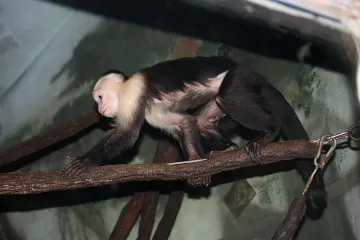
To put the distribution into perspective, imagine a map where the northern extent barely reaches the latitudes of Central American dry zones, and the southern extent terminates where the true Andean ecosystems begin to dominate the range of its cousins like Cebus albifrons. [3][7] This geographic placement—spanning the isthmus and spilling into the continent's northwestern corner—makes the species an important faunal component connecting two major biogeographic regions. [6] Observing a group in a managed setting, such as the rescued individuals at a Costa Rican eco-park, confirms that even in captivity outside their native range, the environmental cues they respond to are inherently tropical. [5]
The fact that this species successfully bridges two continents, with a continuous (though perhaps fragmented) distribution across potentially six countries—Honduras, Nicaragua, Costa Rica, Panama, and Colombia—is impressive for a relatively small primate. [2][9] This wide geographical spread across differing national jurisdictions necessitates conservation efforts that acknowledge cross-border cooperation, which can be an administrative challenge even for a species currently classified as Least Concern. [8] The specific boundaries of their location data often rely on historical sightings mixed with contemporary observations, reinforcing the value of ongoing fieldwork in countries like Nicaragua, where habitat assessment might be less frequent than in well-studied areas like Costa Rica. [4]
Related Questions
#Citations
Panamanian white-faced capuchin - Wikipedia
Cebus capucinus (white-faced capuchin) - Animal Diversity Web
Andean White-fronted Capuchin, Cebus yuracus
Central American White-faced Capuchin (Cebus imitator) - iNaturalist
Monkeys: White-faced Capuchins - Manawakie Eco Nature Park
White-faced capuchin | Research Starters - EBSCO
Cebus albifrons (white-fronted capuchin) - Animal Diversity Web
[PDF] Cebus capucinus, Colombian White-throated Capuchin
Panamanian White-Faced and Colombian White-Throated Capuchins