What key difference in flight posture separates Family Gruidae from Herons (Ardeidae)?
Answer
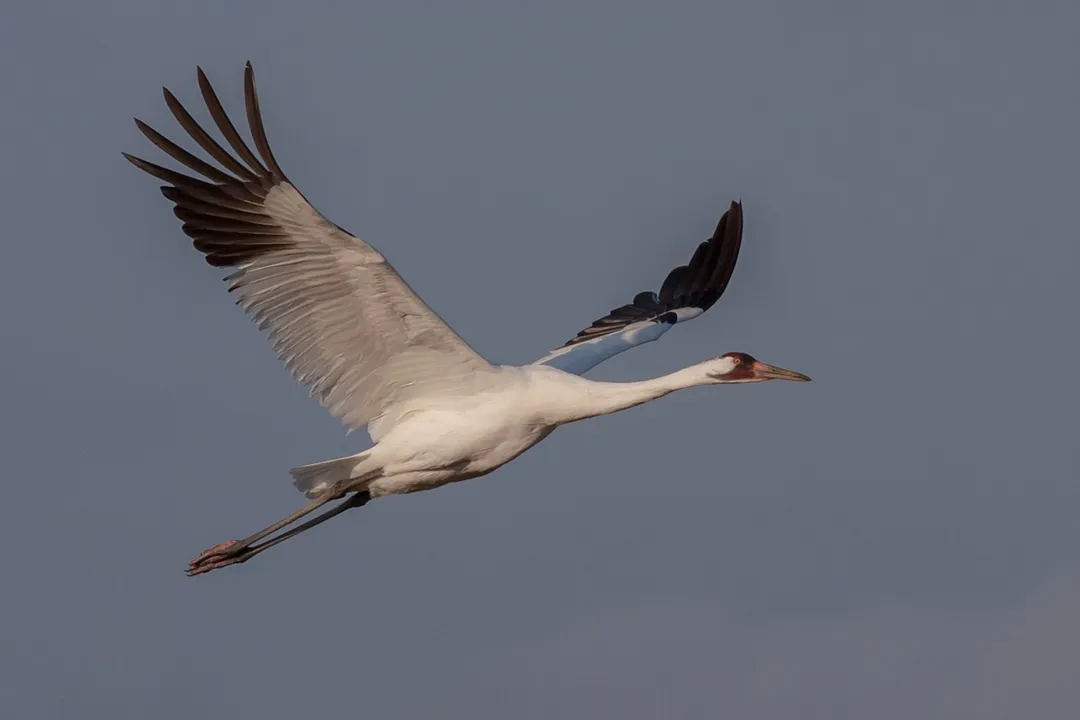
Cranes fly with necks outstretched, while herons fly with necks retracted
When differentiating the crane family (Gruidae) from morphologically similar but evolutionarily distinct families like the herons (Ardeidae), flight posture is a reliable field indicator. Cranes, including the Whooping Crane, maintain a rigid posture during flight, holding their long necks fully extended and pointing straight forward. In contrast, herons characteristically retract their necks during flight, drawing them back into an S-shape configuration. This difference in how the neck is held in the air is a fundamental trait separating these two groups of large wading birds.
Related Questions
What specialized feature produces the Whooping Crane's trumpeting calls within Family Gruidae?Which combination of traits characterizes the Whooping Crane's placement in Class Aves?What characteristic confirms the Whooping Crane's placement in Phylum Chordata?How is the genus *Grus* generally distinguished from other crane genera based on physical structure?How does the species status of *Grus americana* affect regulatory review for development in states like Idaho or North Dakota?What distinct plumage feature characterizes immature *Grus americana* compared to the striking appearance of the adults?What common physical characteristic defines members typically placed in the Order Gruiformes?What key difference in flight posture separates Family Gruidae from Herons (Ardeidae)?What specific conservation status rank does NatureServe assign to *Grus americana* globally?Which genera, besides *Grus*, were historically suggested for the placement of the Whooping Crane based on older classifications?