Whooping Crane Scientific Classification
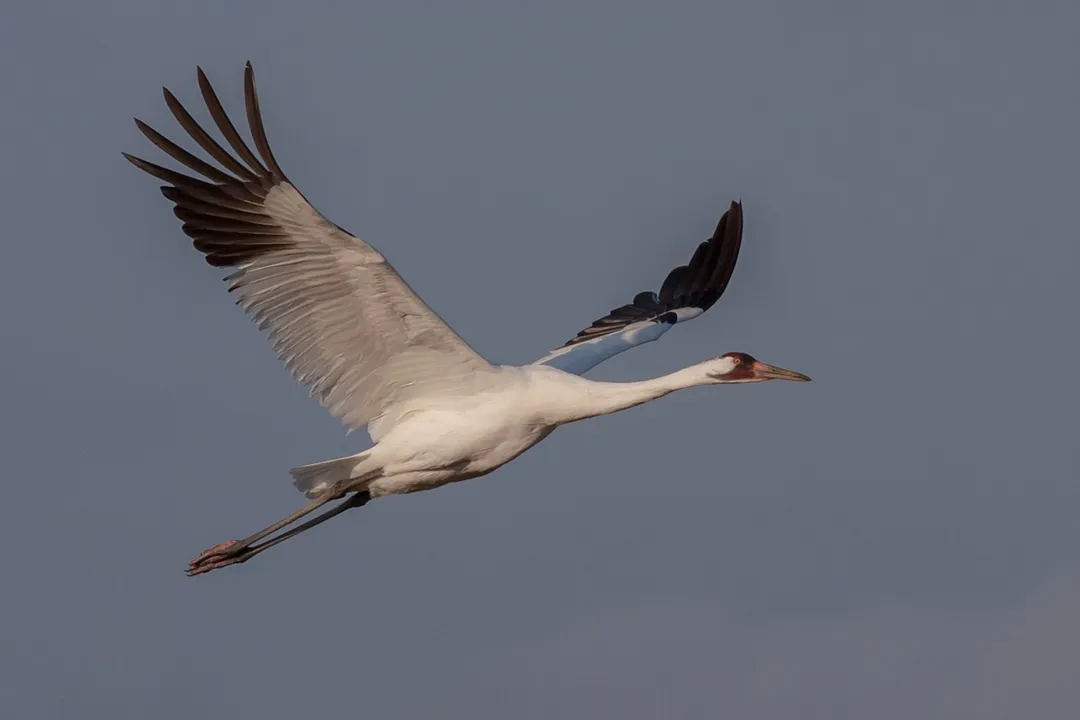
The towering elegance of the Whooping Crane, Grus americana, immediately sets it apart, but its formal placement within the tree of life reveals a deep history shared with vastly different creatures before narrowing down to this magnificent, near-extinct specialist. [1][2][6] Understanding its scientific classification is more than just memorizing Latin names; it unlocks insights into its evolutionary relationships, biological structure, and the specific conservation strategies required for its survival. [4][5] The journey through its taxonomy begins with the broadest categories and methodically refines its identity down to the unique designation reserved only for this species. [6][8]
# Kingdom Animalia
At the very top of the nested system of life, the Whooping Crane resides in the Kingdom Animalia. [6][8] This classification signifies that the crane is a multicellular, eukaryotic organism, heterotrophic—meaning it obtains food by consuming other organisms—and typically motile at some stage of its life cycle. [6] While this kingdom includes everything from sea sponges to blue whales, it immediately separates the crane from plants, fungi, and bacteria. [6]
# Phylum Chordata
Moving one step down, the crane belongs to the Phylum Chordata. [6][8] Organisms in this phylum are characterized by having, at some point during their development, a dorsal hollow nerve cord, a notochord, pharyngeal slits, and a post-anal tail. [6] In birds like the Whooping Crane, these features are modified in the adult form, but their embryonic development confirms this ancient lineage. [6] This places the crane alongside fish, amphibians, reptiles, and mammals, highlighting a shared fundamental body plan established millions of years ago. [6]
# Class Aves
The next level of categorization is the Class Aves, identifying the Whooping Crane as a bird. [6][8] Birds are recognized by feathers, beaked jaws lacking teeth, the laying of hard-shelled eggs, a high metabolic rate, a four-chambered heart, and a strong yet lightweight skeleton, often adapted for flight. [6] This class is vast, yet the crane’s specific characteristics—its immense size, its distinctive calls, and its migration patterns—will soon narrow its position considerably within this group. [9]
# Order Gruiformes
Within Aves, the classification refines the crane's physical and behavioral traits by placing it in the Order Gruiformes. [6][8] This order traditionally groups cranes, rails, gallinules, and coots. [6] Members of Gruiformes are generally characterized by stout bodies, strong legs, and feet often adapted for walking on soft ground or marshes. [6] The Whooping Crane certainly fits the image of a large, long-legged wading bird typical of this order. [9] While some classifications, like those used by some modern genetic studies, might suggest a broader or slightly different arrangement for certain members of this group, Grus americana remains firmly placed within Gruiformes based on established authority. [8]
# Family Gruidae
The distinction sharpens significantly at the Family level, where the Whooping Crane is placed in Gruidae, the crane family. [6][8] This family comprises the "true cranes," which are large, long-necked, long-legged birds. [6] Key characteristics that separate Gruidae from similar-looking families, such as the herons (Ardeidae), include how they fly: cranes fly with their necks outstretched, whereas herons typically fly with their necks retracted or bent. [6][9] Furthermore, cranes possess a unique, elongated trachea (windpipe) that coils around the sternum, acting as a sounding box that produces their loud, trumpeting calls. [9] The Aransas-Wood Buffalo Park population, the only self-sustaining wild population, relies heavily on these vocalizations for territory defense and mate communication across vast distances. [2][7]
# Genus Grus
The genus Grus groups together several of the largest crane species. [6][8] Cranes within this genus generally exhibit a white plumage, though exceptions exist, such as the Sandhill Crane (Grus canadensis) which may have rusty or gray tones. [6][8] The Grus genus is distinguished from other crane genera based on skull structure, leg morphology, and subtle differences in mating displays and vocalizations. [8] Sharing this genus with the Whooping Crane are species like the Common Crane (Grus grus) and the Hooded Crane (Grus monacha). [8] The physical presence of Grus americana—its sheer height, reaching up to 5 feet tall, and its striking white body contrasted with black wingtips—makes it the tallest bird in North America. [9][3]
# Species Grus americana
Finally, the species designation Grus americana isolates the Whooping Crane as unique. [1][6] The species name americana clearly points to its native range in North America. [6] This binomial nomenclature system, established by Linnaeus, serves as the universal identifier. [6] All other organisms are excluded by this specific combination of genus and species epithet. [6]
The precise taxonomic placement of Grus americana is vital for international conservation efforts. For instance, listings under the U.S. Endangered Species Act, managed by agencies like the U.S. Fish and Wildlife Service, rely on this scientific standing to mandate protection across federal lands, such as wintering grounds in Texas. [2][9] When a species is taxonomically defined, it allows managers to track population segments, like the migratory flock utilizing the Platte River during spring migration, with unambiguous scientific clarity. [3]
# Taxonomic Debate and Modern Insights
While the framework—Kingdom through Species—is well-established, modern genetic sequencing often refines relationships within the ranks, particularly at the genus and family levels. [8] Historically, some classifications have placed the Whooping Crane in the genus Grus, while others have, at times, suggested placement in Bugeranus or Leucogeranus. [8] Current authority, supported by molecular evidence compiled by sources like Birds of the World, generally maintains Grus americana within Grus, recognizing its closest relatives among the larger, paler cranes. [8] The subtle differences in breeding biology and morphology, however, are often what drive these fine-scale divisions within the genus. [8]
It is interesting to consider that although the Whooping Crane shares the Phylum Chordata with a mouse, the evolutionary paths that diverged between these two lineages were so profound that their only shared characteristics are the most basic structural requirements of multicellular, protected-nerve animals. [6] This contrast illustrates the tremendous power of classification: taking something as common as a warm-blooded vertebrate and tracing its path back through hundreds of millions of years to a shared ancestor, while simultaneously isolating the precise traits that make it unique today. [6]
# Classification and Conservation Management
The scientific classification of the Whooping Crane directly influences how conservation funds and legal protections are applied across its migratory flyway. [1][3][5] Because Grus americana is recognized globally as a distinct species, conservation bodies like NatureServe assign it a specific conservation status rank—in this case, G1 (Critically Imperiled) globally. [1] This designation is non-negotiable across state lines, whether the bird is breeding in Wood Buffalo National Park in Canada or wintering on the Texas coast. [1][7]
For example, when a pipeline or development project impacts habitat in North Dakota or Idaho, the regulatory review is triggered specifically because the bird belongs to the species Grus americana. [4][5] If a population were reclassified as a subspecies rather than a full species, the required regulatory depth and the public funding streams allocated for its recovery could potentially shift or weaken, illustrating how essential this Linnaean hierarchy remains in modern ecological law. [2] The fact that the primary migratory population is currently designated as a distinct population segment (DPS) for management purposes further emphasizes how critical taxonomy is when implementing recovery actions across multiple governmental jurisdictions. [2] A potential complication arises when considering the isolated, non-migratory Aransas flock—while taxonomically the same species, their localized existence means their immediate threats differ significantly from those facing the migratory segment, requiring species-level understanding combined with population-segment management. [7]
The structural placement within Gruidae means that management practices often borrow successful techniques developed for other crane species, like the Sandhill Crane, although the Whooping Crane’s distinct needs require specialized protocols. [9] The differences in diet and nesting requirements between the very large Grus americana and smaller relatives often necessitate unique habitat manipulation strategies, such as controlling water levels in specific wetlands or managing grazing pressures on grasslands utilized during migration. [3] This synthesis of broad biological knowledge derived from the Order and Family, combined with the specific details of the Species, forms the bedrock of successful recovery plans. [4]
# Morphology Beyond Taxonomy
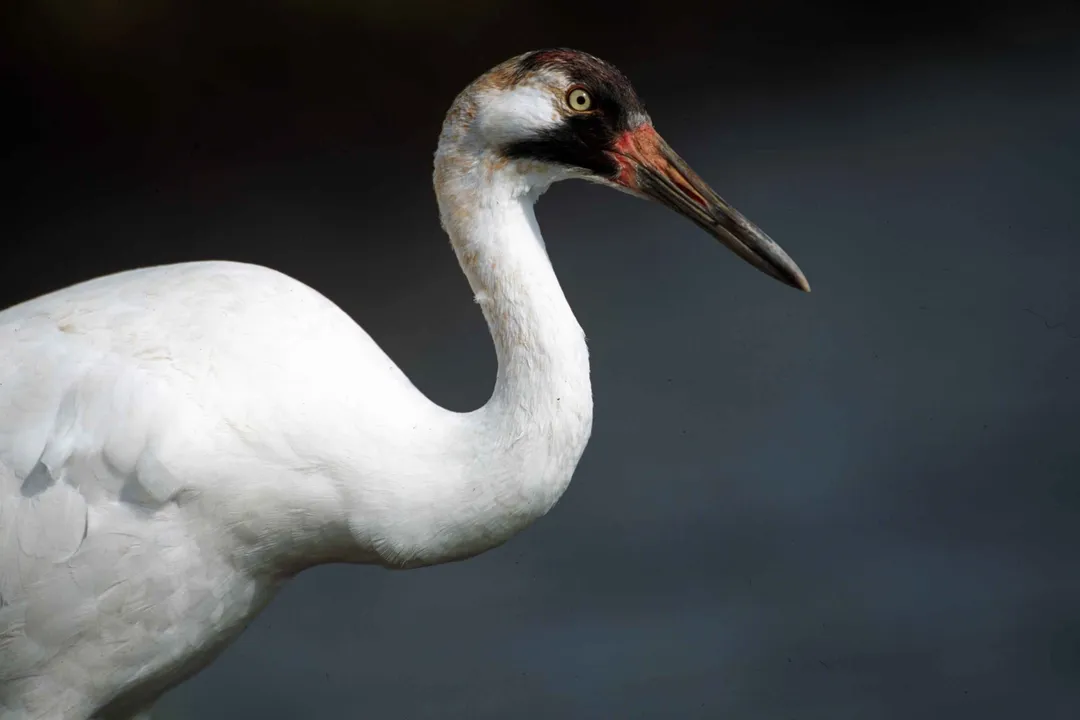
While classification deals with ancestry and shared traits, the physical attributes that define Grus americana are what make its conservation so challenging. The sheer size of this bird is remarkable. [9] Standing up to 5 feet tall with a wingspan approaching 7.5 feet, it is a monumental sight in any North American wetland. [9] This grandeur is matched by its distinctive appearance: an overwhelmingly white body contrasts sharply with black primary and secondary flight feathers, visible only when the bird is in flight or displaying, and a bright red crown and black lores (areas between the eye and bill). [9] Immature birds display a cinnamon-buff wash over their white plumage. [9]
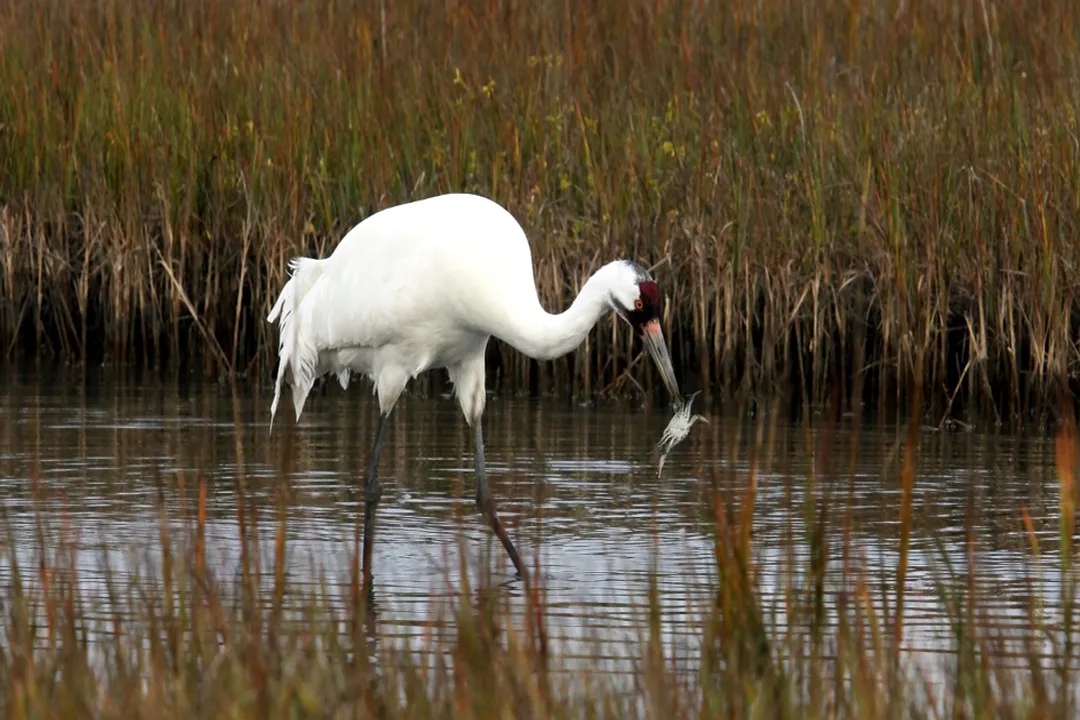
When observing a Whooping Crane wading in the shallows, its specialized bill is apparent—a dark, spear-like tool perfectly adapted for probing mudflats for aquatic invertebrates, small fish, or crustaceans, which form a significant part of its diet, particularly on the Texas wintering grounds. [7][9] This contrasts with the more diverse diet they pursue while staging along rivers like the Platte, where they consume tubers, grains, and amphibians. [3] The fact that such a large, conspicuous bird could vanish almost entirely—dropping to fewer than 20 individuals in the 1940s—is a stark reminder that taxonomic success (a unique evolutionary branch) does not guarantee immediate survival in the face of rapid habitat loss and human pressure. [2][7] The intense recovery efforts are a direct response to the scientific recognition of this species’ unique and irreplaceable slot in the avian order. [1]
Related Questions
#Citations
Grus americana - Whooping Crane - NatureServe Explorer
Whooping Crane (Grus americana) | U.S. Fish & Wildlife Service
Whooping crane - Platte River Recovery Implementation Program
Grus americana (Whooping Crane) | Idaho Fish and Game Species ...
Whooping Crane - North Dakota Game and Fish
Grus americana (whooping crane) - Animal Diversity Web
Whooping Crane - Guadalupe-Blanco River Authority
Systematics - Whooping Crane - Grus americana - Birds of the World
[PDF] Whooping Crane - Grus americana - Texas Parks and Wildlife