What feature defines the common warthog's placement in Phylum Chordata?
Answer
Possession of a notochord during developmental stages
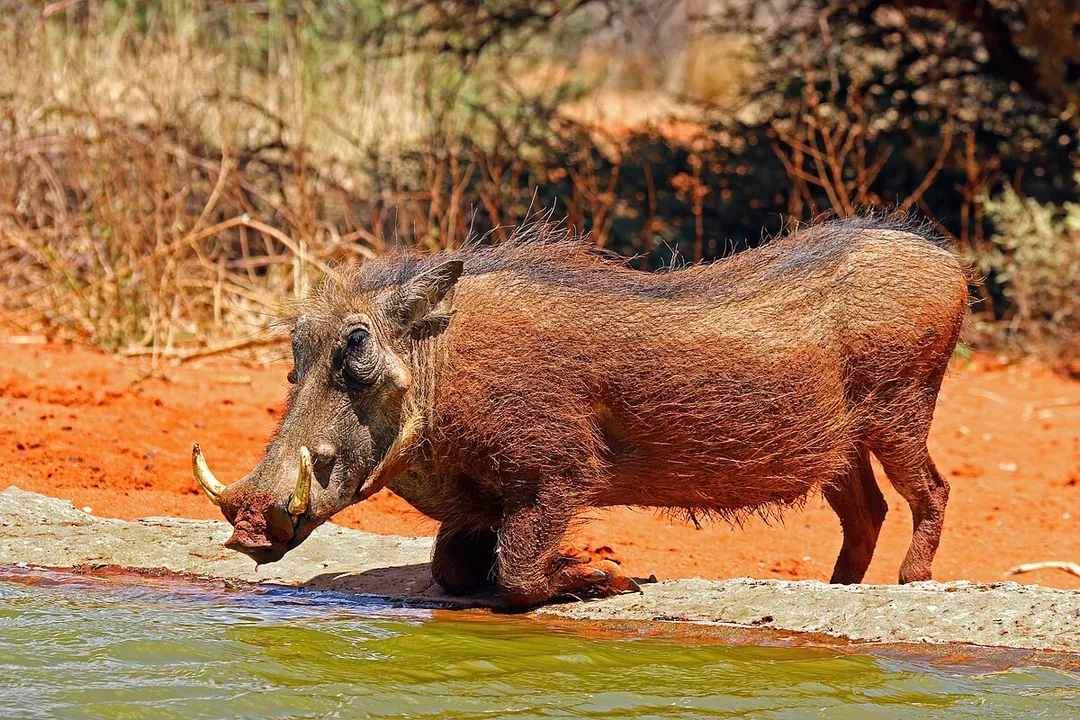
The Phylum Chordata encompasses all animals that, at some stage in their development, exhibit four defining characteristics: a notochord, a dorsal hollow nerve cord, pharyngeal slits, and a post-anal tail. In the common warthog, like all vertebrates, the flexible rod-like notochord present during early development is later replaced by the mature vertebral column or backbone. This internal support structure is fundamental to this phylum. The presence of this defining embryological feature, even if modified later, solidly places the warthog within Chordata, separating it from invertebrates lacking this internal structure.
Related Questions
What characteristic is definitive for classifying an organism in Class Mammalia?What feature defines the common warthog's placement in Phylum Chordata?What defines the structural adaptation characterizing the Order Artiodactyla?What must occur for the species name *Phacochoerus africanus* following binomial nomenclature rules?How does the genus *Phacochoerus* derive its meaning based on Greek derivation?What specific morphological trait separates the common warthog genus *Phacochoerus* from other Suidae like *Sus scrofa*?What is the implication of the warthog belonging to Kingdom Animalia regarding its nutrition?What conservation consideration is directly influenced by recognizing the Desert Warthog as *Phacochoerus aethiopicus*?What evidence suggests the genus *Phacochoerus* experienced a long period of independent evolution within Suidae?When identifying a specimen using the Linnaean hierarchy, what step follows confirmation that it is in Family Suidae?