What do the Tupi words *yarará* and *ca* translate to regarding Bothrops jararaca's specific name derivation?
Answer
Large snake
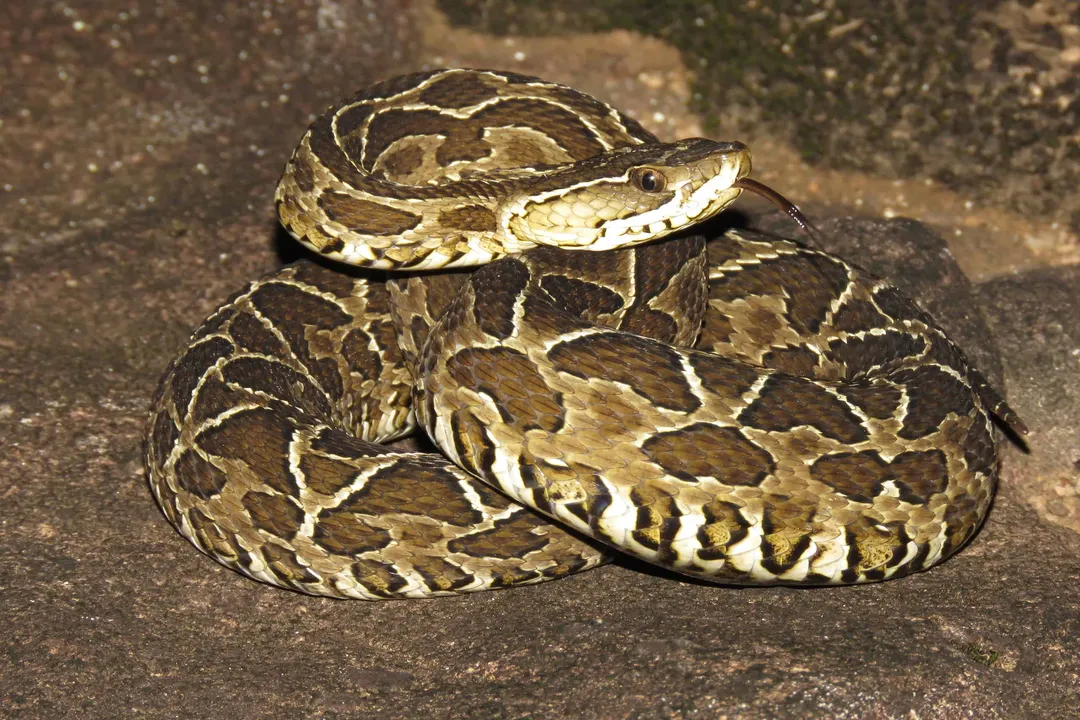
The scientific name *Bothrops jararaca* is derived from indigenous Tupi language roots, providing insight into how the snake was perceived by local populations historically. The combination of the Tupi words *yarará* and *ca* is attributed to meaning 'large snake.' This linguistic heritage reflects the imposing presence and substantial size that this species exhibits in the field, distinguishing it culturally and descriptively within the region it inhabits.
Related Questions
Which Argentine province is cited as a likely overlap zone for both Bothrops jararaca and Bothrops alternatus?What does the Latin term *alternatus* in Bothrops alternatus reference regarding its physical appearance?How does the location preference of juvenile B. jararaca differ from the adults in terms of vertical space?Which Yarara species possesses a wider distribution across the central and northeastern Argentinian provinces?What biomedical application is mentioned regarding the venom derived from Bothrops species?What do the Tupi words *yarará* and *ca* translate to regarding Bothrops jararaca's specific name derivation?What common ecological thread defines the micro-locations favored by Yararas, regardless of precise species?Where geographically is the name "Yarara" used for a small locality unrelated to the venomous vipers?For B. jararaca, what specific national region or province is cited as being particularly endemic to its distribution?How many Argentinian provinces are confirmed to harbor Bothrops alternatus based on the provided provincial list?