How were the teeth of Xiphactinus set, distinguishing it from later bony fishes?
Answer
Set in grooves rather than sockets
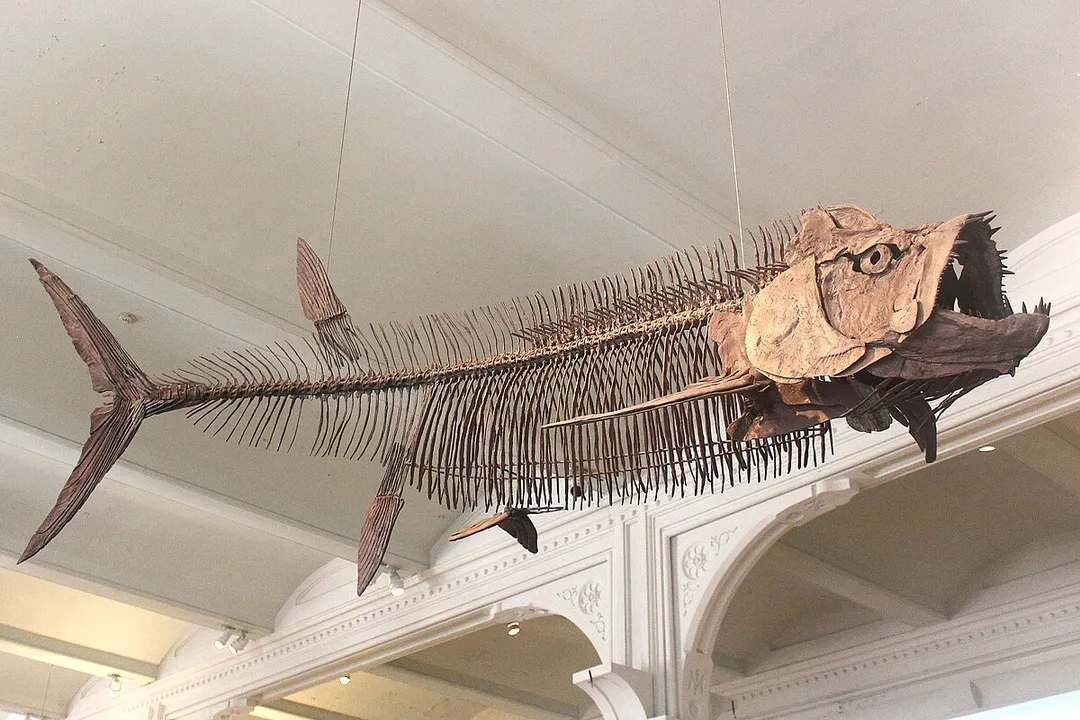
A critical anatomical feature distinguishing *Xiphactinus* from more advanced bony fishes is the setting of its teeth. Instead of being situated within distinct sockets as seen in later, more derived fish groups, the sharp, backward-curving teeth of *Xiphactinus* were set directly into grooves along the jaw structure. This morphology, identified as plesiomorphic, reflects an older, yet highly effective, adaptation suited for grasping and retaining struggling prey during active pursuit.
Related Questions
To which family does the apex predator Xiphactinus belong?During which geological ages did Xiphactinus maintain its predatory success?What is the commonly estimated adult length range for Xiphactinus specimens?How were the teeth of Xiphactinus set, distinguishing it from later bony fishes?What morphological feature did the caudal fin of Xiphactinus share with modern tuna?What potential metabolic state is debated for Xiphactinus compared to most modern fish?What ancient ocean once split North America where Xiphactinus thrived?From which famous chalk beds are detailed Xiphactinus fossils frequently recovered?Which massive marine reptile did Xiphactinus coexist with but not dominate as a predator?Which Xiphactinus species is designated as the more widely known and larger apex predator?What aggressive feeding strategy does the swallowed Protosphyraena illustrate for Xiphactinus?