Xiphactinus Evolution
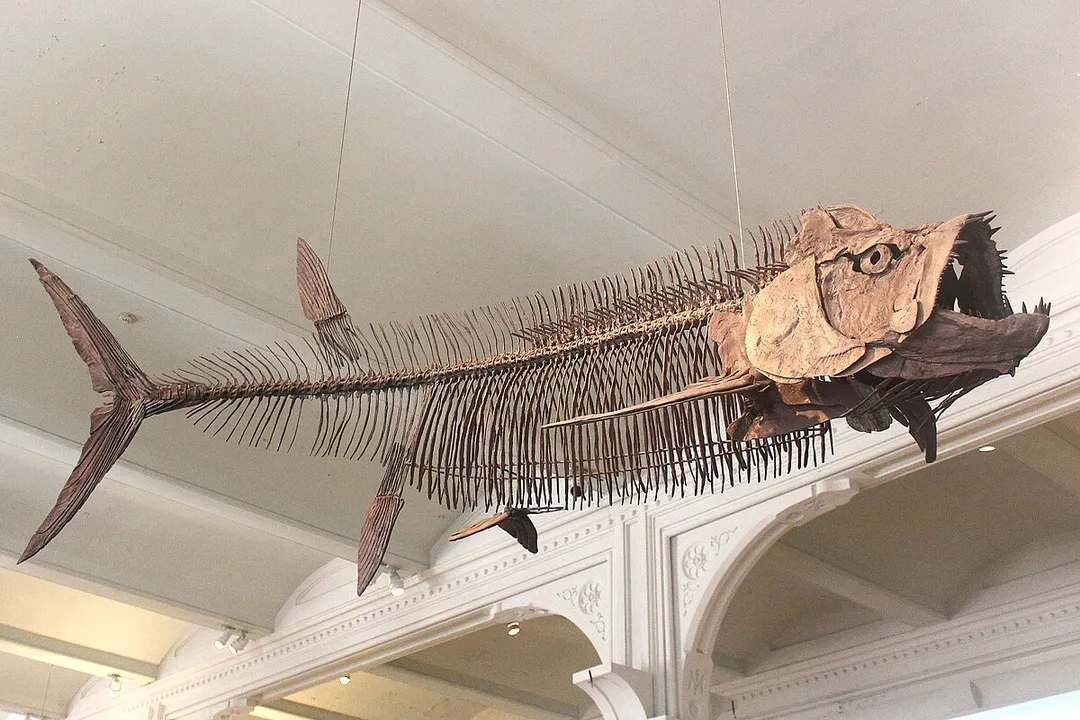
The Late Cretaceous seas were a domain ruled by creatures of imposing scale and formidable predatory adaptations, and among the most impressive of these was Xiphactinus. This massive bony fish was not a dinosaur, but an apex predator that commanded the waters of the Western Interior Seaway, a vast ancient ocean that once split North America in two. [2][4][5] To understand Xiphactinus is to look at a highly specialized achievement in piscine evolution, a creature perfectly calibrated for a warm, productive marine environment teeming with life. [1][2] Its fossils, frequently recovered from the famous chalk beds of Kansas, offer a rare and detailed glimpse into the structure and behavior of a dominant, non-marine reptile predator of that time. [5][8]
# Bony Fish
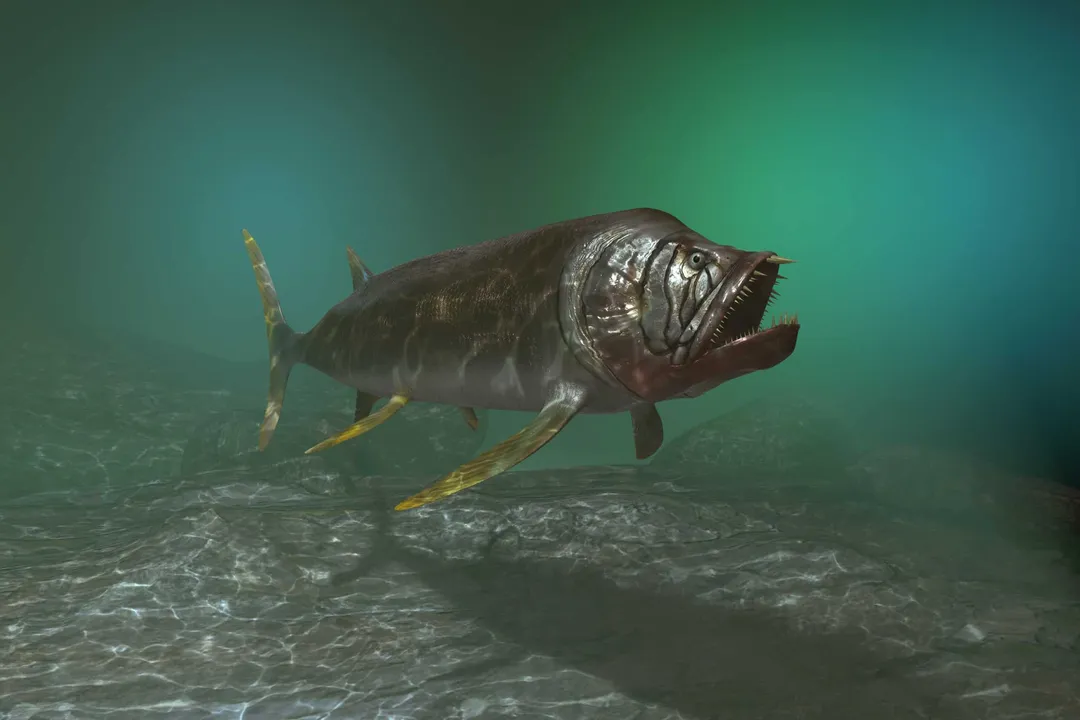
Xiphactinus belongs to the order Teleostei, placing it within the vast group of ray-finned fishes, which includes most modern fish species. [1] More specifically, it is categorized within the family Ichthyodectidae. [1][7] This family represents a group of fish that were already relatively advanced for their time, yet Xiphactinus stands out for its sheer size and specialized characteristics compared to its relatives. [1] While the precise evolutionary pathway leading directly to Xiphactinus might involve fossil intermediates yet to be fully characterized, its position within the Ichthyodectidae framework suggests it evolved from smaller, likely more generalized ichthyodectids that were already well-adapted to pelagic, open-water life during the mid-Cretaceous. [1]
Its robust build and large size suggest that Xiphactinus was an example of evolutionary gigantism within its clade, a trend seen across many marine ecosystems when ecological niches allow for the removal of size constraints. This specialization suggests a long period of successful adaptation to exploiting the abundant prey resources available in the ancient seaway. [1][2]
# Terror Size
The physical dimensions of Xiphactinus are staggering, cementing its reputation as a terror of its environment. [2] Adult specimens commonly reached lengths of around 11 to 13 feet (3.4 to 4 meters). [1][4] Some estimates, based on the largest known fragments, even suggest potential individuals approaching 16 feet in length. [1] For perspective, while it coexisted with massive marine reptiles like Mosasaurus, Xiphactinus was the dominant fish predator. [2][5]
The structural features directly supported this predatory lifestyle. Its jaws were powerfully built, and the teeth were set in grooves rather than sockets, which is a key characteristic distinguishing it from later, more advanced bony fishes. [1] These teeth were sharp, backward-curving, and suited for grasping and holding struggling prey, consistent with an active, pursuit-style hunter. [2] Furthermore, its streamlined, muscular body structure points toward significant swimming capabilities. [2] The caudal (tail) fin was deeply forked, a morphological feature often associated with high cruising speeds in modern fast swimmers like tuna. [1]
The relative stability of this predatory body plan across its known lifespan in the fossil record—spanning the Campanian and Maastrichtian ages of the Late Cretaceous—suggests that once this apex niche was established, the morphology remained highly successful until the end-Cretaceous extinction event. [1][7]
Here is a brief comparison of its key features compared to related groups:
| Feature | Xiphactinus audax | Ichthyodectids (General) | Modern Tuna (Analogy) |
|---|---|---|---|
| Estimated Length | Up to 13 feet [1] | Smaller, varied [1] | Up to ~15 feet (Bluefin) |
| Teeth Setting | In grooves (Plesiomorphic) [1] | Variable, but distinct | In sockets (More derived) |
| Tail Shape | Deeply forked [1] | Generally forked | Deeply forked [1] |
| Metabolism | Debated (Warm-blooded?) [3] | Unknown | Warm-bodied (Regional endothermy) |

# Metabolic Debate
One of the most fascinating aspects surrounding Xiphactinus, which hints at its advanced evolutionary status compared to many other contemporary fishes, is the scientific debate over its metabolism. [3] While most modern fish are ectothermic (cold-blooded), evidence suggests that Xiphactinus may have possessed some form of regional or even full endothermy (warm-bloodedness). [3]
The arguments supporting a higher metabolic rate stem from its sheer size and inferred activity level. Sustaining a body mass of over 500 pounds requires a significant amount of sustained energy, suggesting the need for a body temperature regulated above the ambient water temperature, particularly if it was actively hunting in deeper or cooler parts of the seaway. [1][3] This potential endothermy would have given it a substantial advantage in speed and endurance over truly cold-blooded competitors, allowing it to maintain high activity levels regardless of slight thermal fluctuations in the environment. [3]
If we consider the implied energy budget: a 13-foot fish capable of burst speeds required to catch fast-moving prey like other large fish and squid, it likely needed efficient, constant power. [2] The shallow Western Interior Seaway, while warm overall, would have still presented thermal gradients. An endothermic capability, even a regional one analogous to that seen in modern lamnid sharks or tuna, would explain its success as the supreme piscine predator in an ecosystem crowded with marine reptiles that were also likely utilizing gigantothermy (retaining heat due to large size) or outright endothermy. [3] This need for constant high energy output, potentially driving evolutionary pressure towards higher internal temperature regulation, represents a key area where Xiphactinus appears more convergent with advanced modern fish than with its more primitive relatives within the Teleostei lineage.
# Seaway Environment
The geological setting of Xiphactinus is inseparable from its biology. It lived in the Western Interior Seaway during the Late Cretaceous period, roughly 85 to 66 million years ago. [1][5][7] This seaway covered much of what is now the central United States. [2][8] The environment was warm, shallow, and rich in organic material, supporting an enormous biomass. [2]
This abundance fueled the evolution of massive predators. [2] The fossil deposits, particularly the Niobrara Chalk of Kansas, have preserved Xiphactinus remains exceptionally well, sometimes alongside evidence of its last meal—a phenomenon that offers direct insight into its feeding ecology. [8] The famous discovery of a Xiphactinus specimen appearing to have swallowed a Protosphyraena (another large fish) whole illustrates the aggressive, gap-limited feeding strategy it employed. [1][2] The preservation of these associations within the chalk suggests rapid burial and mineralization, protecting the entire scene. [6]
When contrasting this habitat with the earlier Mesozoic oceans, the Xiphactinus fauna represents a peak of specialized bony fish dominance in that marine setting, before the K-Pg extinction event wiped the slate clean. [5] While the environment was warm, the success of Xiphactinus suggests that its specialized morphology allowed it to exploit the water column more efficiently than the slower-moving or less specialized chondrichthyans (cartilaginous fish) or other marine reptiles present at the time. [1][2]
# Species Variation
While Xiphactinus is often treated as a single entity, the fossil record indicates some level of species diversity within the genus itself. [9] The two most commonly referenced forms are Xiphactinus audax and Xiphactinus vetus. [9]
Xiphactinus audax is the more widely known and larger of the two, firmly established as the gigantic apex predator described previously. [9] The specimens from the Kansas chalk, representing the peak of its size and specialization, generally fall under this designation. [8]
Xiphactinus vetus is also documented from Cretaceous formations, including those in Georgia. [9] While it shares the characteristic features of the genus, recognizing distinct species like X. vetus allows paleontologists to track subtle evolutionary trends or regional variations in size and morphology across the vast expanse of the ancient seaway or through slightly different time intervals within the Late Cretaceous. [9] This distinction implies that even within a highly successful genus, minor selective pressures continued to shape populations differently across space or time, a typical hallmark of ongoing evolution rather than a static, finalized form. [1]
# Evolutionary Significance
Xiphactinus serves as a spectacular, albeit terminal, example of marine teleost evolution during the Cretaceous. It achieved top-predator status relying on speed, size, and a specialized dentition built for grasping large, single prey items, rather than the crushing or shearing tools seen in other contemporary marine carnivores. [2] Its evolutionary significance lies in demonstrating how far the Ichthyodectidae lineage could be pushed in terms of size and predatory refinement within the specific ecological constraints of the seaway. [1]
Its eventual disappearance with the K-Pg boundary signifies the end of this particular evolutionary line of giant bony fish predators in the Atlantic basin. [5][7] Unlike some groups that survived the event or evolved rapidly afterward, the highly specialized Xiphactinus niche was effectively erased, leaving later Cenozoic oceans to be dominated by different fish lineages, such as the ancestors of modern billfish or tunas, which exhibited even more derived skeletal and physiological adaptations, such as teeth set in sockets. [1] The study of its morphology, especially the features related to its musculature and cardiovascular demands (like the endothermy question), provides paleontologists with a vital case study on how large, active predators managed the physiological demands of high-level ecology before the modern Cenozoic marine faunas took shape.
Related Questions
#Citations
Xiphactinus
Xiphactinus, Terror Of The Inland Seaway
Xiphactinus audax endothermic?
Xiphactinus Animal Facts
Xiphactinus | Smithsonian Ocean
A Xiphactinus Dig: Excavating Clues to Noah's ...
Xiphactinus | Dinopedia | Fandom
Xiphactinus audax Leidy
7D: Xiphactinus vetus - Exploring Georgia's Natural History