How many distinct longitudinal stripes typically overlay the base coloration of the Desert Grassland Whiptail (*A. uniparens*)?
Answer
Six
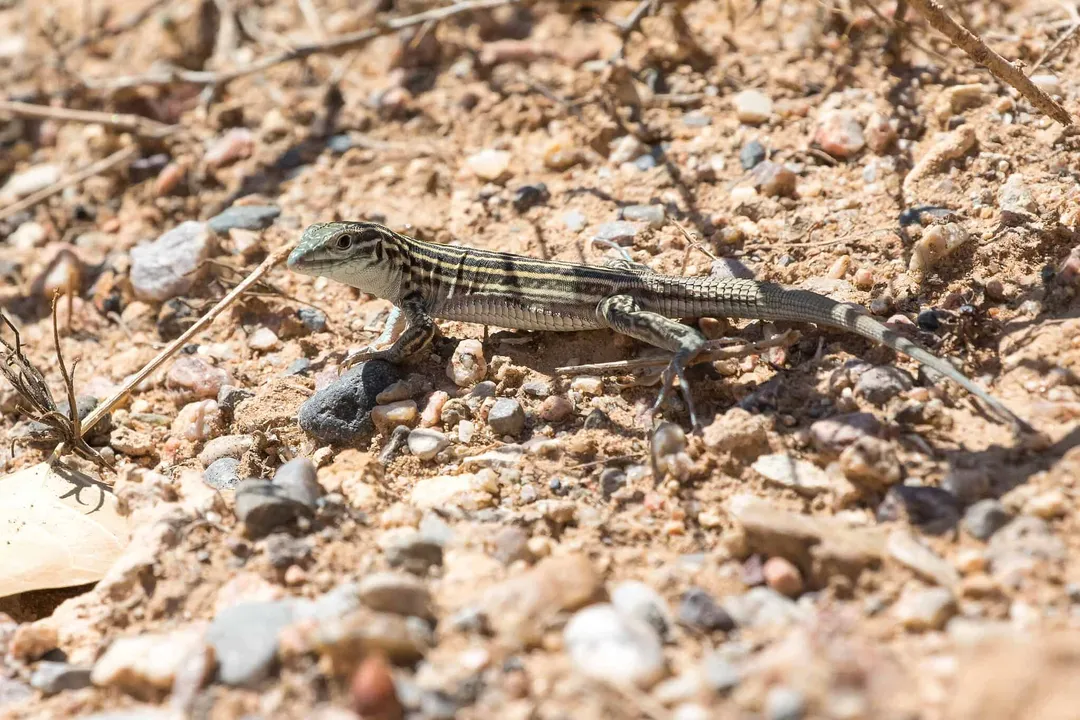
The physical description of the Desert Grassland Whiptail (*Aspidoscelis uniparens*) includes a consistent pattern of striping that aids in identification. Its base coloration is usually olive-brown to black. Superimposed upon this base are precisely six distinct longitudinal stripes. These stripes are cream or yellowish in color and run continuously from the head area all the way down to the tail. This specific count distinguishes it, as related species like the New Mexico Whiptail (*A. neomexicanus*) are sometimes noted as possessing seven pale yellow stripes.
Related Questions
What color is the tail of juvenile Desert Grassland Whiptail lizards upon hatching?How do the all-female *A. uniparens* and *A. neomexicanus* reproduce without fertilization?What invertebrate frequently constitutes the major component of the whiptail diet, sometimes up to 42.5%?What specific behavior, involving female-on-female mounting, is thought necessary to trigger ovulation in parthenogenetic whiptails?According to Lowe and Wright's proposal, which genus retained South American whiptail taxa after the split?What difference exists between the granular scales on a whiptail's upper body and the scales on its belly?What maximum running speed are some whiptail species capable of attaining, often using bipedal locomotion?How many distinct longitudinal stripes typically overlay the base coloration of the Desert Grassland Whiptail (*A. uniparens*)?What inherent conservation risk is linked to the asexual, clonal reproduction strategy of the *A. uniparens* population?In what two non-native geographical locations has the New Mexico Whiptail (*A. neomexicanus*) established populations?