How is the flight style of adult *E. sarcitrella* often described?
Answer
Weak fliers, exhibiting fluttery, erratic movements
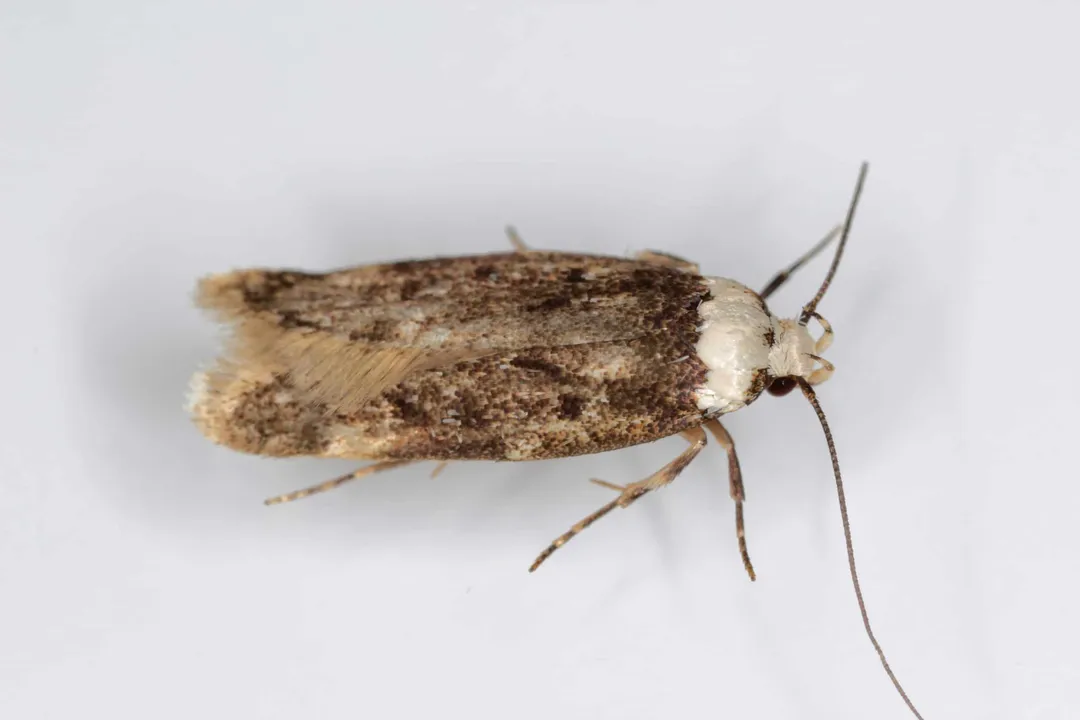
Beyond static physical characteristics, the way the adult moth interacts with the air provides a useful secondary clue for identification. Adults of the White-shouldered House Moth are commonly characterized as weak fliers. When disturbed, their movement is not direct or strong, but rather described as fluttery and erratic. This suggests that the physical structure of the moth is optimized for short bursts or hops rather than sustained aerial navigation, often leading them to settle quickly nearby after being disturbed from a dark corner. This contrast in flight performance helps differentiate *E. sarcitrella* from more active, sustained flyers found indoors.
Related Questions
What is the typical wingspan range for an adult White-shouldered House Moth?What color characterizes the head and posterior thorax of *Endrosis sarcitrella*?What feature distinguishes *E. sarcitrella* forewings from the Clothes Moth?What is the scientific catalog designation for the White-shouldered House Moth?What contrasting feature is present on the larva of *Endrosis sarcitrella*?How are the hindwings of the White-shouldered House Moth generally described?Which moth species is characterized by a uniform, dull gold color according to identification notes?Besides wingspan, what measurement is specified for the wing length of *E. sarcitrella*?How do the wings of *E. sarcitrella* appear when the moth is perched?How is the flight style of adult *E. sarcitrella* often described?