Winter Moth Physical Characteristics
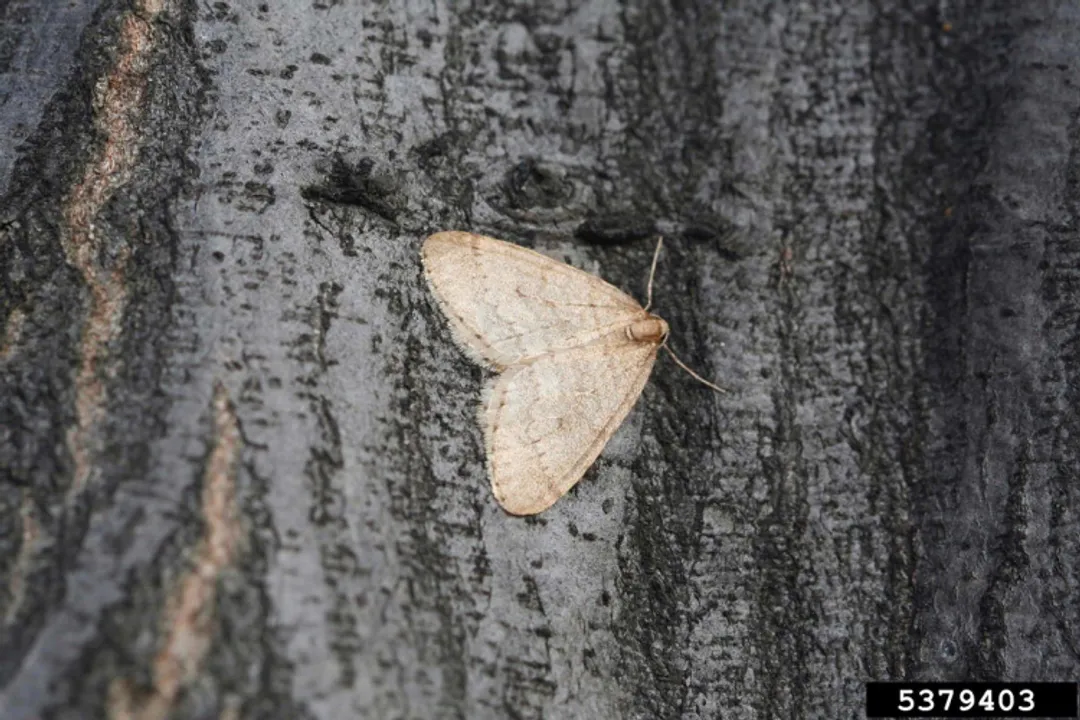
The Winter Moth, scientifically classified as Operophtera brumata, presents a fascinating case study in evolutionary divergence between the sexes, particularly for an insect that arrives when many others have long since retired for the year. [3][4] Though native to Europe and Russia, its presence in North America, particularly as an invasive species in regions like coastal Maine, Massachusetts, Rhode Island, and the Pacific Northwest, makes its physical traits important for identification and management. [1][2][3][7] The adult moths emerge during late autumn and early winter, a time frame that sets them apart from most other lepidopterans in temperate zones. [3][4]
# Male Appearance

The winged male Winter Moth is generally a small insect, described as varying in forewing color from grey-yellow to beige-brown, and occasionally showing a slight reddish tint. [3] Other sources note the color spectrum ranges from tan to mottled grey. [1][6] Across different descriptions, the common thread is a muted, earth-toned palette suitable for camouflage against tree bark during their active period. [4][8] The forewings often feature indistinct, band-shaped dark brownish patterns. [3] A fine detail noted by some observers is the presence of little fringes of hair situated at the base of the male's wings. [1] The hindwings tend toward a pale grey or yellow-grey shade, [3] and the antennae are characteristically short and finely hairy. [3] In terms of measurement, the wingspan for the male is frequently cited as approximately three-quarters of an inch, [2] though a range spanning from 22 to 28 millimeters has also been recorded for the male's wingspan. [4] They are strong flyers, actively seeking out mates using pheromones released by the females. [3][5]
# Flightless Females
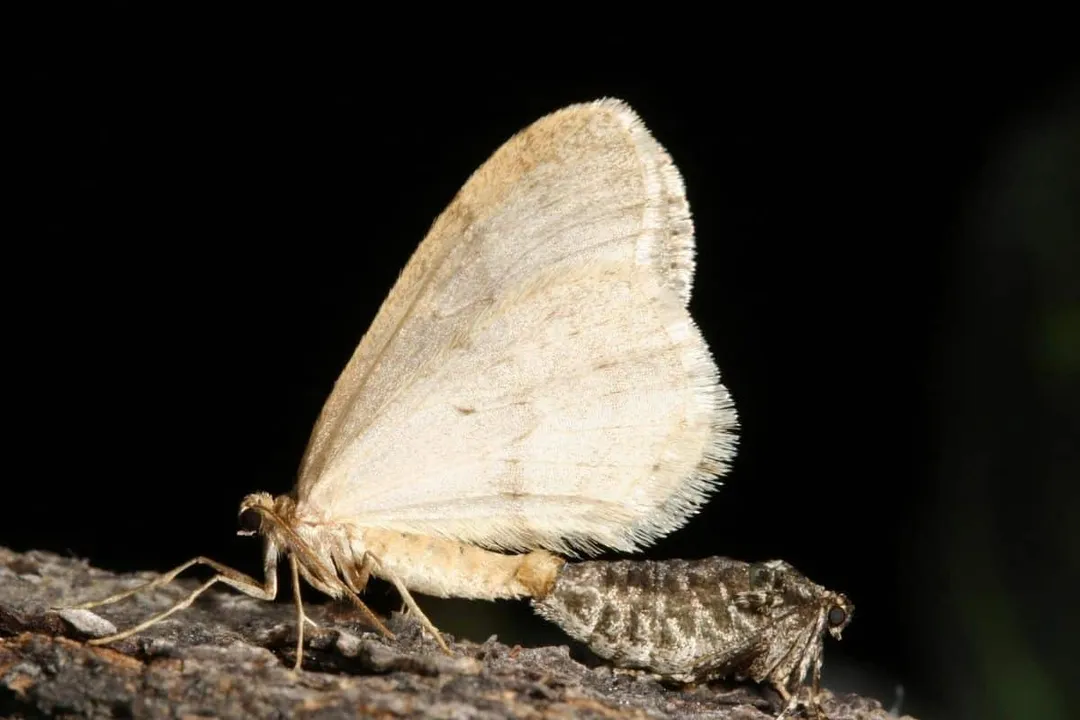
Perhaps the most striking physical characteristic of the species is the extreme sexual dimorphism, where the female barely resembles a moth at all. [4][8] The female Winter Moth has effectively lost the ability to fly. [1][3][5] While they are described as "virtually wingless", [3] closer inspection often reveals they possess greatly reduced wings, sometimes appearing as little stubs or rudimentary structures. [1][5] This flightless state necessitates a different approach to reproduction; the female emerges from the pupa and crawls up tree trunks or buildings to emit sex pheromones to attract the males, who fly to her location. [3][5][8] Physically, the flightless female is characterized by a brownish-grey body, [3][6] sometimes described as mottled grey, [1] often appearing quite plump or possessing a "fat abdomen". [1] They also tend to have notably large black eyes. [1] Both sexes share a similar small body length, generally approximated around 1 centimeter or 0.4 inches, [3] or about half an inch. [6] This disparity—a strong, winged male seeking out a sedentary, cryptic female—is a significant morphological adaptation influencing mating patterns. [3]
# Comparing Sexual Morphology

The contrast between the sexes is one of the key identification markers for Operophtera brumata. [1][5] While the male is equipped for aerial dispersal and mate searching across distances, the female is adapted for a static, ground-based existence immediately following emergence, which localizes her egg-laying site. [3][6] It is interesting to consider the reproductive trade-off inherent in this morphology. Sources indicate that the larger an adult female moth is, the greater the number of eggs she is capable of depositing. [3] This suggests that physical robustness in the female, perhaps correlated with better larval feeding success, directly translates into higher reproductive output—a tangible advantage for a stationary reproducer. [3] Furthermore, the native Bruce spanworm (Operophtera bruceata), which hybridizes with the invasive species, also displays this dimorphism, but the native female's wings are typically longer, reaching halfway down the body, a measurable difference from the stubbier wings of O. brumata. [3][8]
# Larval Form
The larval stage, often called the caterpillar, is the damaging phase of the Winter Moth's life cycle. [5][7] Upon hatching in the early spring, the caterpillars are minute, measured around 2.5 millimeters (0.1 inches) [3] or just a few millimeters long. [1] At this nascent stage, some descriptions note they can appear blackish. [6] They undergo rapid growth over about six weeks, [3] eventually reaching lengths of roughly half an inch to three-quarters of an inch (about 19 mm). [2][3][6] Their primary color when larger is generally described as pale green, [1][7] or lime green. [7] A consistent marking across various reports is the presence of longitudinal stripes running down the body; these are often detailed as thin yellow lines [1] or creamy-yellow stripes running lengthwise along each side of the body. [5][7] The Wildlife Trusts notes a dark line along the top of the body for the native UK population, which may or may not overlap with the invasive species' markings. [8]
A defining physical characteristic of the larvae, which earns them the common names "looper" or "inchworm," is their gait. [6][7] This characteristic movement is a direct result of their leg structure: they possess only two pairs of prolegs toward the rear of their body, forcing them to contract their body into a loop when moving, bringing the back appendages forward to meet the front legs. [6][9] This looping locomotion contrasts with the straight-line crawling of many other caterpillars. The very young larvae employ a clever dispersal technique called "ballooning," where they release long strands of silk to be carried aloft by wind, sometimes aided by electrostatic forces. [1][4][5] This physical attribute allows them to travel between host plants before settling into the buds and leaves. [1][5]
# The Egg Stage
Before the larvae are visible, the eggs must survive the winter period. [4] Following mating, the wingless females deposit small clusters of eggs [5] in protected locations like bark crevices, under loose bark scales, or within lichen growth on the host tree. [2][3][7] The eggs themselves are tiny. [3][7] The initial color observed is typically orange, [7] but a crucial physical indicator of imminent hatching is a color shift: the eggs will turn dark blue shortly before the larva emerges. [7] This transition from orange to blue provides a very narrow window for those attempting to treat the eggs before larval activity begins. [7] It is worth noting that because the female is flightless, she tends to deposit all her eggs on the tree she climbs, leading to a physically clumped deposition pattern that differs from species where flight allows for wider dispersal of egg masses. [9]
# Distinguishing Features Summary
To summarize the key physical differentiators, one could look at a quick reference guide based on these observations, noting that identification must always account for regional variants like the paler male northern Winter Moth. [8]
| Life Stage | Sex | Key Physical Trait(s) | Typical Size/Measurement |
|---|---|---|---|
| Adult | Male | Fully winged, strong flyer, finely hairy antennae [3] | Wingspan ~22-28 mm [4] |
| Adult | Female | Wingless/stubby wings, fat abdomen, cryptic grey color [1][5] | Body length ~1 cm [3] |
| Larva | All | Pale green body with two pale longitudinal side stripes [7] | Hatch: ~2.5 mm; Mature: up to 19 mm [3] |
| Egg | N/A | Changes from orange to dark blue before hatching [7] | Tiny, laid in bark crevices [3][7] |
The tendency for female moths to lay a large number of eggs per tree, concentrated in one area due to their inability to fly, means that while infestations can be localized initially, the sheer physical volume of eggs laid can lead to intense, localized defoliation in subsequent seasons. [9] Conversely, while the larvae use the physical mechanism of silk production for ballooning, [1] the looping movement required for terrestrial crawling—a result of their specific proleg arrangement—is an energy-intensive behavior for climbing or descending, which might explain why they drop to the soil once fully grown rather than climbing down. [6] This combination of flightless adults laying clustered eggs, highly mobile larvae, and a distinct larval gait forms the core of the Winter Moth's physical identity.
Related Questions
#Citations
Winter Moth - Butterfly Conservation
Winter moth - Wikipedia
Winter Moths - Mass Audubon
Winter moth | The Wildlife Trusts
Winter Moth - Environmental Factor
WINTER MOTH Operophtera brumata - Maine.gov
[PDF] Winter Moth
Winter moth - Invasive Species Council of British Columbia
Hazelnut-Winter moth