White Sturgeon Physical Characteristics
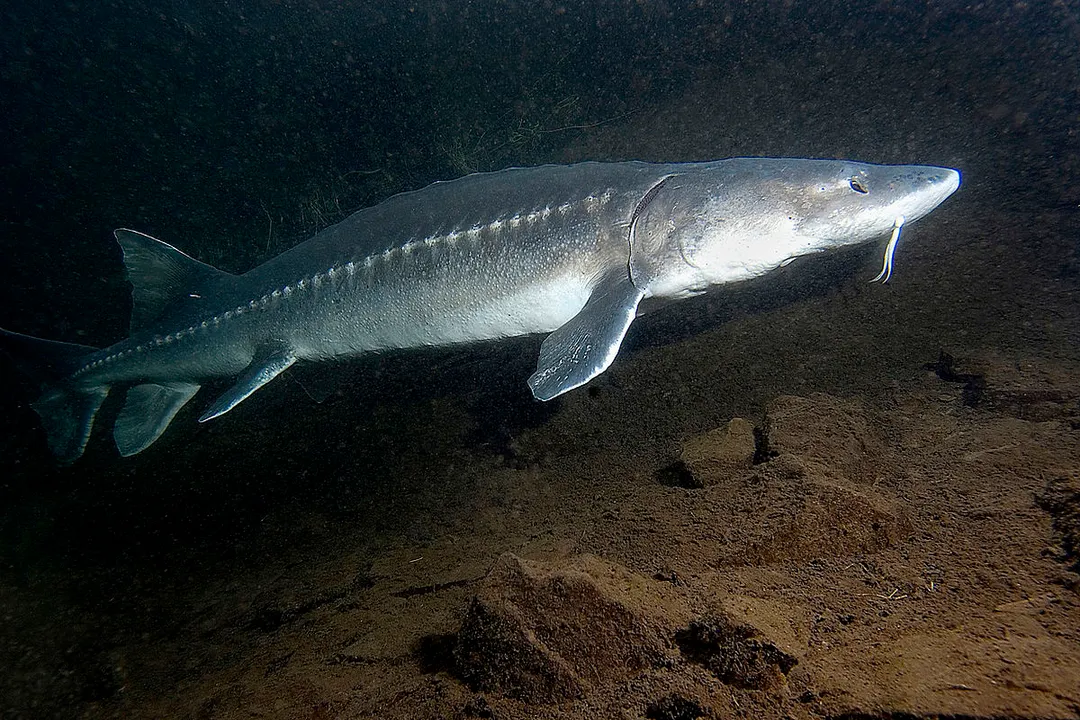
The White Sturgeon, scientifically known as Acipenser transmontanus, presents a truly ancient and imposing figure in the aquatic landscapes of western North America. This fish stands out immediately due to its torpedo-shaped, elongated, and cylindrical body, lacking the typical overlapping scales found on most other fish species. Instead of scales, the White Sturgeon is armored with five distinct, prominent rows of bony plates, called scutes, running along the length of its body, giving its skin a rugged, sandpaper-like texture. These sturgeons are often described as living fossils because their fundamental body plan has remained largely unchanged since the Late Cretaceous period, spanning over 66 million years.
# Size Records
The sheer potential for size in the White Sturgeon is staggering, cementing its status as the largest freshwater fish found across North America. Historically, accounts describe individuals reaching immense proportions: up to 6.1 meters (20 feet) in length and weighing in excess of 816 kilograms (1,799 pounds). While such colossal specimens might be relics of the past, perhaps due to intensive fishing pressure in the late 1800s, modern large individuals still command respect. Today, the largest White Sturgeon typically reach lengths around 3 meters (10 feet) and weights approaching 181 kilograms (400 pounds). The most well-documented maximum weight record hovers around 630 kg (1,390 lb).
It is important to note that maximum size can be geographically dependent. For example, the landlocked population residing in Montana’s Kootenai River, downstream of Kootenai Falls, is described as notably smaller than their anadromous counterparts found elsewhere in their range. Even within this restricted system, while adults generally do not exceed 200 pounds, documented fish have reached 6 feet in length. Considering the massive historical maximums against today's reported giants reveals a significant shift in the size structure of the wild populations, a direct consequence of environmental changes and historical harvest. Furthermore, while the maximum lifespan remains technically unknown, one specimen was estimated to be 104 years old, and others are cited as potentially living up to 100 years.
# Body Armor
The distinctive feature that truly sets the White Sturgeon apart from more modern bony fishes is its external armor plating. Rather than being covered in cycloid or ctenoid scales, the sturgeon possesses five rows of these hardened scutes. These scutes are arranged along the dorsal (top), lateral (side), and ventral (bottom) axes of the fish.
The most critical row for species identification and physical assessment is the mid-lateral row. The California Department of Fish and Wildlife indicates that adults possess 38 to 48 mid-lateral plates. This number is a crucial metric in population assessments, often counted alongside other features to track individuals or confirm status. Interestingly, other regional descriptions provide slightly different counts, indicating potential intraspecies variation that researchers must account for. The Montana population description notes counts of 36 to 48 lateral scutes. Similarly, the dorsal row is described as having 11 to 14 plates in the Kootenai River population, while another source notes about 45 rays present in the dorsal fin generally, which likely refers to the scute count itself or the ray count in the fin itself, reinforcing the presence of numerous dorsal plates. It is insightful for conservation biologists to track these seemingly minor variations in scute counts between geographically isolated populations; such differences, when coupled with genetic data, help validate the existence of distinct riverine demes, even within the same species.
Another key morphological feature related to this armor system is the placement of the scutes immediately behind the anus and leading toward the tail. One source specifies that two rows of four to eight ganoid bony plates are situated between the anus and the anal fin.

# Head Structure
The head of the White Sturgeon is uniquely adapted for its role as a bottom-dwelling benthic feeder. The snout is characteristically blunt and rounded. It features four barbels (sensory feelers) positioned on the underside of this snout, and these barbels are situated closer to the tip of the snout than they are to the mouth itself. These barbels are highly sensitive tactile and chemical receptors, assisting the fish in locating food on the substrate in often murky waters.
Its feeding mechanism is equally specialized. The mouth is ventral (situated on the underside of the head) and sub-terminal, meaning it is downward-oriented and located behind the extended rostrum or snout. The White Sturgeon has no teeth; instead, it relies on large, highly protruding lips that it extends to create suction, effectively vacuuming prey items from the river or seafloor. A fascinating, though perhaps less frequently cited, physical characteristic related to feeding is that its taste buds are located on the outside of its mouth. This arrangement, combined with the sensitive barbels, paints a picture of a highly evolved sensory system tuned exclusively to the near-field chemical and tactile environment of the bottom substrate, making it less reliant on vision than pelagic (open-water) feeders.
# Body Profile and Tail
Beyond the armor, the overall profile contributes to its ancient appearance. The sturgeon has a cartilaginous skeleton, much like sharks, which contributes to its robust structure. The tail fin is distinctly heterocercal, which means the vertebral column extends into the upper lobe of the caudal fin, making the upper lobe extend farther than the lower lobe. This tail structure is another characteristic linking it to very early fish forms.
# Coloration
Coloration in White Sturgeon is generally muted, offering effective camouflage against the varying bottom habitats they frequent, which can range from marine estuaries to river gravel beds. The dorsal side, or back, typically ranges in color from gray to brownish. As the body transitions downward, the color becomes noticeably paler or white on the ventral surface (belly). The fins are generally described as gray. While the general pattern is consistent across the species, it is not a fixed identifier. The Kootenai River population, for example, is simply described as being gray in color, which contrasts with the historically larger, more widely distributed populations that showed more variability in their dorsal shading.
# Distinctions in Early Life Stages
The physical characteristics of the White Sturgeon undergo a noticeable transition from the larval stage through to maturity, reflecting changes in habitat and feeding strategy.
- Larvae and Young-of-the-Year (YOY): Newly hatched larvae are small, measuring only about 10–11 mm in total length. They initially rely on their yolk sac for sustenance. Once they transition to external feeding, these young fish become relatively sedentary, relying on water currents to move them downriver to suitable feeding grounds where they consume small benthic invertebrates like Corophium species.
- Juveniles: As juveniles, they become tolerant of brackish water, allowing them to exploit estuarine habitats during their first summer. Juveniles, typically less than 600 mm (2.0 feet) in length, continue to focus on invertebrates but also consume fish eggs and fry. Their growth is rapid initially, with body weights potentially doubling every two to three weeks in warm conditions during their first four months of life. They develop the full complement of scutes, though perhaps smaller in proportion to their body size, and rely on their emerging armor for defense.
The combination of their ancient skeletal structure, the unique arrangement of five rows of scutes replacing true scales, the specialized barbels and mouth for bottom feeding, and their impressive maximum size makes the White Sturgeon a fascinating subject of ichthyological study. These physical traits have allowed the species to persist for eons, adapting to the dynamic freshwater and estuarine environments of the Pacific slope.

# Scute Variability and Aging Insight
When considering the physical markers, the scute counts provide a consistent yet variable system for identification. The dorsal count is relatively small (around 11-14), while the lateral count is high (36-48). If a field researcher needs a rapid, non-lethal assessment of a large specimen suspected to be a White Sturgeon, counting the lateral scutes and confirming the presence of four barbels anterior to the sub-terminal mouth provides a much higher degree of confidence than relying on coloration alone, which can be highly influenced by diet and water clarity in different river systems. This adherence to an ancient, segmented skeletal pattern is a hallmark of their evolutionary success.
# Sensory Apparatus and Feeding Adaptation
The suite of physical characteristics related to feeding offers a clear illustration of evolutionary specialization. The White Sturgeon is a specialist in consuming bottom-dwelling organisms. This specialization is evident in three main structural components:
- Barbels: These four tactile appendages act as highly sensitive chemical and touch sensors, allowing the fish to "taste" and feel food items buried in the substrate.
- Snout: The short, broad, and slightly shovel-like snout physically guides the fish across the bottom, positioning the mouth correctly.
- Mouth: The ventral, toothless mouth equipped with extensible, protrusible lips functions like a vacuum or scoop, capable of generating suction to ingest prey whole without needing to bite or chew.
This physical configuration means that in low-visibility conditions, such as turbid river water or deep estuarine mud, the White Sturgeon possesses a sensory and physical advantage over visually-oriented predators. Their dependence on chemical sensing—taste buds exterior to the mouth—further solidifies their adaptation to this low-light, bottom-feeding niche.
Related Questions
#Citations
White sturgeon - Wikipedia
White sturgeon | Animals - Monterey Bay Aquarium
Acipenser transmontanus (Oregon sturgeon) - Animal Diversity Web
White Sturgeon Enhanced Status Report - CA Marine Species Portal
White Sturgeon - Montana Field Guide