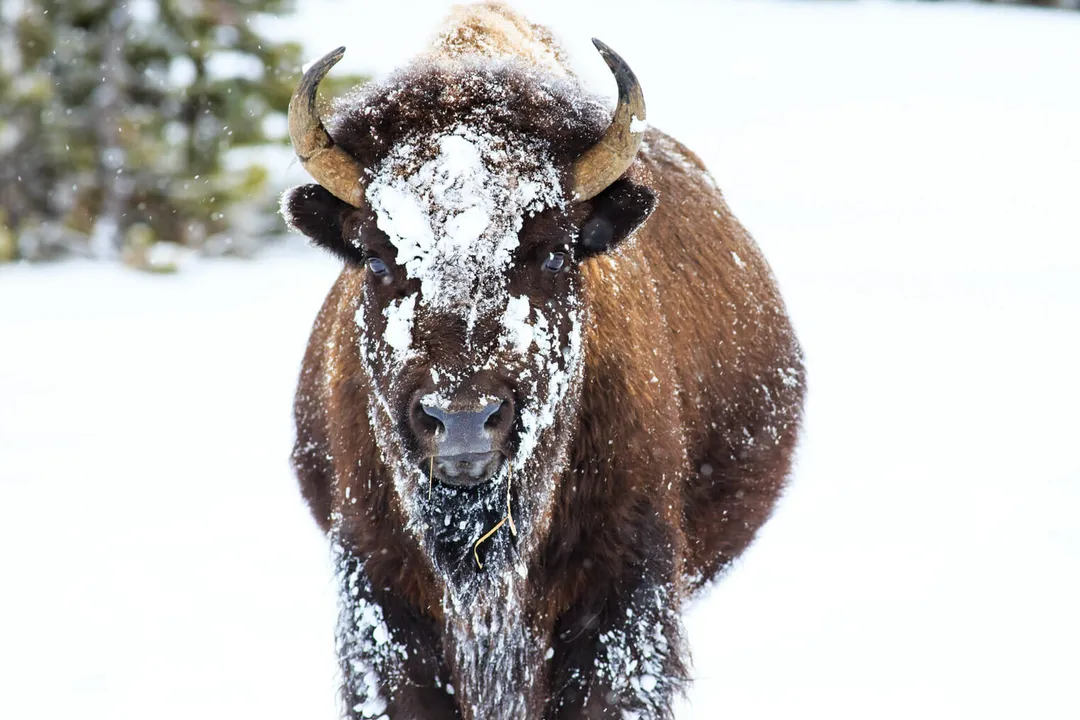
How does the bison's layered insulation help manage large temperature swings, such as from $-20^{ ext{F}}$ to $35^{ ext{F}}$?
The insulating physical covering acts as a buffer against rapid external changes without causing overheating
Bison often face not just sustained cold but dramatic, rapid fluctuations in ambient temperature, such as a shift from a sub-zero morning to a relatively warm afternoon warmed by intense sun exposure. The bison's layered coat is highly effective at managing this variability. Functioning like high-performance man-made insulation, it creates a stable thermal microclimate immediately adjacent to the animal's skin. When the external temperature rises significantly, this buffering capacity prevents rapid heat transfer inward, stopping the bison from overheating quickly. Conversely, during sudden dips, it prevents rapid heat loss. This physical barrier is crucial because, unlike some other ungulates, the bison does not possess extremely efficient internal thermoregulation for rapid adjustments, relying heavily on this physical covering to smooth out the severe environmental gradients encountered throughout a single day.