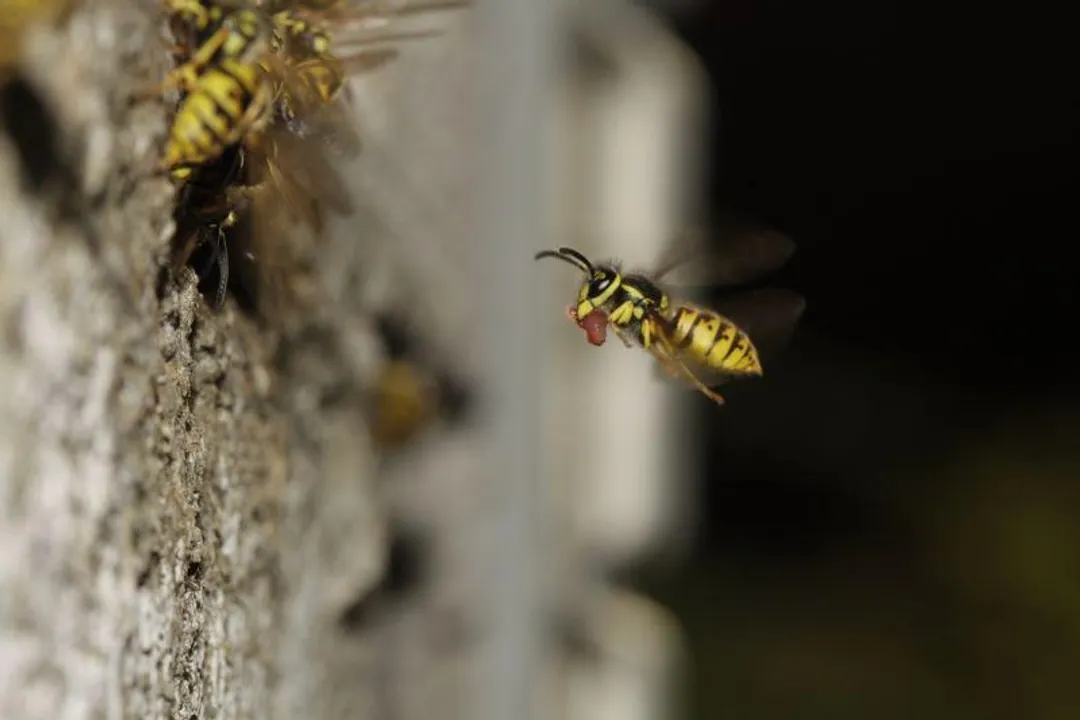
How do the hamuli facilitate efficient flight in Hymenoptera wings?
They interlock the forewing and hindwing into one aerodynamic surface.
Wasps, belonging to Hymenoptera, utilize an ingenious mechanism to maximize the efficiency of their two pairs of wings during powered flight. The hindwing is equipped along its leading edge with tiny hooks called hamuli. These hamuli physically engage with a corresponding ridge located on the trailing edge of the larger forewing. When coupled together by these hooks while the wasp is in motion, the two separate wings effectively function as a single, large, highly efficient aerodynamic surface. This coupling maximizes lift and control during sustained flight. Once the wasp lands, this mechanical interlocking disengages, allowing the wings to fold independently, which is often observable in resting individuals.