Compared to bees, what is characteristic of the wasp integument?
Answer
It tends to be much less hairy, appearing smoother or glossier.
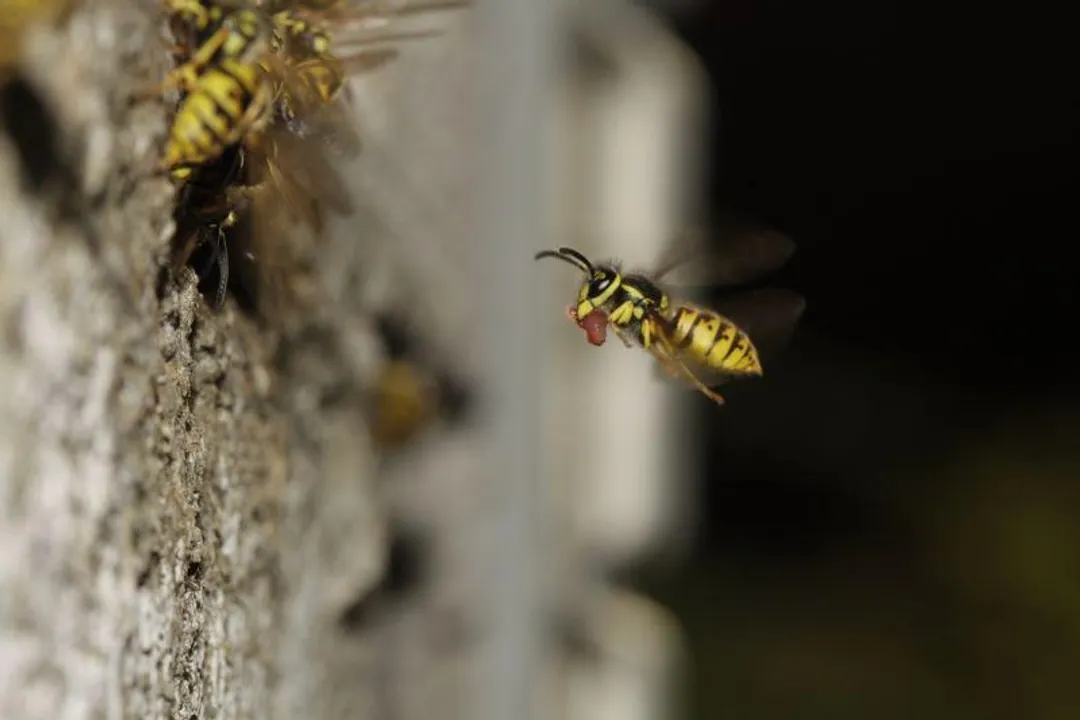
A key morphological distinction used to differentiate wasps from bees involves the body's outer covering, or integument. Bees have evolved to be covered with dense, often branched hairs which are functionally necessary for gathering and transporting pollen grains from flowers. In contrast, wasps generally lack this heavy hair covering; they appear much smoother, glossier, or more polished in texture. While some solitary wasp species may possess fine hairs, the prominent, fuzzy appearance typical of familiar bees like bumblebees is characteristically absent in the majority of common wasp species, reflecting their different primary ecological roles.
Related Questions
What anatomical feature marks the narrow constriction connecting the wasp's thorax and abdomen?What is the believed function of the typically three ocelli located on a wasp's head?How do the hamuli facilitate efficient flight in Hymenoptera wings?Compared to bees, what is characteristic of the wasp integument?Why does the smooth structure of the wasp stinger allow for repeated use?What evolutionary purpose does the stark black and yellow striping serve for many wasps?Morphologically, what structure is the wasp's stinger considered to be a modification of?What type of antennae structure is commonly observed in social wasps like yellowjackets and hornets?What specific morphological feature is noted in mud daubers related to subduing prey?According to typical size ranges, which social wasp is generally the largest encountered, sometimes exceeding an inch in length?Despite being configured for chewing, what capability do wasp mouthparts often retain for utilizing certain food sources?