Despite being configured for chewing, what capability do wasp mouthparts often retain for utilizing certain food sources?
Answer
Lapping up liquids like nectar or scavenged sweets
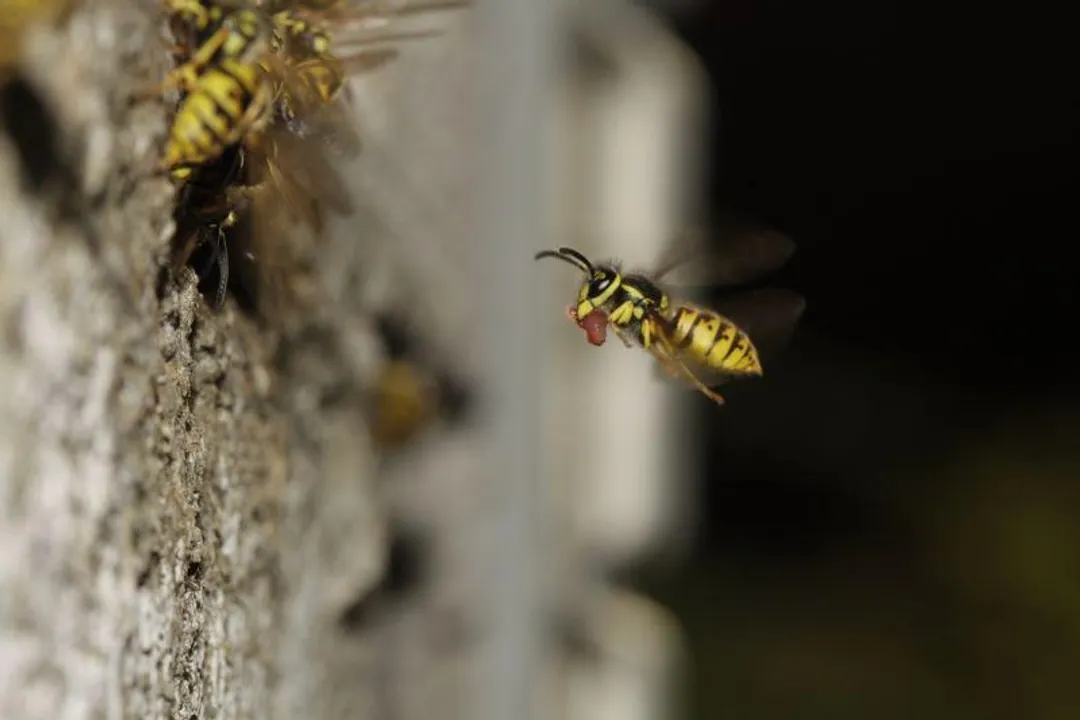
The mouthparts of most wasps are fundamentally structured for chewing, which is necessary for manipulating materials used in nest construction (like chewing wood fibers into pulp) or for tearing apart the exoskeletons of captured insect prey. However, this mechanical structure is not entirely rigid. Many wasp species retain a degree of flexibility in their feeding apparatus that allows them to transition to consuming liquid nutrition when available. This capability enables them to effectively lap up sugary liquids, such as flower nectar or scavenged sweets, fulfilling their energy requirements when solid prey items are not accessible or preferred.
Related Questions
What anatomical feature marks the narrow constriction connecting the wasp's thorax and abdomen?What is the believed function of the typically three ocelli located on a wasp's head?How do the hamuli facilitate efficient flight in Hymenoptera wings?Compared to bees, what is characteristic of the wasp integument?Why does the smooth structure of the wasp stinger allow for repeated use?What evolutionary purpose does the stark black and yellow striping serve for many wasps?Morphologically, what structure is the wasp's stinger considered to be a modification of?What type of antennae structure is commonly observed in social wasps like yellowjackets and hornets?What specific morphological feature is noted in mud daubers related to subduing prey?According to typical size ranges, which social wasp is generally the largest encountered, sometimes exceeding an inch in length?Despite being configured for chewing, what capability do wasp mouthparts often retain for utilizing certain food sources?