How did the dentition of *Homotherium* differ functionally from *Smilodon*'s dagger-like sabers?
Answer
*Homotherium* teeth were better suited for shearing muscle and connective tissue
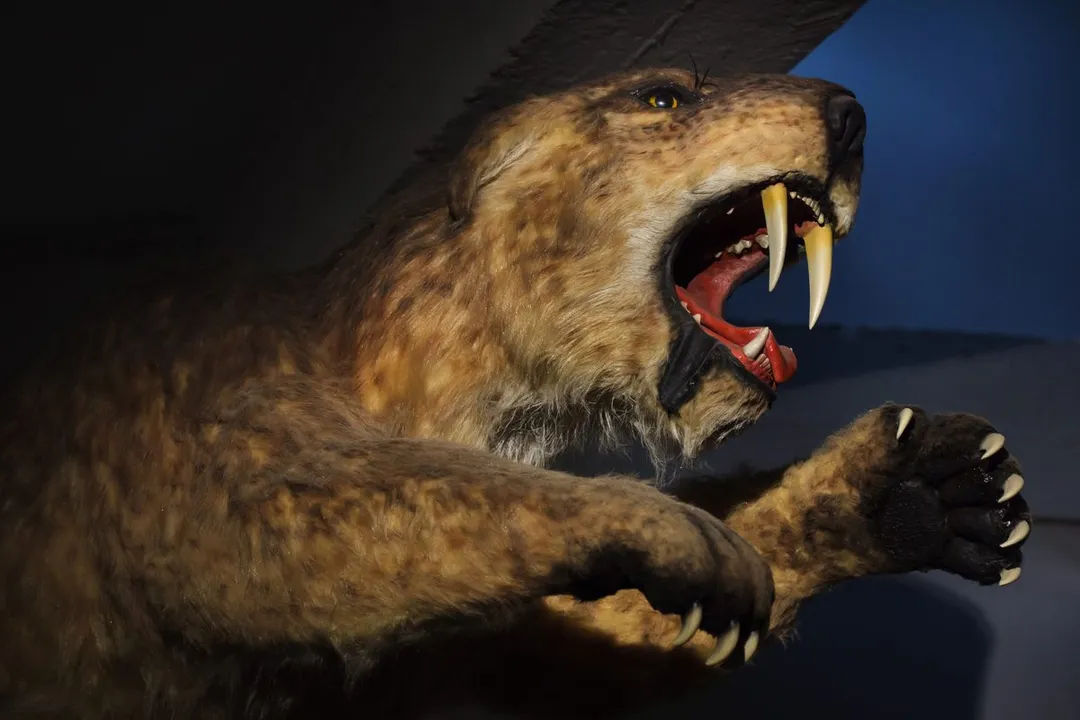
The canines of *Homotherium* were shorter and wider with heavy serrations, suggesting they were better suited for shearing through connective tissue and muscle rather than the deep stabbing employed by *Smilodon*.
Related Questions
How long could the upper canines of the largest *Smilodon fatalis* reach?What was the functional description of the saber-tooth's cutting edges?Compared to a modern lion's 65-degree limit, what was the approximate maximum gape of *Smilodon*?Why did the lower jaw (mandible) of *Smilodon* have a reduced chin or mental prominence?What was the primary role suggested by the powerful forelimbs and well-developed shoulder muscles of *Smilodon*?How did the overall body plan of *Smilodon* contrast with that of modern pursuit hunters like the cheetah?The physical adaptations of the saber-tooth appear linked to what type of ecosystem prey during the Pleistocene?How did the dentition of *Homotherium* differ functionally from *Smilodon*'s dagger-like sabers?What structural feature in the neck vertebrae supported the specialized hunting method of *Smilodon*?What aspect of the saber-tooth's evolution is cited as potentially contributing to its demise?