What physical qualities of the tiger have been mentioned?
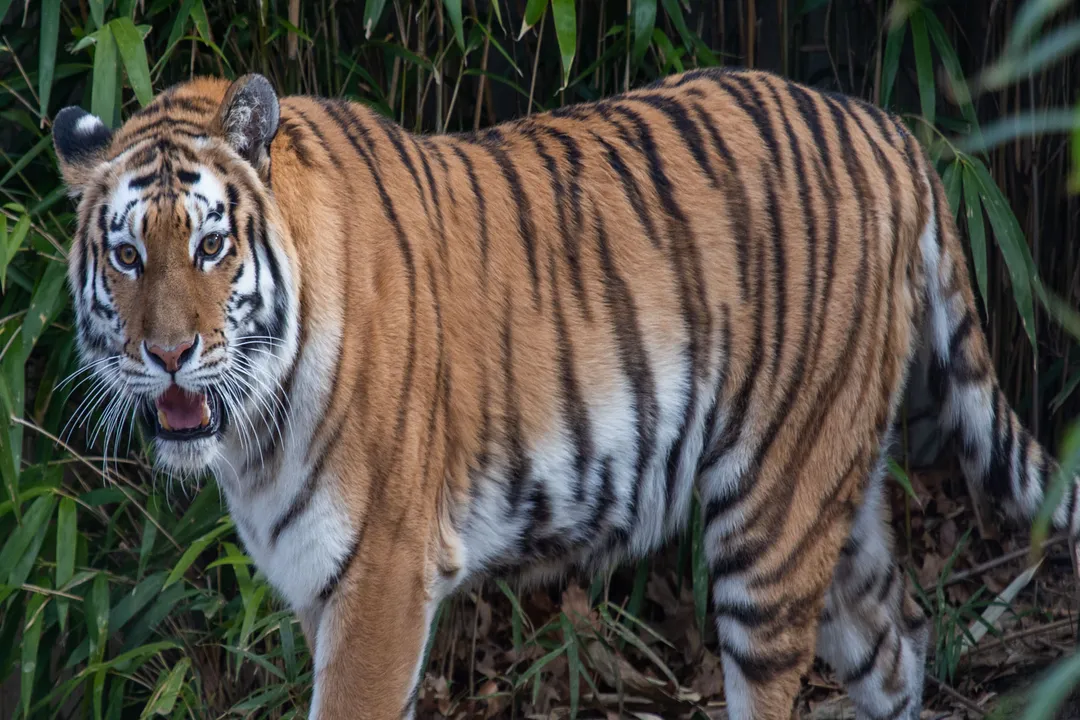
The most immediately recognizable feature of the tiger, Panthera tigris, is its breathtaking coat, a brilliant canvas of color punctuated by bold, dark markings. This striking appearance, featuring a reddish-orange base overlaid with prominent black stripes, serves a critical purpose: camouflage. [2] These patterns allow the tiger to vanish into the dappled light of their forest or grassland habitats, a necessary trait for an ambush predator. [2] The physical architecture of this great cat is a testament to its apex status, built for immense power and agility across diverse terrains. [2]
# Size and Scale
Tigers stand out among the world’s cats; they are, in fact, the largest species alive today. [2] The sheer size, however, is not uniform across the species, as subspecies have evolved distinct body masses reflecting their native environments. [2] The Amur tiger, also frequently called the Siberian tiger, holds the title of the largest subspecies. [1][2] In this group, adult males can attain weights approaching 660 pounds (or 300 kilograms) and measure up to 10 feet in length, [2] with some reported measurements reaching 12.14 feet in length (3.7 meters) and weighing over 423 kg.
In sharp contrast to this northern giant, the Sumatran tiger is the smallest of the remaining subspecies. [2] Males of this island-dwelling subspecies typically max out around 310 pounds (140.6 kilograms) and reach about 8 feet in length. [2] The general rule across all subspecies is that females are noticeably smaller than their male counterparts, exhibiting clear sexual dimorphism in size. [2] Bengal tigers, the most numerous subspecies, usually fall in the middle ground, with males weighing between 400 and 570 pounds (180 to 260 kg).
This extreme range in body mass, from the massive Amur to the relatively smaller Sumatran, illustrates how intensely localized environmental pressures shape physical characteristics over time. For instance, the need to survive brutal Russian winters favors the bulkier Amur tiger with its greater heat retention capacity, while the denser Sumatran forests may favor a slightly leaner build, though both must maintain the necessary musculature for taking down large prey.
# Coat Details
Beyond the general orange and black scheme, closer examination reveals fascinating details in the tiger’s pelage. [2] The signature stripes are perhaps the most scrutinized feature. It is a frequently noted fact that no two tigers share the exact same stripe pattern—they are as unique as human fingerprints. [1][2] Researchers in the field have long depended on these individual markings for non-invasive identification and population monitoring. [1][2]
While the stripes are universal, their appearance and the ground color of the coat differ significantly by region. Amur tigers, adapted to the snowy terrain of the Russian Far East, present a paler overall hue, often described as tannish-yellow or pale orange. [1][2] Their fur is noticeably thicker and longer than other tigers, supported by an insulating layer of fat beneath the skin to combat extreme cold. [1] Furthermore, they tend to have fewer and sometimes paler stripes, which may assist in blending into snow-covered landscapes. [1] In contrast, the Sumatran tiger exhibits a very orange coat with numerous dark stripes and relatively little white coloration on its throat and belly. [2]
The white patches are not limited to the underside. The belly, the insides of the limbs, and patches situated above the eyes and on the cheeks are typically creamy or white. [1] Interestingly, while the dark lines around the eyes are often symmetrical, the marks on either side of the face are frequently asymmetrical. The tail, too, follows the pattern, being reddish-orange and ringed with several dark bands. One unique physical marker noted in captive populations is an owl-shaped mark on a specific Sumatran tiger’s neck, illustrating the subtle, unique variations that can appear across individuals. [2] The complexity of this striping pattern, combined with its individual nature, suggests an evolved system that breaks up the animal’s outline not just against horizontal elements like tall grasses, but also against the vertical shadows and dappled sunlight of dense woodlands.
# Predatory Tools
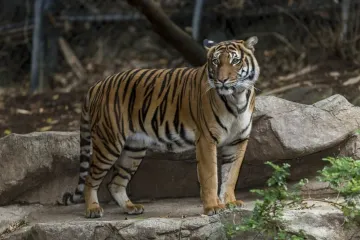
As an apex predator and a carnivore, the tiger is equipped with specialized physical apparatus for hunting and consuming its required meat diet. [2] Their offensive equipment centers on brute strength, sharp weaponry, and powerful biting mechanics. [2]
# Teeth and Jaws
Tigers possess strong jaws, essential for securing and dispatching prey. [2] Morphologically, their skull is described as robust, short, and broad. The Bengal tiger subspecies is noted for having the longest canines among all extant large cats, with these teeth measuring between 7.5 to 10 centimeters in length. These canines are designed to deliver a killing bite, often aimed at the neck or throat to crush the trachea or sever the spine. [2] For larger kills, a throat bite to cause suffocation is the preferred tactic, minimizing the risk of retaliation from the prey. Furthermore, their teeth are complemented by a tongue covered in hard papillae, which acts like a rasp, effectively scraping flesh directly off the bones of a carcass.
# Claws and Limbs
The limbs support this predatory style. Tigers feature massive forelimbs and broad forepaws, perfectly suited for grappling with prey during an ambush. They are armed with long, retractible claws that provide necessary grip during a take-down. These physical attributes facilitate a hunting strategy that relies on stealth followed by a powerful, short-range pounce, rather than a sustained chase. [2]
# Locomotion and Sensory Structures
The physical traits of the tiger also speak to its comfort in varied environments, extending beyond just terrestrial movement. Tigers are known to be excellent swimmers. [2] Water does not typically present a barrier to them, and they have been documented crossing rivers as wide as 5 miles (8 km). [2] This adaptability is crucial in habitats like the mangrove swamps where some Bengal tigers hunt.
While the primary sources focus heavily on coat and size, the fundamental structure of a tiger's head supports intense communication and sensory input. Tigers have a well-developed sagittal crest, which provides necessary muscle attachment points for their strong bite force. Their ability to produce a deep, far-reaching roar, a key signal of dominance, is attributed to a flexible hyoid apparatus and a vocal fold equipped with a thick fibro-elastic pad.
While sight and hearing are believed to be the primary senses used to locate prey, their physical design allows them to move with near silence when stalking, taking cautious steps low to the ground to avoid detection. The white spots on the back of the ears may also play a role in intraspecific communication, signaling to other tigers visually even when the rest of the body is obscured. The sheer power implied by the skeletal and muscular structure—capable of dragging prey weighing 700 kg—is the final expression of these physical qualities that define the tiger in its ecosystem.
Related Questions
#Citations
Tiger | Smithsonian's National Zoo and Conservation Biology Institute
Amur Tiger - San Francisco Zoo & Gardens
Tiger: A Lone Hunter and Apex Predator - Animals | HowStuffWorks
Panthera tigris (tiger) | INFORMATION - Animal Diversity Web