Besides continuous forest tracts, what modified environments can *D. viridis* populations persist in?
Answer
Suburbs, parklands, and towns
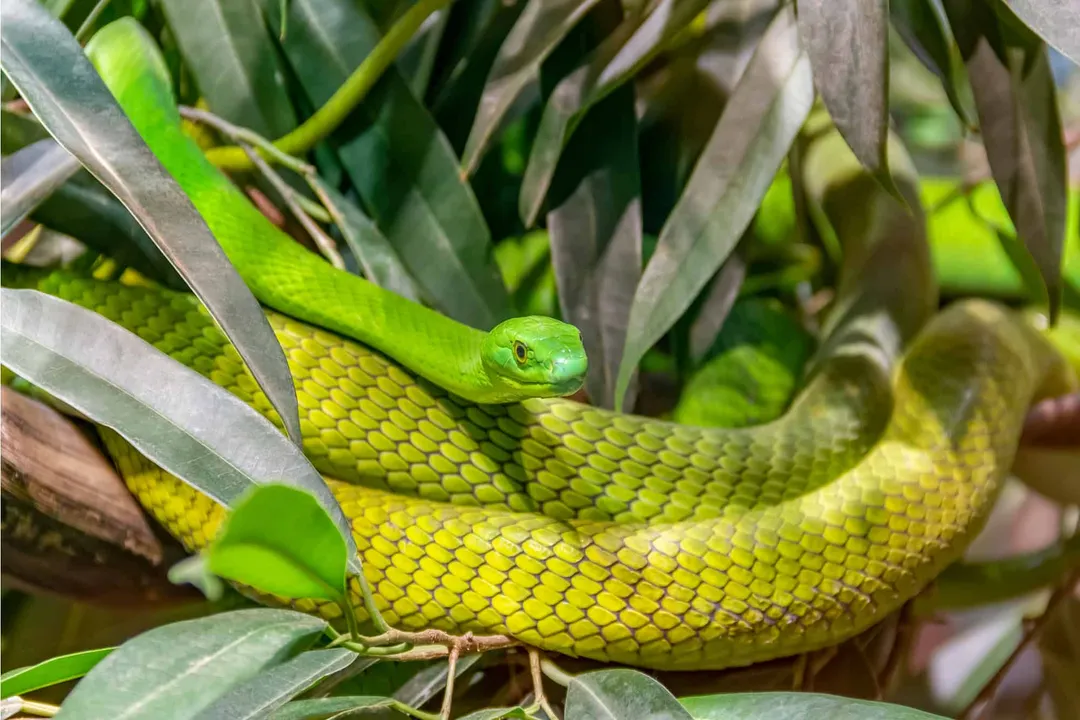
Although the majority of records stem from continuous forest tracts, the ecological tolerance of *D. viridis* is slightly broader than just pristine wilderness. Populations are capable of surviving even in areas where significant tree cover has been cleared, provided that essential habitat elements like adequate hedges and thicket remain intact. This adaptability allows them to successfully occupy modified human-influenced environments, including suitably vegetated suburbs, parklands, and towns within their native range, utilizing these transitional edge habitats for survival.
Related Questions
Which nation marks the eastern boundary of the core *Dendroaspis viridis* distribution?What minimum annual rainfall level generally confines the western green mamba distribution?What is the current IUCN population status assigned to the western green mamba?What specific habitat types are noted to host *D. viridis* in the northern parts of its range, such as in Togo?What is the rough English translation for the scientific name component *Dendroaspis*?Which North American zoo is listed as housing captive *Dendroaspis viridis* specimens for viewing and study?Besides continuous forest tracts, what modified environments can *D. viridis* populations persist in?What is the typical activity pattern described for wild western green mambas during daylight hours?Which nation's reports of *Dendroaspis viridis* presence are specifically flagged as dubious in mapping its true territory?What characteristic linkage dictates the location of the western green mamba's habitat structure?