Which sensory organs guide the Western Rat Snake toward hidden prey using chemical cues?
Answer
Tongue and Jacobson's organ
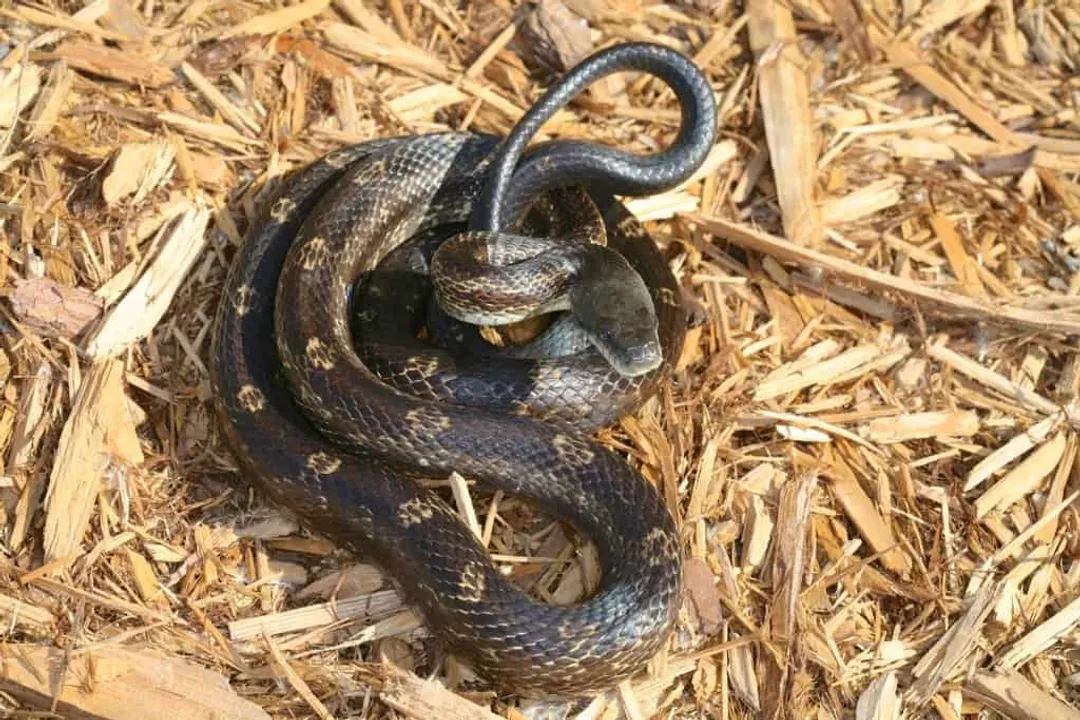
While Western Rat Snakes are active foragers, locating prey that may be hidden under debris, in burrows, or within dense vegetation relies heavily on chemical sensing rather than purely visual tracking. The snake utilizes its specialized anatomy to sample the environment chemically. It flicks its forked tongue out to collect airborne or substrate-borne chemical particles. These particles are then transferred to the Jacobson's organ, located in the roof of the mouth. This organ analyzes the collected molecules, allowing the snake to follow scent trails and pinpoint the exact location of hidden prey items effectively.
Related Questions
What primary food sources define the initial diet of newly emerged Western Rat Snakes?Why is the common name "rat snake" highly accurate for mature *Pantherophis obsoletus*?How do Western Rat Snakes subdue warm-blooded prey through constriction?How does the required feeding frequency differ between a juvenile and a large adult rat snake?What is the ecological result of the trophic separation between young and old *Pantherophis obsoletus*?Which sensory organs guide the Western Rat Snake toward hidden prey using chemical cues?What advantage does the semi-arboreal nature provide in securing meals for the Western Rat Snake?How is the feeding strategy of the Western Rat Snake best described?What observation might correlate a dip in Western Rat Snake size or number, indicating their role as a bio-indicator?Besides mice and rats, what larger mammals might occasionally be predated by a powerful adult Western Rat Snake?