What specialized tail fin structure did Xiphactinus possess, signaling high-speed swimming capability?
Answer
A lunate tail fin
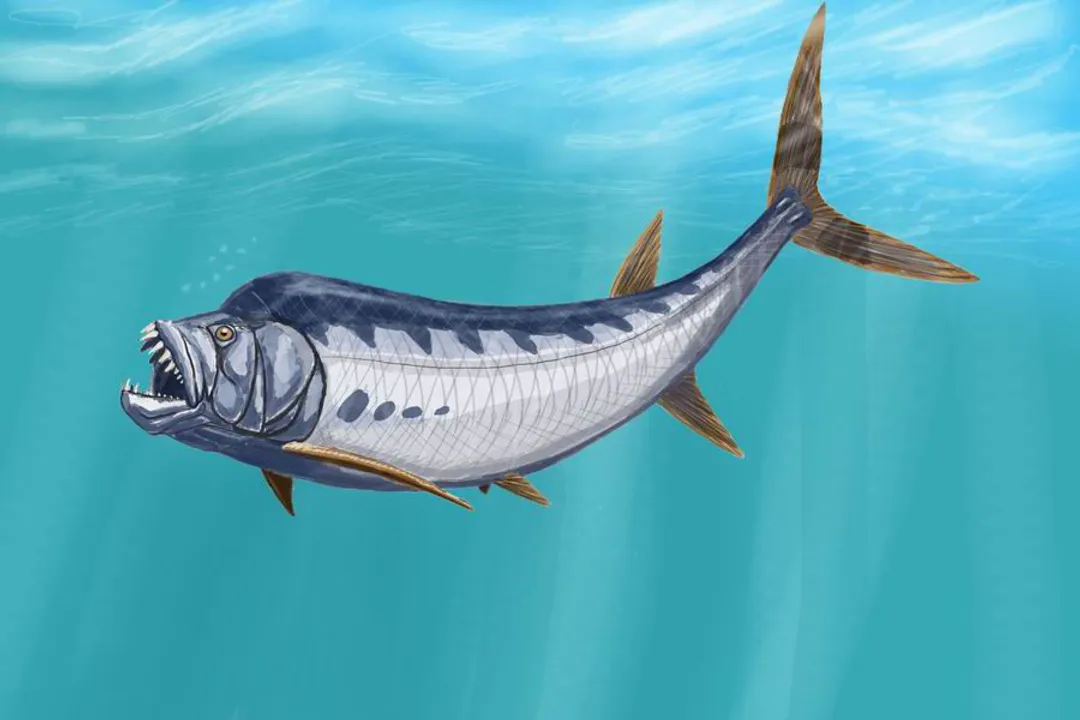
The fossil evidence strongly indicates that Xiphactinus utilized a lunate tail fin, which is crescent-shaped. This specific morphology is highly characteristic of modern, fast, sustained swimmers, such as tuna and mackerel, that rely on efficient propulsion for cruising or rapid acceleration over long distances. The lunate shape maximizes thrust efficiency while minimizing the drag created during the powerful upstroke and downstroke motions. The presence of this highly specialized caudal fin strongly corroborates the hypothesis that Xiphactinus was an active, oceanic hunter requiring bursts of speed to secure its substantial prey, rather than being a sluggish creature inhabiting the seafloor.
Related Questions
What was the estimated maximum length for the predatory bony fish Xiphactinus?What specialized tail fin structure did Xiphactinus possess, signaling high-speed swimming capability?What classification is given to the large, diamond-shaped, bony scales covering Xiphactinus?How are the large, prominent teeth found in the upper jaw of Xiphactinus described in relation to movement?Which physical characteristic of Xiphactinus demonstrates an adaptation for rapid, open-water pursuit?Which class of fishes, defined by its bony skeleton, did Xiphactinus belong to?Where did the gape of the Xiphactinus's enormous mouth extend relative to its eye socket?What weight estimation, in kilograms, is suggested for the massive Xiphactinus?In which ancient North American marine environment did Xiphactinus function as a dominant apex hunter?What evolutionary trade-off resulted from Xiphactinus possessing both heavy dermal armor and a lunate tail?