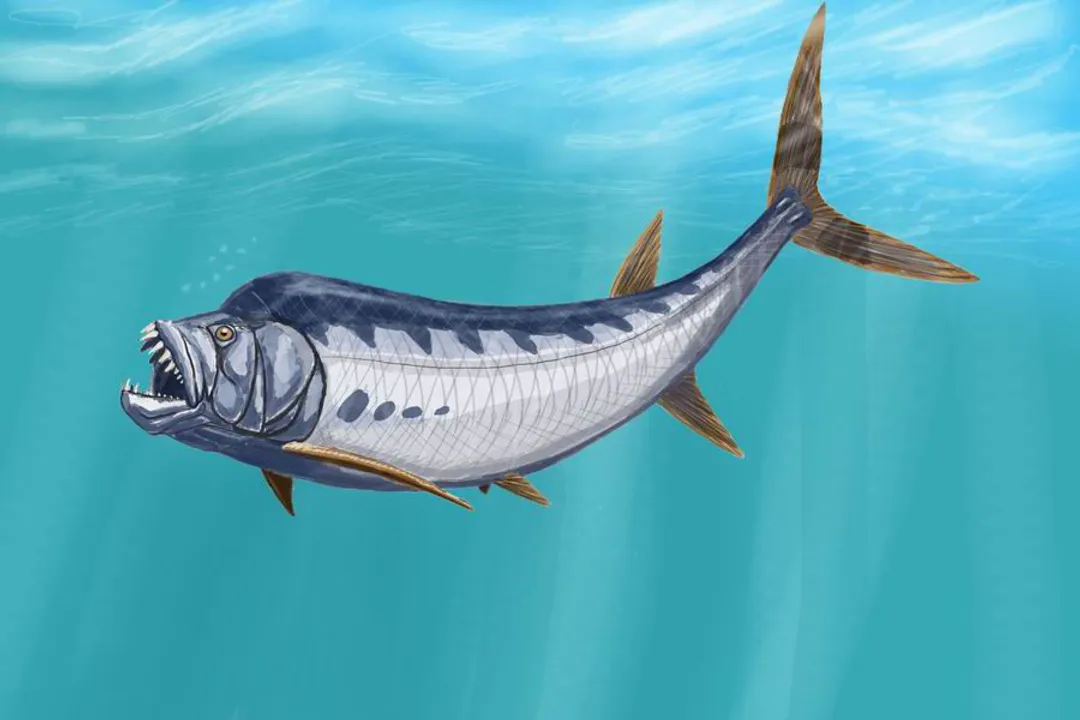
What evolutionary trade-off resulted from Xiphactinus possessing both heavy dermal armor and a lunate tail?
The safety provided by armor was prioritized over achieving absolute maximum hydrodynamic efficiency
The combination of highly advanced features—the lunate tail indicating high-speed capability, and the heavy, interlocking ganoid scales providing significant defense—highlights a crucial evolutionary trade-off. The dense dermal armor imposed a notable weight penalty, which inherently compromises the absolute theoretical maximum speed achievable compared to a fish lacking such covering. The fact that Xiphactinus retained this heavy armor suggests that the protection and structural rigidity afforded by the scales were deemed more critical for survival against predation or during intense feeding activities than achieving the pinnacle of pure hydrodynamic efficiency observed in modern, lightly scaled pelagic swimmers.