In which ancient North American marine environment did Xiphactinus function as a dominant apex hunter?
Answer
The Western Interior Seaway
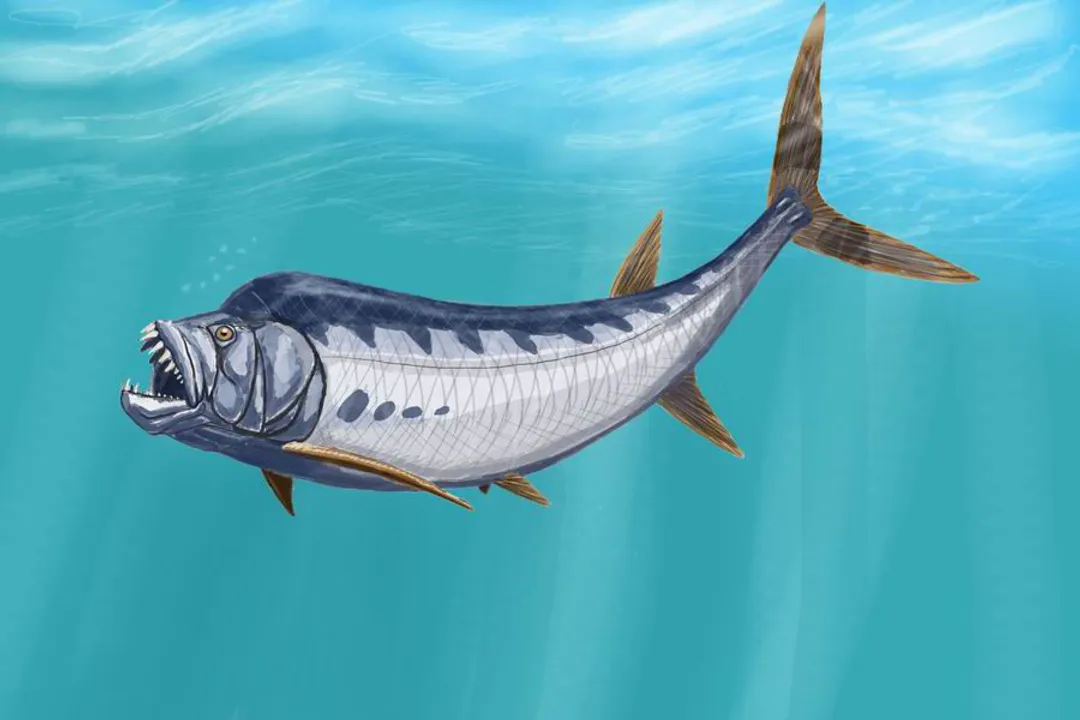
Xiphactinus was a defining predator within the Western Interior Seaway, a vast ancient body of water that once bisected North America during the Late Cretaceous period, approximately 85 million years ago. The abundance of its fossils across marine deposits in this region confirms its success and widespread dominance within that specific Cretaceous ecosystem. Its physical profile—combining speed adaptations with heavy armor—allowed it to effectively exploit the ecological niche of an apex marine hunter in these ancient waters.
Related Questions
What was the estimated maximum length for the predatory bony fish Xiphactinus?What specialized tail fin structure did Xiphactinus possess, signaling high-speed swimming capability?What classification is given to the large, diamond-shaped, bony scales covering Xiphactinus?How are the large, prominent teeth found in the upper jaw of Xiphactinus described in relation to movement?Which physical characteristic of Xiphactinus demonstrates an adaptation for rapid, open-water pursuit?Which class of fishes, defined by its bony skeleton, did Xiphactinus belong to?Where did the gape of the Xiphactinus's enormous mouth extend relative to its eye socket?What weight estimation, in kilograms, is suggested for the massive Xiphactinus?In which ancient North American marine environment did Xiphactinus function as a dominant apex hunter?What evolutionary trade-off resulted from Xiphactinus possessing both heavy dermal armor and a lunate tail?