Xiphactinus Physical Characteristics
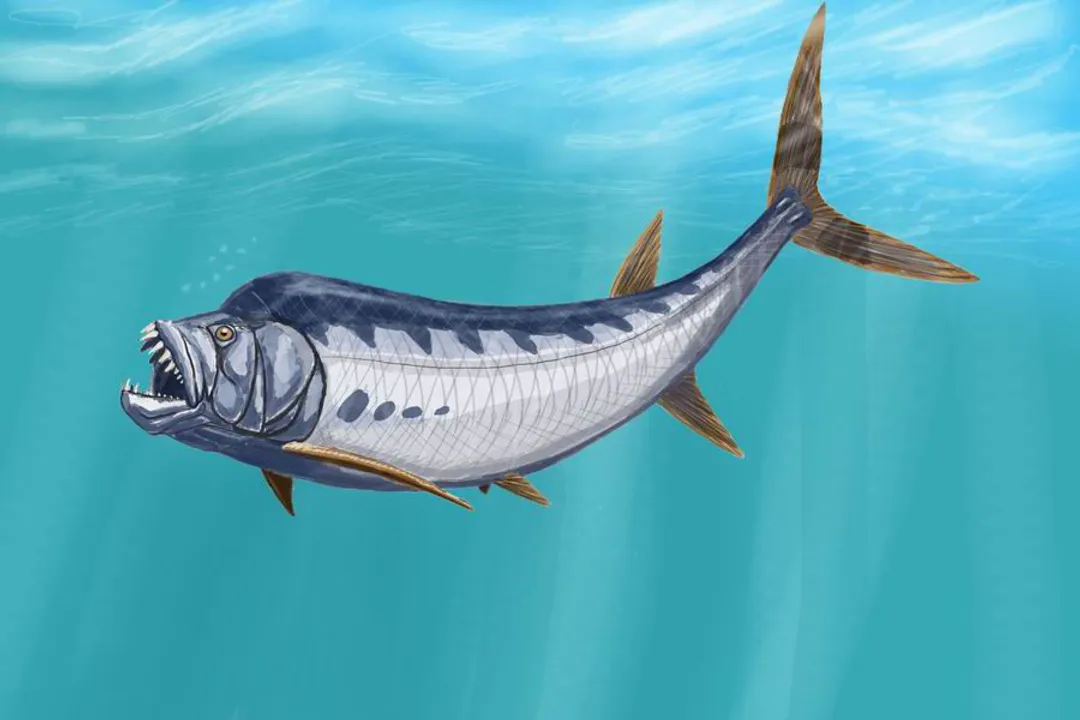
The Xiphactinus, often evoked as a true terror of the Late Cretaceous seas, presents a fascinating physical profile for an ancient bony fish. This creature was not merely large; it represented a highly evolved, fast-swimming predator whose anatomy speaks volumes about its role in the ancient Western Interior Seaway of North America. [1][3][5][7] Its physical characteristics, from its massive skull to its specialized tail, paint a picture of an apex marine hunter that dominated its ecosystem roughly 85 million years ago. [1][4][6]
# Immense Scale
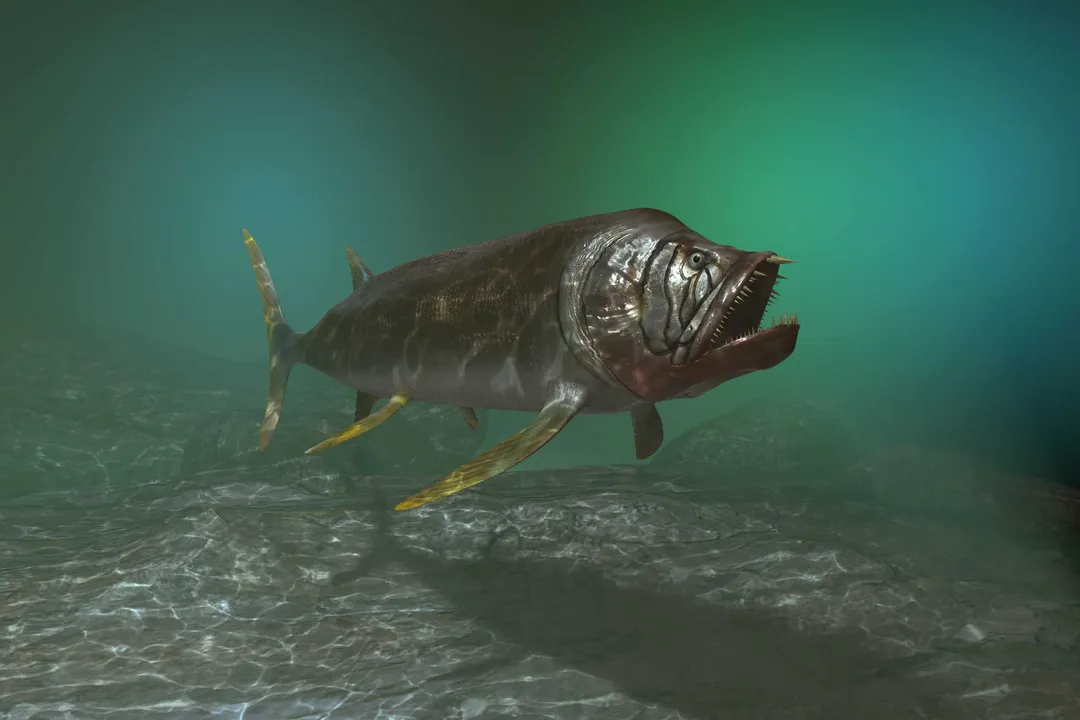
The sheer size of Xiphactinus sets it apart instantly from most modern fish. Estimates place its maximum length at around 15 feet (4.6 meters). [1][3][6] Some accounts push this figure slightly higher, suggesting lengths approaching 16 feet. [5] To visualize this, one must imagine a fish longer than many modern automobiles. While hard fossil data for weight is challenging to establish definitively, estimations suggest a mass hovering around 150 kilograms. [3] This places it among the largest known predatory bony fishes of its era. [3] Its status as an enormous predator in its time is undeniable, dwarfing most of the other fauna sharing its Cretaceous waters. [7] Comparing its size to modern marine life, while it shares a general evolutionary branch with modern teleosts, its dimensions far exceed those of contemporary large predators like the present-day tuna or even the large salmon species, placing it in a league of its own for a non-mammalian, non-cartilaginous fish of that specific ancient environment. [7]
# Streamlined Build
Physically, Xiphactinus exhibited a powerful and athletic build, necessary for an active hunter. [6] Its overall body shape was streamlined, [1][6] a classic indication of a creature adapted for rapid, open-water pursuit. This form minimizes drag, allowing for efficient movement through the water column, a trait shared by many successful pelagic predators across geological time. [3] While the general impression might be similar to a modern tarpon in terms of overall profile—a long, muscular body—the Xiphactinus took this predatory adaptation to an extreme level, especially when considering the density provided by its unique dermal armor. [7] The overall geometry suggests a creature that relied on bursts of speed and powerful thrusts to secure its substantial meals. [3]

# Cranial Features
The skull of Xiphactinus was remarkably massive relative to its body size, reflecting the power needed to subdue large prey. [1] One of its most defining features was its enormous mouth, the gape of which extended well past the eye socket. [1][3] This large opening allowed it to swallow sizeable victims whole or seize them with devastating force. [3]
The dentition reveals its role as a raptorial feeder. [3] The upper jaw possessed large, prominent teeth that were fixed in place—meaning they were not designed to be retracted or replaced as easily as some other ancient predators’ teeth. [1] These teeth could reach lengths of approximately two inches. [1] In contrast, the teeth in the lower jaw were slightly smaller in stature but still substantial. [1] This configuration—large, fixed teeth aimed at gripping and tearing rather than just shearing—suggests an adaptation for securing slippery or powerful prey in the open ocean. [1][3] It is interesting to note that while they possessed formidable dentition, the structure of the jaw likely dictated a feeding strategy focused on engulfing a large portion of the prey item at once, given the rigidity of the upper teeth compared to the more flexible arrangements seen in some contemporary sharks. [1]
# Defensive Covering
Unlike the smooth, modern scales often associated with fast fish, Xiphactinus was encased in a system of tough, bony plates. [1][3][5][7] These were large, diamond-shaped, bony scales that interlocked tightly to form a defensive coat of armor across the body. [1][3][5] These are classified as ganoid scales. [5]
This combination of immense size and heavy dermal armor presents an interesting biophysical consideration. While the scales provided crucial protection against other large predators—perhaps even intraspecific combat—they represent a significant weight penalty compared to a lightly scaled, purely pelagic fish today. [3] For a fish advertised as a speedy pursuit predator, this heavy covering suggests an evolutionary trade-off: the safety and structural rigidity provided by the armor were deemed more critical to survival than achieving the absolute maximum speed possible without it. In essence, the Xiphactinus likely compensated for the added mass by developing exceptionally powerful musculature, evidenced by the sheer force required to propel a 150-kilogram, armored body through water. [3] This trade-off between protection and pure hydrodynamic efficiency offers insight into the competitive pressures of the Cretaceous oceans. [7]

# Tail and Thrust
The engine of this large predator was its tail fin. The fossil record indicates that Xiphactinus possessed a lunate tail fin. [1][3] A lunate (crescent-shaped) tail is the hallmark of fast, sustained swimmers in the modern ocean, such as tuna and mackerel. [3] This fin structure maximizes thrust efficiency by minimizing drag during the powerful downstroke and upstroke motions required for long-distance cruising or rapid acceleration. [3] The presence of such a specialized caudal fin strongly corroborates the hypothesis that this was an active, oceanic hunter rather than a sluggish bottom-dweller. [1][7]
In addition to the tail, the other fins contributed to stability and maneuvering. The dorsal fin was notably large. [1] While the pectoral and pelvic fins would have been important for steering and braking, the sheer size of the crescent tail suggests that the majority of its motive power came from powerful side-to-side flexing of the posterior body and fin. [3]
# Skeletal Framework
As a member of the class Actinopterygii (ray-finned fishes), Xiphactinus possessed a bony skeleton, distinguishing it from contemporary marine reptiles or sharks. [3] The fossil record for Xiphactinus is quite good, providing relatively complete skeletons that allow paleontologists to reconstruct its overall posture and proportions accurately. [4][5] The preservation, particularly in areas like Kansas, has yielded remarkable specimens demonstrating the connection points for its massive musculature and the relative positioning of its heavy scales. [5][8] Understanding the robustness of its vertebral column is key to appreciating how it could support such a large frame while engaging in aggressive feeding behaviors, such as swallowing a victim the size of a smaller fish whole, as evidenced by fossil finds. [1][6]
For a general comparison of features, one can observe the distinctions between this ancient bony fish and other large Cretaceous predators:
| Characteristic | Xiphactinus | Modern Apex Predator (e.g., Shark/Tuna Analogue) | Implication |
|---|---|---|---|
| Body Covering | Large, interlocking ganoid scales [5] | Smooth, placoid scales (sharks) or thinner scales (tuna) | Increased weight, significant armor protection [3] |
| Jaw Teeth | Large, prominent, fixed [1] | Often replaceable/re-curved (sharks) or smaller/denser (tuna) | Strategy focused on immediate, strong grip [1] |
| Tail Shape | Lunate (Crescent) [1] | Lunate | Indicates high-speed swimming capability [3] |
This table highlights the mixture of traits: modern speed mechanics (lunate tail) combined with older, heavier defenses (ganoid scales), suggesting a successful evolutionary path unique to its time and niche within the ancient seaway. [7] The abundance of its fossils in marine deposits across the region confirms its success as a widespread and dominant inhabitant of that ancient water body. [5][7]
Related Questions
#Citations
Xiphactinus - Prehistoric Life Wiki - Fandom
Xiphactinus audax - A-Z Animals
Xiphactinus - Wikipedia
Xiphactinus - Facts and Figures - ThoughtCo
Xiphactinus audax Leidy - Oceans of Kansas Paleontology
Xiphactinus: The Beautiful Bull of the Sea - Prehistoric Otter
Xiphactinus Audax Pictures, Facts, Desktop Wallpaper, Animals ...
Xiphactinus, Terror Of The Inland Seaway - FossilEra.com
Figure 6. Xiphactinus Fossil - Encyclopedia of Alabama