What key ecological distinction separates the arboreal niche of D. viridis from the niche of D. polylepis?
Answer
D. viridis favors moisture-rich forests, while D. polylepis adapted to drier, more open woodlands
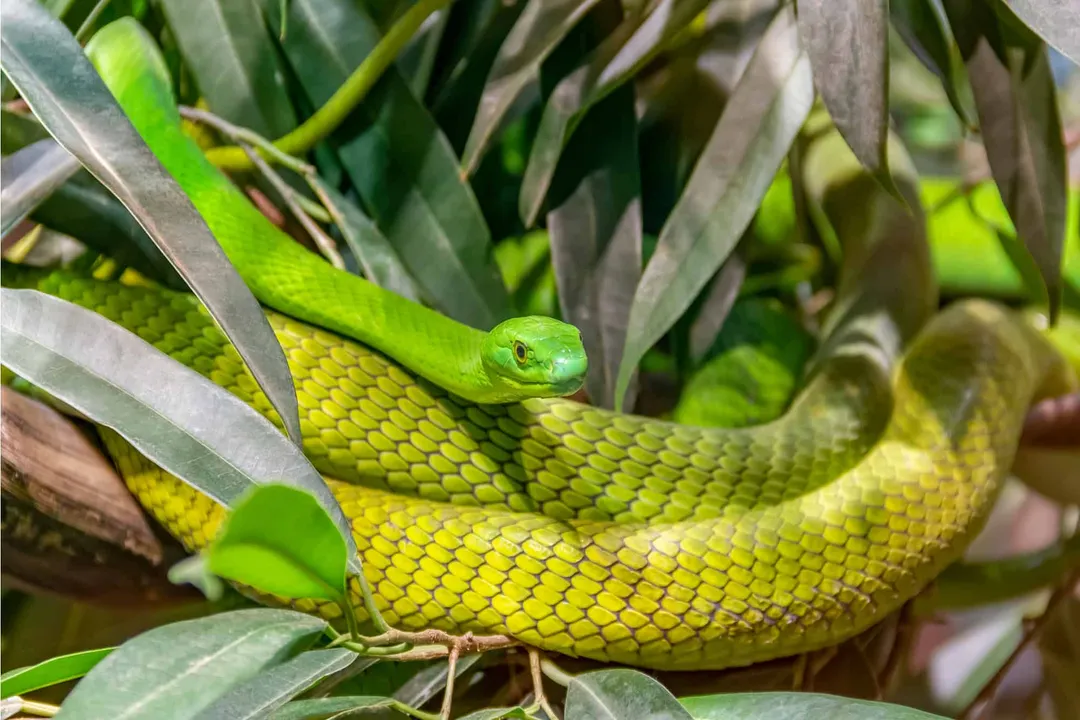
Although both species belong to the *Dendroaspis* genus and share arboreal ancestry, their specific ecological adaptations have driven them into distinct habitats. *Dendroaspis viridis* is highly adapted to a specific, moisture-rich West African forest environment. In contrast, the Black Mamba, *Dendroaspis polylepis*, adapted to drier, more open savannas and woodlands in sub-Saharan regions. This environmental divergence shaped their morphology, behavior, and the specific composition of their venoms, illustrating evolutionary pressures even among close relatives within the same genus.
Related Questions
What structural feature distinguishes Family Elapidae, which includes Dendroaspis viridis, from vipers?What lifestyle is described by the Greek derivation of the Genus name Dendroaspis?What specific Latin meaning is assigned to the specific epithet viridis for Dendroaspis viridis?What embryonic structure confirms the placement of the Western Green Mamba within Phylum Chordata?What primary effect does the neurotoxic venom of Dendroaspis viridis have on the body?According to the text, which West African nation is explicitly part of the geographical range of D. viridis?What is the basis for the name of Order Squamata, which includes all lizards and snakes?How does the conservation classification of Dendroaspis viridis generally compare to the Black Mamba (D. polylepis)?What defining feature must reptiles in Class Reptilia exhibit, which includes the Western Green Mamba?What key ecological distinction separates the arboreal niche of D. viridis from the niche of D. polylepis?