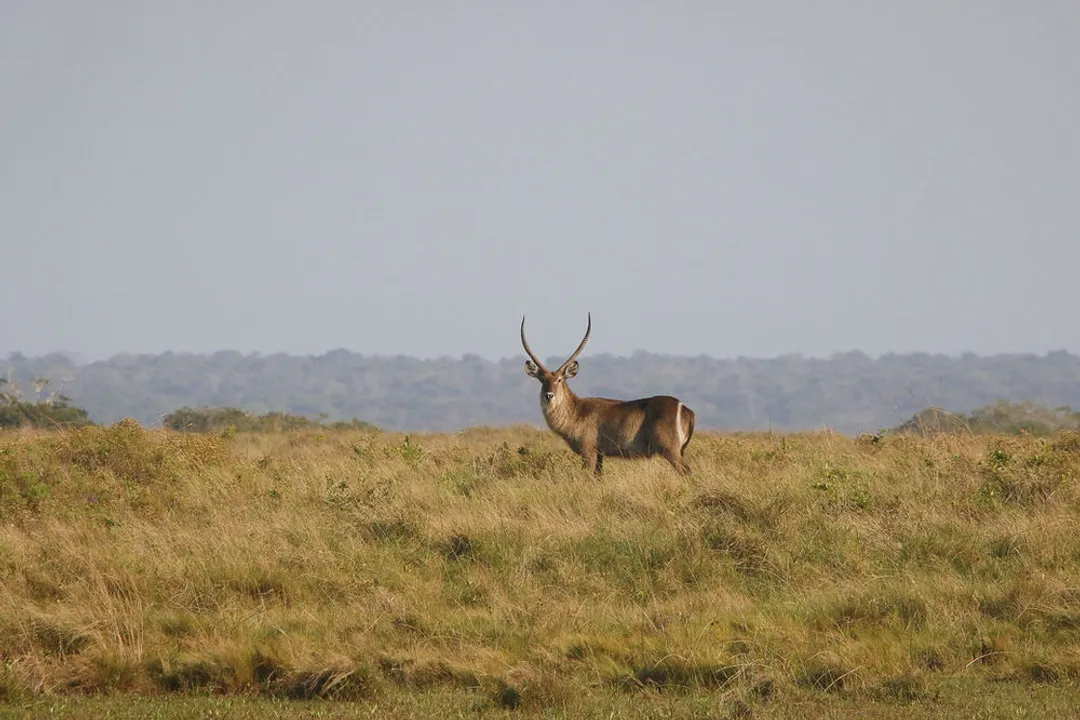
What ecological pressure dictates the waterbuck's relatively slow growth and reproductive cycle compared to smaller antelopes?
Survival depending more on adult longevity and consistent access to high-quality forage.
The waterbuck's life history strategy, characterized by giving birth to only a single calf after a gestation of approximately 8 to 9 months, aligns with the pattern seen in many larger ungulates. This conservative reproductive output is linked to their specific niche strategy. Their success is less dependent on rapid population growth to replace heavy losses (as seen in species relying on sheer numbers) and more reliant on consistent survival into adulthood. Since their survival hinges on maintaining access to high-quality grasses adjacent to perennial water, adult longevity and maintaining access to reliable, nutrient-dense forage become the most critical factors, making a slow, steady rate of replacement more evolutionarily sensible than high-risk, high-volume breeding.