What anatomical feature causes the eyes of the Western Blind Snake to be largely non-visible externally?
Answer
They are covered by overlying scales
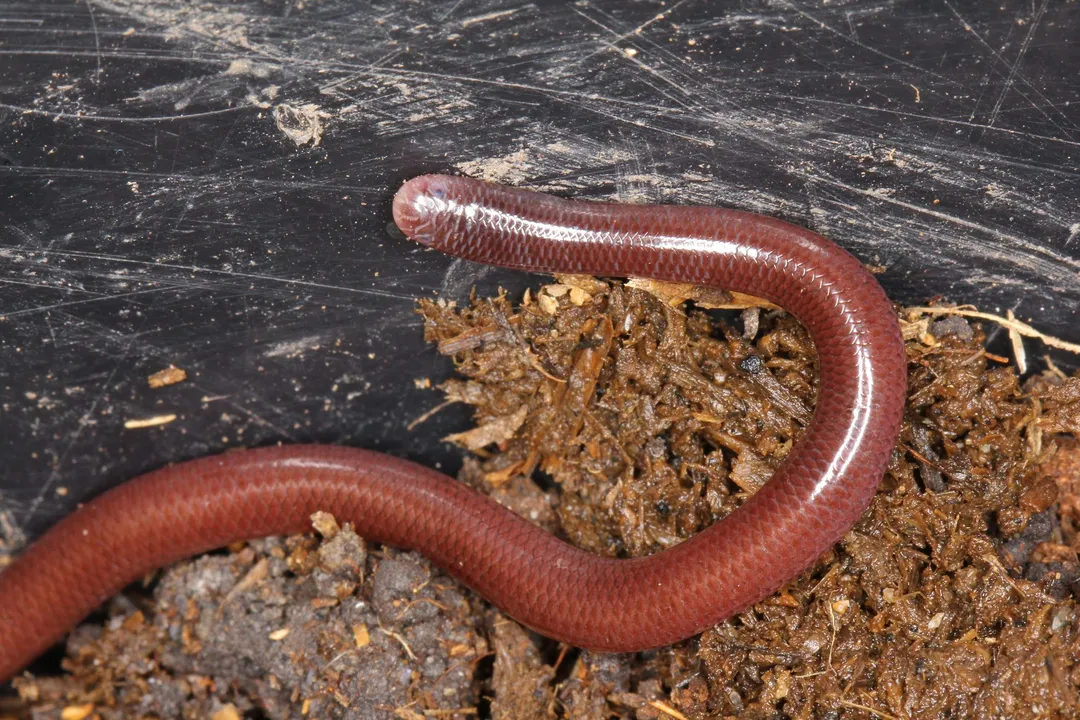
The eyes of the Western Blind Snake are highly reduced, classified as vestigial, which is consistent with an animal living primarily underground where sight is of little utility. These small eyes do not protrude or present as distinct external organs. Instead, they are completely obscured by the scales that lie over the skin. If a specimen is inspected closely, one might detect a faint, dark spot situated underneath the scale covering the eye location. This adaptation confirms the snake's deep fossorial specialization.
Related Questions
What common objects compare to the diameter of the slender Western Blind Snake?What texture characterizes the scales of *Rena humilis* that aids its subterranean movement?What specific marking is found at the very terminus of the blunt tail of *Rena humilis*?What anatomical feature causes the eyes of the Western Blind Snake to be largely non-visible externally?What common food sources are reflected by the small mouth structure of *Rena humilis*?What coloration feature often distinguishes the belly region of *Rena humilis* from its dorsal side?Which feature distinguishes *Rena humilis* from many pit vipers regarding head shape?What is the generally reported maximum length for adult Western Blind Snakes?How do the scales of *Rena humilis* compare to True Blind Snakes (Typhlopidae) regarding pattern uniformity?What characteristic of the *Rena humilis* head contributes to its rudimentary profile?