How do the scales of *Rena humilis* compare to True Blind Snakes (Typhlopidae) regarding pattern uniformity?
Answer
Threadsnakes have slightly larger scales on the top than on the bottom
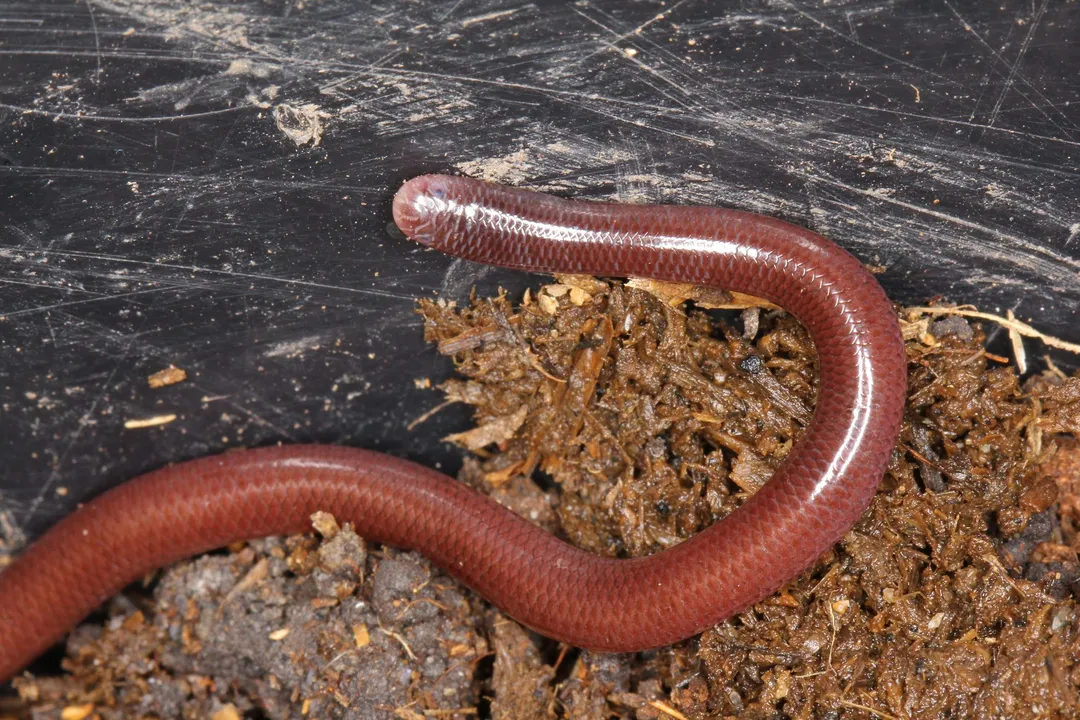
When compared to close relatives like the True Blind Snakes (Typhlopidae), *Rena humilis* (a threadsnake) exhibits subtle differences in scale arrangement despite sharing a generally smooth, glossy appearance. True Blind Snakes are typically noted for having scales arranged in a more uniform pattern across the entire body circumference. In contrast, *Rena humilis* exhibits a slight difference in size, possessing scales on its dorsal (top) surface that are somewhat larger than the scales found on its ventral (bottom) surface.
Related Questions
What common objects compare to the diameter of the slender Western Blind Snake?What texture characterizes the scales of *Rena humilis* that aids its subterranean movement?What specific marking is found at the very terminus of the blunt tail of *Rena humilis*?What anatomical feature causes the eyes of the Western Blind Snake to be largely non-visible externally?What common food sources are reflected by the small mouth structure of *Rena humilis*?What coloration feature often distinguishes the belly region of *Rena humilis* from its dorsal side?Which feature distinguishes *Rena humilis* from many pit vipers regarding head shape?What is the generally reported maximum length for adult Western Blind Snakes?How do the scales of *Rena humilis* compare to True Blind Snakes (Typhlopidae) regarding pattern uniformity?What characteristic of the *Rena humilis* head contributes to its rudimentary profile?