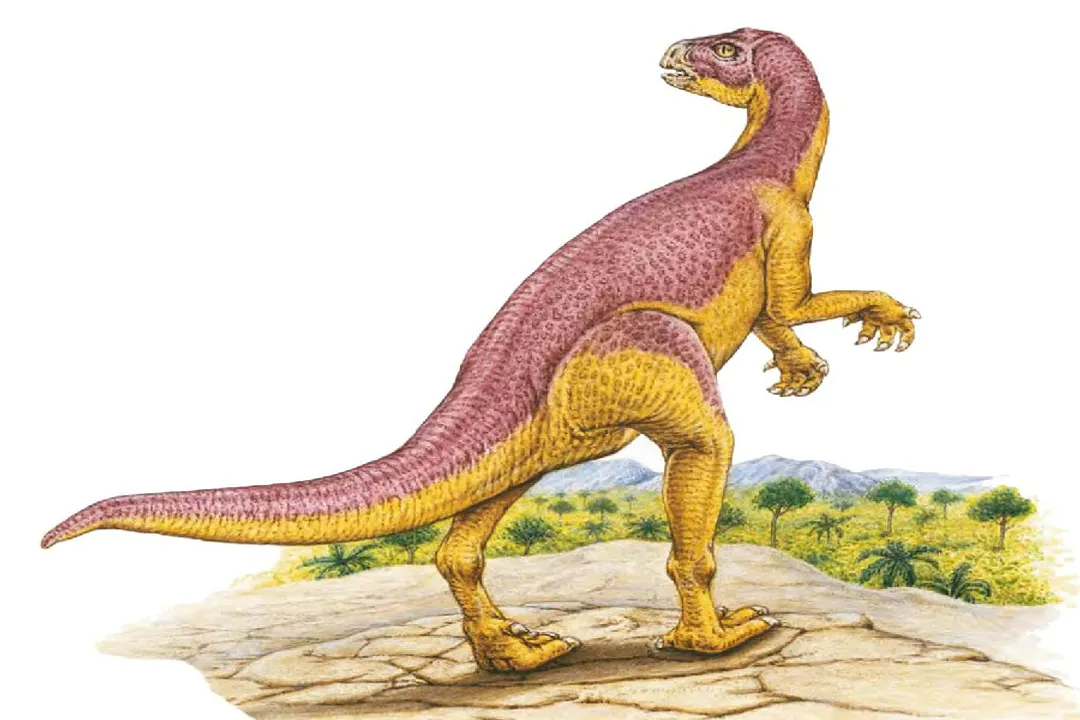
How many distinct toes terminated the hind feet of the bipedal Xiaosaurus?
Answer
Four toes
The skeletal structure of *Xiaosaurus* shows a specialized limb arrangement reflecting its bipedal locomotion. The powerful hindlimbs, which were adapted for support and running, ended in feet that uniquely possessed four distinct toes. This contrasts sharply with its forelimbs (arms), which, although small and comparatively useless for locomotion, possessed five distinct fingers. This difference in digit count between the manus (forelimb) and pes (hindfoot) is an important anatomical detail derived from the fossil evidence, particularly the material from the holotype specimen.
Related Questions
What is the primary translation of Xiaosaurus, derived from the Chinese word xiao?During which geological epoch did Xiaosaurus roam the Earth, spanning roughly 170.3 to 163.5 million years ago?How many distinct toes terminated the hind feet of the bipedal Xiaosaurus?What term, meaning 'doubtful name,' was applied to Xiaosaurus due to insufficient diagnostic material?What was the measured length of the femur, or thigh bone, of a Xiaosaurus hindlimb?What primary dietary classification defines Xiaosaurus, necessitating adaptations like a beaked mouth for cropping vegetation?What specific autapomorphy, a unique derived trait, was identified to provisionally validate the Xiaosaurus genus?In which specific geological layers within the Sichuan Basin were the fossils of Xiaosaurus found?Which two paleontologists formally assigned the moniker Xiaosaurus dashanpensis in 1983?Despite being bipedal with small forelimbs, how many distinct fingers did the front limbs of Xiaosaurus possess?