How does the waxy secretion affect common contact insecticides applied to woolly aphid colonies?
Answer
Common contact insecticides struggle to reach the insect's body surface effectively.
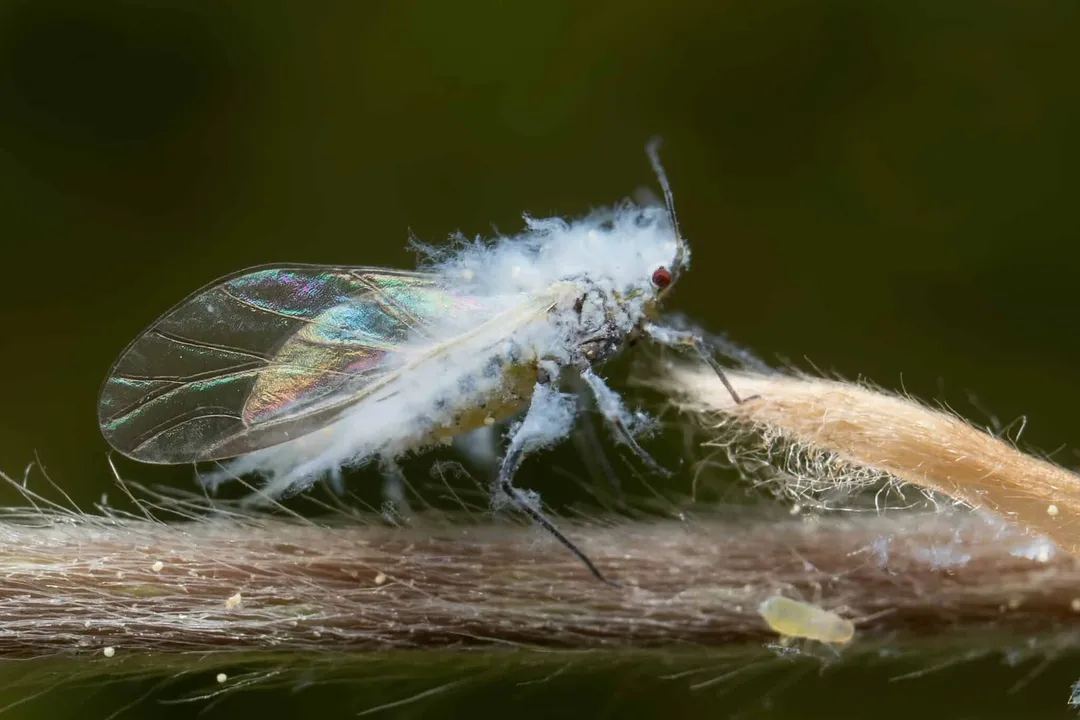
The dense, waxy secretion produced by the woolly aphid serves as a built-in shield specifically designed for defense. When chemical treatments, particularly common contact insecticides, are applied, this external layer physically obstructs the substance from making direct contact with the aphid's actual body surface. This difficulty in penetration renders many standard chemical control measures less effective against the colony because the primary target remains insulated and protected by the voluminous, fluffy coating, making eradication a more complex task requiring specialized methods or higher concentrations to penetrate the barrier.
Related Questions
What subfamily do woolly aphids belong to, defined by their external wax layer?How does the waxy secretion affect common contact insecticides applied to woolly aphid colonies?What is the range of the actual body coloration of an individual woolly aphid beneath its covering?What metric measurement corresponds to the typical adult woolly aphid length of 1/16 of an inch?How does the texture of woolly aphid wax generally differ from the coating of mealybugs?What visual paradox exists regarding the woolly aphid's waxy defense mechanism?Where do woolly aphid colonies characteristically cluster on affected host plants?How do nymphs within the mass compare visually to adults concerning their external covering?What material constitutes the distinctive, cotton-like fluff that gives the woolly aphid its common name?What anatomical features of the woolly aphid are noted to be relatively long compared to some other aphid species?