How did the premaxilla structure in *Coelodonta antiquitatis* differ from its modern relatives, and what linked this difference?
Answer
It was proportionally smaller, linked to its cropping grazing diet.
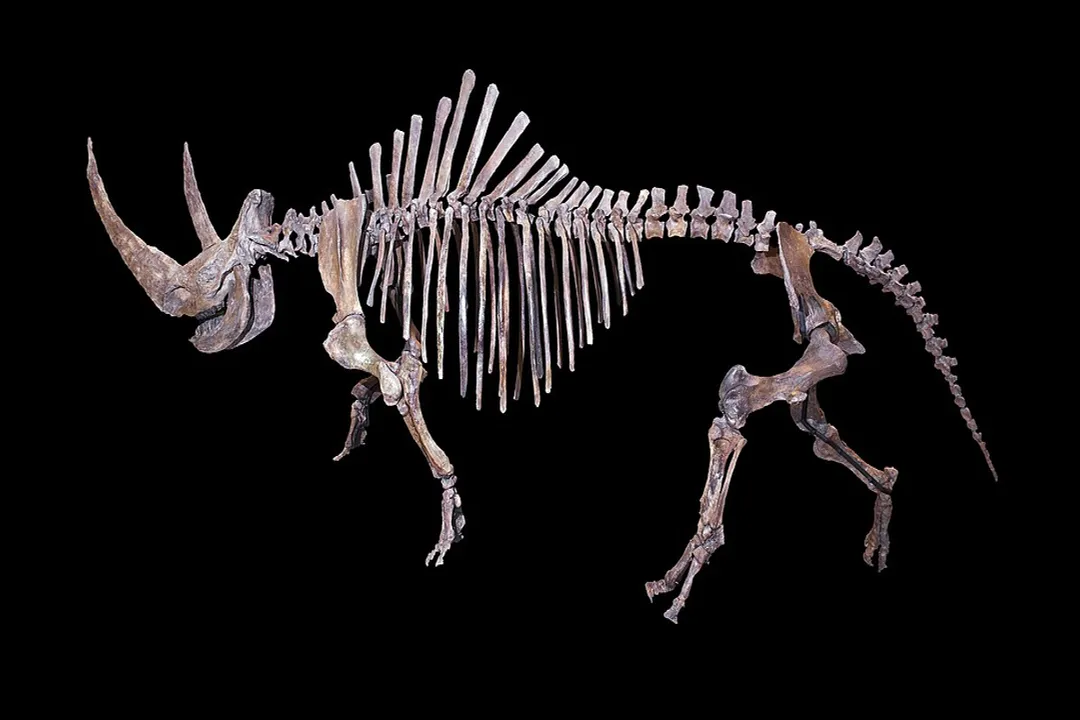
A significant anatomical divergence from modern rhinos involved the premaxilla, the bone structure comprising the front of the upper jaw. In the Woolly Rhino, this structure was proportionally smaller than in its modern cousins. This reduction is directly linked to its feeding ecology; browsers need elongated muzzles and protruding lips to grasp twigs and leaves, whereas grazers, like the Woolly Rhino and the modern White Rhino, possess shorter muzzles that terminate in a broader, flatter surface perfectly adapted for cropping grasses very close to the ground.
#Videos
The MANY Interpretations of the Woolly Rhino! (Coelodonta)
Related Questions
What specific function is hypothesized for the flattened front edge of the *Coelodonta antiquitatis* frontal horn?What dietary classification defines the Woolly Rhinoceros, *Coelodonta antiquitatis*?How did the insulating strategy of the Woolly Rhino compare to that of the Woolly Mammoth regarding fat layers?How did the overall bulk of the Woolly Rhino compare to the modern White Rhinoceros?What structural characteristic of the Woolly Rhino's legs aided navigation on uneven or slippery terrain?What shape characterized the molar crowns of the Woolly Rhinoceros, indicative of its abrasive diet?How did the premaxilla structure in *Coelodonta antiquitatis* differ from its modern relatives, and what linked this difference?What two distinct components made up the thick exterior layer providing insulation for the Woolly Rhino?How did the shape of the Woolly Rhino's primary frontal horn contrast functionally with those of many modern species?What was the estimated average weight range for an adult male Woolly Rhinoceros?