How did the brow horns of Xenoceratops compare functionally and morphologically to its nasal horn?
Answer
Brow horns were either small or entirely absent while the nasal horn was large and robust.
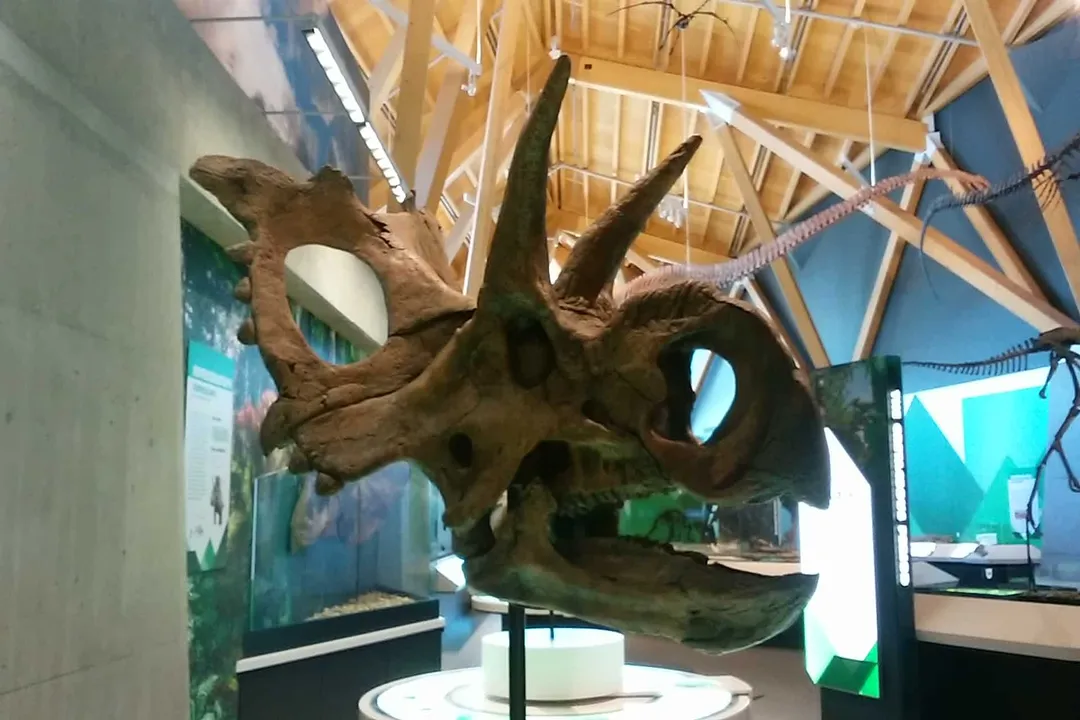
In Xenoceratops, there is a distinct emphasis on the nasal structure. The text indicates that the nasal horn was large and robust, suggesting it was a primary feature of its display apparatus. Conversely, the brow horns, which are characteristic features in later forms like Triceratops, were either significantly reduced in size or completely absent in Xenoceratops. This configuration supports the idea that the reduction or modification of brow horns in favor of a stronger nasal display was an early branching evolutionary pattern established within the Centrosaurinae subfamily.
#Videos
History and Biology of Xenoceratops! Dino Times - YouTube
Related Questions
Approximately how old is the oldest definitive ceratopsid, Xenoceratops, discovered in North America?What specific subfamily within Ceratopsidae does phylogenetic analysis firmly place Xenoceratops within?What descriptive meaning is conveyed by the name Xenoceratops regarding its facial structure?What unique structural characteristic is noted on the rear margin of the Xenoceratops frill?How did the brow horns of Xenoceratops compare functionally and morphologically to its nasal horn?In which geological formation and stage is Xenoceratops firmly placed, establishing its age?What does the derived morphology of Xenoceratops suggest about the evolutionary pace of Centrosaurines?What unusual feature concerning the frill openings did Xenoceratops possess compared to other contemporary centrosaurines?What is the catalog designation given to the relatively complete holotype specimen of Xenoceratops?What was the estimated general size classification and length range for Xenoceratops in its environment?