What are the unique features of Xenoceratops?
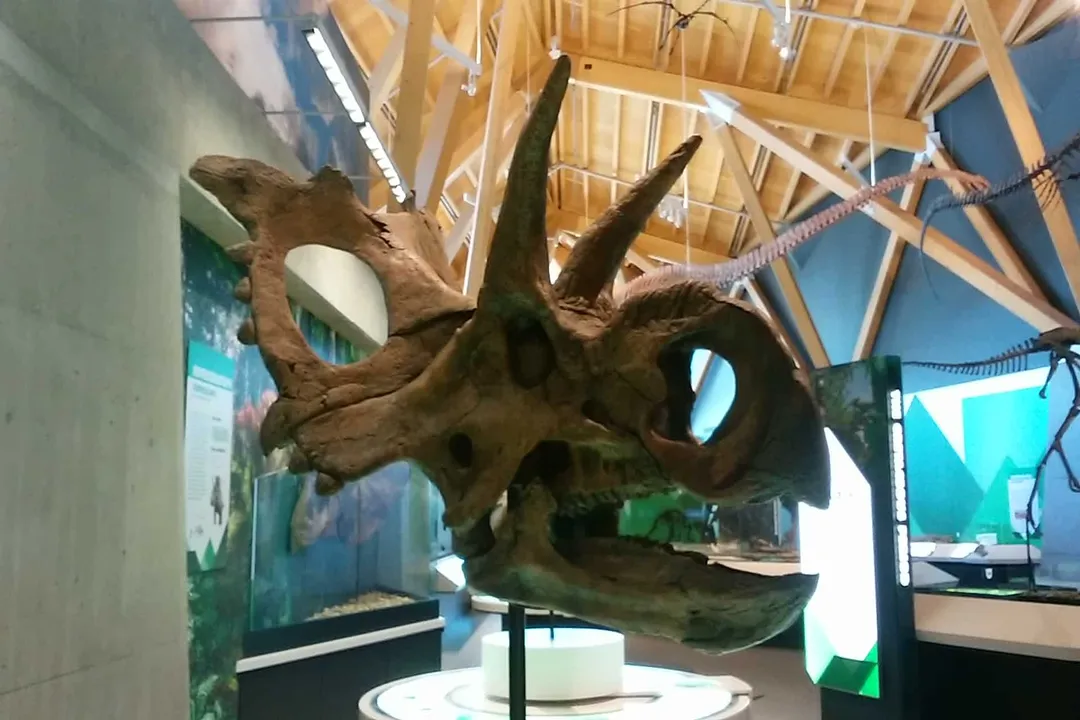
The discovery of Xenoceratops foremostensis offered paleontologists a rare glimpse into the very beginning of a major dinosaur lineage in North America. This plant-eater, identified from fossils originally collected back in the mid-20th century, quickly established itself as the most ancient large-bodied horned dinosaur yet found in Canada. [1][5] Its existence pushes the known timeline for these massive, frilled herbivores further back, revealing that elaborate headgear was present right at the start of their evolutionary explosion about 80 million years ago, during the Late Cretaceous period. [1][2][5]
# Naming Origin
The name Xenoceratops is a composite derived from Greek, translating literally to “alien horned-face”. [1][5] This moniker was apt for two primary reasons: first, the unusual and "strange pattern of horns on its head" was unlike contemporary finds; [1][5] second, horned dinosaur fossils from the specific geological layer where it was found—the Foremost Formation—were historically quite scarce, making the discovery feel almost foreign to the existing fossil record. [1][5] The species name, foremostensis, pays homage to the Village of Foremost in Alberta, Canada, situated near where the original specimen was unearthed. [1][5]
# Massive Stature
When picturing Xenoceratops, one can imagine a creature comparable in size to a modern rhinoceros. [2][4] Estimates place its total length at approximately 20 feet, or about 6 meters. [1][2][5] Despite this imposing length, its weight was likely around two tons, or roughly 4,000 pounds. [1][2][4] Standing about seven feet tall at the shoulder, Xenoceratops foremostensis held the title of the largest ceratopsid roaming its particular ecosystem 80 million years ago. [1][2] This scale is significant because it confirms that the ceratopsid group was already producing large members early in the Campanian stage of the Late Cretaceous. [3][5]
# Frill Architecture
The most defining features of any ceratopsian are its face horns and the bony neck shield, or frill, and Xenoceratops provides a fascinating, somewhat experimental, starting point for this group. [2][3] Belonging to the Centrosaurinae subfamily—known for having some of the most ornate frills among all horned dinosaurs—Xenoceratops showcases specific, key characteristics on its parietal bone. [3][4]
Its large frill did not bear the typical array of symmetrical spikes seen in later, more famous relatives. Instead, the ornamentation described from the holotype skull fragments includes several distinct elements:
- Thick Knobs: Two heavy bony projections positioned closest to the midline of the frill, which orient inward toward that center line. [3]
- Lateral Spikes: Adjacent to each of these central knobs sits a single, long, flattened spike that points both backward and outward (laterally). [3]
- Anterior Knobs: The front-most corners of the parietal bone feature a distinctive, large triangular knob. [3]
What is particularly striking, and what contributes to its "alien" designation, is the relative lack of decoration elsewhere. Crucially, the midline bar of the frill, a region often bumpy or ornamented in other centrosaurines, appears to be smooth, lacking any bumps or adornments. [3] This combination—thick knobs paired with single spikes, contrasted with a bare midline—sets it apart. It suggests that the process of evolving spectacular cranial displays within the Centrosaurinae was not a linear progression but perhaps involved different, unique structural experiments early on. While later members like Styracosaurus developed multiple sharp spikes, Xenoceratops settled on a simpler, yet bold, configuration of two main spikes emerging from its shield. [2]
# Facial Hardware
While the frill grabs the most attention, the rest of the face also tells a story about this herbivore’s feeding strategy. [2] Like all ceratopsids, Xenoceratops possessed a parrot-like beak—a powerful keratinous structure well-suited for cropping tough vegetation. [2] Its face featured two long brow horns positioned above the eyes, typical for the group, though the exact configuration is interpreted based on associated, but fragmentary, material. [1][5] Scientists studying the partial nasal bone suggest that the nose horn might have been long and low, possibly resembling the structure seen in Medusaceratops. [3] Furthermore, fragments suggest the brow horns were large, perhaps analogous to those found on Albertaceratops or Diabloceratops, positioning it within a specific evolutionary grouping. [3]
# Discovery Context
The story of Xenoceratops is as unique as its headgear because the physical evidence was waiting decades for recognition. [1] Skull fragments were first unearthed in 1958 by Wann Langston, Jr. from the Foremost Formation in Alberta. [3] However, this material languished in storage cabinets at the Canadian Museum of Nature for over forty years. [1][3][5] It wasn't until the early 2000s that paleontologists Michael J. Ryan and David C. Evans revisited the neglected specimens, recognizing them as representing a previously unknown genus and species, formally described in 2012. [1][3][5] This nearly five-decade delay between excavation and scientific publication underscores a vital truth in paleontology: museum collections, particularly those sourced from less intensely studied rock units like the Foremost Formation, function as irreplaceable, long-term archives of biodiversity. [1][5] Finding this dinosaur in that specific formation makes it the very first ceratopsian to be formally described from the area, filling a notable blank in the region’s fossil record. [3]
# Evolutionary Branching
As a centrosaurine, Xenoceratops is situated within one of the two main branches of the large-bodied horned dinosaurs, distinct from the lineage that produced Triceratops (which belongs to the Chasmosaurinae). [1][2] Its dating, approximately 80 million years ago, places it about half a million years older than Albertaceratops, another key centrosaurine find, making Xenoceratops the earliest known representative of the large-bodied North American ceratopsids. [5]
Phylogenetic analysis, such as that detailed in the initial description, places Xenoceratops foremostensis near the base of the Centrosaurinae group, suggesting it represents a very early diversification event. [3] It shares recent ancestry with dinosaurs like Diabloceratops and Machairoceratops, and lies outside the more derived Nasutoceratopsini clade and the Centrosaurini tribe, which contains later forms such as Styracosaurus and Centrosaurus. [3] Understanding Xenoceratops is therefore fundamental; it shows that the massive size and the development of a robust frill were established features before the more complex, hyper-ornamented forms evolved. [1][5] It demonstrates that the evolutionary trajectory toward elaborate cranial displays in this group began robustly and with unique stylistic variations quite early in their history in the northern continent. [1]
# Diet and Environment
Being a ceratopsid, Xenoceratops was an obligate herbivore. [2] Its diet likely consisted of the tough, fibrous flora available in its Late Cretaceous habitat, such as ferns, cattails, and various flowers growing near ancient river deltas. [2] The efficiency of processing this bulky food was aided by its shearing, bird-like beak. [2] Given the challenging nature of Cretaceous plant material, it is plausible that, like some later herbivores, Xenoceratops relied on microbial fermentation within its gut to break down cellulose, indicating a complex digestive system necessary to sustain its multi-ton body mass. [2] Its environment in what is now Alberta was far from the cold province it is today; during its time, the region was a subtropical area characterized by alternating periods of significant rain and pronounced dry spells. [2]
In assessing potential dangers, while Xenoceratops shared its ecosystem with formidable predators, including tyrannosaur relatives, its sheer bulk and formidable head armament likely made it a difficult target. It would have coexisted with duck-billed dinosaurs and club-tailed ankylosaurs, but its defenses probably rendered most local carnivores hesitant to attack a healthy adult. [2]
If we were to construct a hypothetical scenario based on the evidence, an individual Xenoceratops moving through the semi-arid floodplains of the Foremost Formation would have needed constant feeding to support its two-ton frame. [2] The specific design of its frill, featuring the inward-pointing knobs and single lateral spikes, might have served multiple purposes beyond simple display, perhaps acting as lateral stabilizers for head movements during feeding or as slightly less robust defense compared to the dense armor of a later Pachyrhinosaurus, suggesting a focus on overall intimidating bulk supported by distinct, but not overly aggressive, ornamentation. [3] The fact that the skull fragments belonged to at least three individuals suggests that these animals were somewhat common in their localized area, though the formation itself remains poorly sampled overall. [1][3]
The existence of Xenoceratops serves as a powerful reminder that the fossil record is often a fragmented story. The discovery hinged on researchers recognizing significant, yet previously overlooked, material in a museum drawer, proving that new species are not always unearthed by trowels in the field, but sometimes by careful eyes in the collection hall. [1][5] This specimen, predating most of its well-known cousins, gives texture to the evolutionary explosion that soon followed, showing the early iterations of what would become the iconic horned dinosaurs of the final age of dinosaurs. [1]
# Comparison Points
To better appreciate the unique features, contrasting Xenoceratops with its later relatives clarifies its specific evolutionary position. [2]
| Feature | Xenoceratops foremostensis | Triceratops | Styracosaurus |
|---|---|---|---|
| Time Period | ~80 Million Years Ago | ~68 Million Years Ago | Late Cretaceous |
| Subfamily | Centrosaurinae | Chasmosaurinae | Centrosaurinae |
| Brow Horns | Two long brow horns (Inferred large) | Three horns (Two large brow, one small nose) | One prominent nose horn |
| Frill Spikes | Two long spikes, distinct knobs/triangular features | Two straight spikes on the rear edge | Numerous long spikes (4-6) ringing the edge |
| Midline Frill | Lacks ornamentation | Generally lacks major ornamentation | Often has hooks or bumps |
| [1][2][3] |
The distinction in frill morphology is paramount. Triceratops sports three horns and a different frill construction characteristic of the Chasmosaurinae. [2] Styracosaurus, a fellow Centrosaurine, opted for a greater number of long, sharp spikes around the frill margin. [2] Xenoceratops, by focusing its decoration on specific knobs and single large spikes near the center and corners of the parietal, presents a distinctly different architectural blueprint for the shield. [3]
# Conservation Status
As an extinct species, Xenoceratops is no longer subject to modern conservation assessments, but its history suggests it died out before the catastrophic K-Pg extinction event that ended the reign of the non-avian dinosaurs. [2] Its existence within the older layers of the Foremost Formation implies its lineage concluded approximately 78 million years ago, making it one of the earliest chapters in the story of large ceratopsids, a chapter that was later closed by geological turnover before the final mass extinction. [2]
Related Questions
#Citations
Xenoceratops - Wikipedia
Xenoceratops Animal Facts - A-Z Animals
[PDF] Xenoceratops - Cloudfront.net
Xenoceratops | Dinopedia - Fandom
Meet Xenoceratops: Canada's newest horned dinosaur - EurekAlert!
Xenoceratops, New Horned Dinosaur from Canada | Paleontology