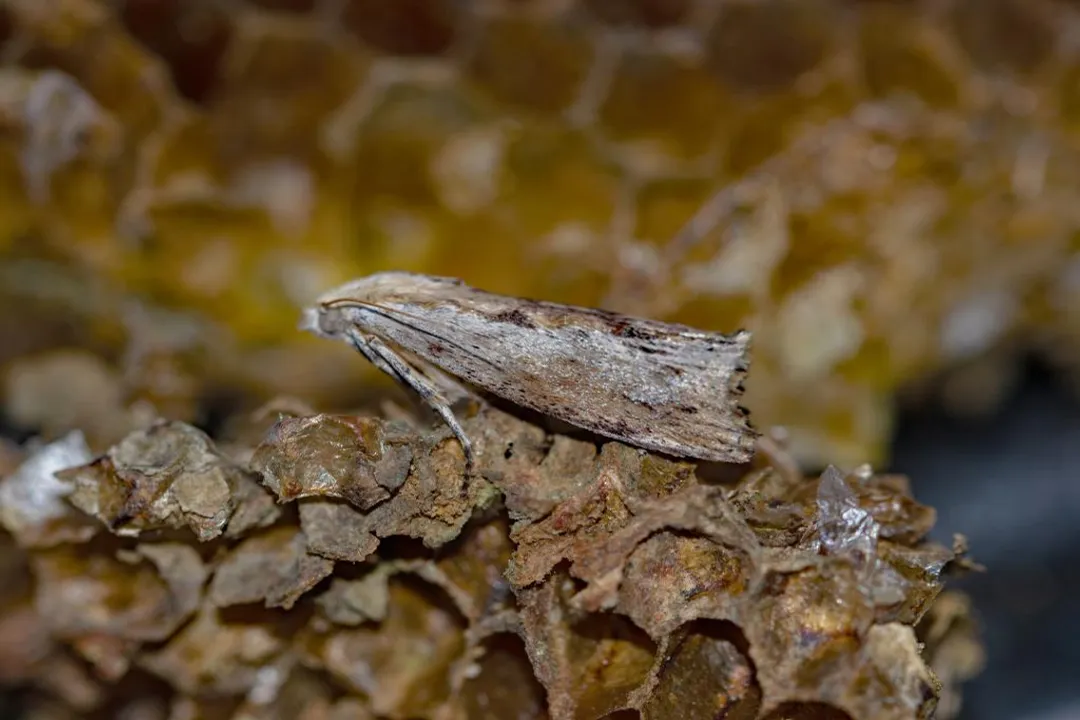
Due to what appearance do resting adult moths blend in near hive entrances or on the ground?
Answer
Buff or mottled brown appearance
When adult Greater Wax Moths are found resting outside the hive, such as near entrances or on the ground, their coloration aids in providing camouflage, making them less conspicuous compared to the highly destructive activity of their larval counterparts. The overall appearance adopted by the resting adult moth is described as buff or mottled brown. This coloration allows the adult insect to blend effectively with typical environmental surfaces like wood, dirt, or detritus, contrasting sharply with the conspicuous, damaging activity associated with the larval stage inside the protected comb structure.
Related Questions
What is the typical wingspan range for the adult Greater Wax Moth (Galleria mellonella)?What is the crucial physical characteristic distinguishing the Galleria mellonella larva's head capsule?What structure do Galleria mellonella larvae spin as they move through the comb structure?How is the forewing appearance of the adult wax moth generally described?What is the typical appearance of the hindwings on an adult wax moth compared to the forewings?What visual distinction aids in identifying male versus female *Galleria mellonella* coloration?What wingspan range is cited for reports of a general or Lesser Wax Moth (*Achroia grisella*)?Approximately how long can the *Galleria mellonella* caterpillar grow before pupation?What specific materials are consumed by the destructive larval stage of the wax moth?Due to what appearance do resting adult moths blend in near hive entrances or on the ground?