What are the characteristics of a spongy moth?
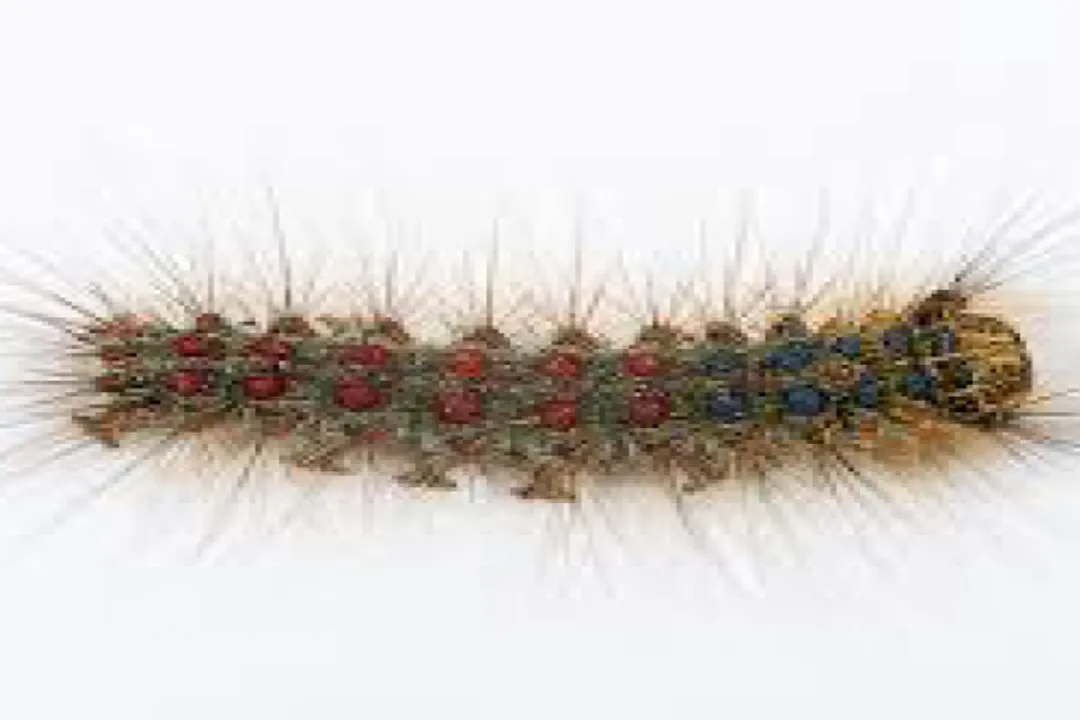
The spongy moth, a name recently adopted to replace the former gypsy moth or Ldd moth designation, [2] represents one of North America’s most destructive invasive forest pests. [3][4] This insect, scientifically known as Lymantria dispar dispar, originates from Europe, Asia, and North Africa, arriving in North America over a century ago and establishing itself widely across the northeastern United States and parts of eastern Canada, including Ontario, Quebec, New Brunswick, Nova Scotia, and Prince Edward Island. [2][3] Though its spread westward is constrained by climate suitability, detection efforts are ongoing across many states. [3] Understanding the characteristics across its four distinct life stages is key to recognizing and managing its presence.
# Life Cycle
The spongy moth adheres to a univoltine life cycle, meaning it completes only one generation per year. [2][4][5] This progression involves four main stages: egg, larva (caterpillar), pupa, and adult moth. [4] The insect overwinters in the egg stage, with active feeding occurring when the larvae emerge in the spring, typically around April. [2][4] The adult stage, focused solely on mating and reproduction, is fleeting, lasting less than two weeks before the moths perish. [2]
# Egg Masses
The initial phase of the cycle is the egg mass, laid by the female moth from late summer into the early fall. [5] These masses are unmistakable features, described as tan, fuzzy, or felt-like patches affixed to surfaces. [2][6] The protective fuzz is actually composed of hairs shed from the female’s abdomen during deposition. [2] A single mass can contain anywhere from 400 to 1,000 eggs. [4]
These eggs exhibit a remarkable tolerance for temperature and moisture, allowing them to travel well. [3] They are not selective about their substrate, favoring protected areas such as crevices in tree bark, but also readily colonizing man-made objects. [2][5] This includes firewood, trailers, vehicles, lawn furniture, walls, and even children’s toys. [2][3][5] It is critical for residents in established or quarantine areas to conduct thorough inspections before moving any outdoor items to new locations, as this is the primary mechanism for long-distance spread. [2][3] For instance, any item stored outside during the late summer or fall—not just firewood—is a potential transport vehicle, making annual inspections of seemingly static property elements like outdoor swing sets or parked RVs a vital preventative measure. [2][3]
# Larva Appearance
When the eggs hatch in the spring, tiny, black, hairy caterpillars emerge to begin their feeding. [3][4] Over approximately 40 days, these larvae grow significantly, reaching up to 2.5 or even 3 inches in length before pupation. [2][4][5]
The defining characteristic of the spongy moth caterpillar, which helps distinguish it from other native species, is the arrangement of colored spots running along its back. [3][4] This pattern consists of five pairs of blue dots followed immediately by six pairs of reddish-orange or rusty red dots. [2][3][5][6] While they are generally hairy and may appear mottled yellow to gray as they mature, these colored tubercles are the most reliable visual cue. [3][4] The larvae are voracious feeders, generally preferring to consume leaves at night, often starting their feast in the tree canopy. [2][4]
# Adult Moths
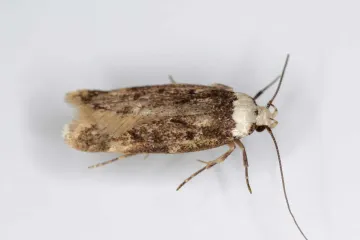
The transition to the adult stage occurs after the pupal phase in mid-summer, typically emerging in late July or August. [5] Adults lack functional mouthparts, meaning their adult life is purely dedicated to reproduction, lasting only about two weeks. [2][4] There is a striking physical difference, or sexual dimorphism, between the sexes.
The female moth is substantially larger, possessing a wingspan of about 2 inches. [3] Her body is stout, and her wings are nearly white or beige, marked distinctly with dark, saw-toothed or wavy patterns. [3][4][5] A key characteristic for North American populations is that the female cannot fly. [2][3][5] She is responsible for laying the next generation of eggs after mating, guided by the scent produced by her own body. [5]
Conversely, the male moth is smaller, with a wingspan around 1.5 inches. [3] Males are typically a brownish-gray color, though they still feature dark markings on their wings. [3][4] Their most useful identification feature, shared by many moths, is their large, feathery or plumose antennae, which they use to locate females using pheromones. [3][4][6] Unlike the females, the males are strong fliers and actively seek mates. [4]
The fact that the established North American female spongy moth cannot fly is a fundamental characteristic shaping its spread. While the larvae can disperse significant distances by "ballooning" on wind currents, the long-distance colonization leaps seen across the continent are almost entirely dependent on human transport of the egg masses. If the female shared the strong, directed flight capability of her Asian cousins, the established range would likely be expanding much faster than the reported annual rate of 3 to 29 km/yr, suggesting that focused regulatory efforts on the movement of objects outside quarantine zones are highly impactful in slowing this subspecies' overall progression.
# Host Range
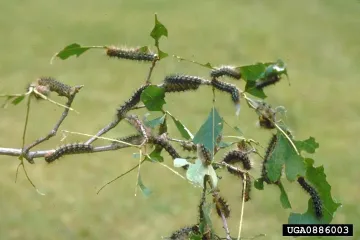
Spongy moths are notorious generalists, capable of feeding on the foliage of over 300 different tree and woody plant species. [2][3][5] While they consume a broad range, their preference dictates the severity of an infestation. [2]
The caterpillars heavily favor hardwood trees. [2][4] Among the most favored hosts are Oak species (Quercus spp.), which are often the primary target. [6] Other preferred hosts include Maple (Acer spp.), Birch (Betula), Alder (Alanus spp.), and Hawthorne (Crataegus spp.). [2][4] Although conifers (softwoods) are generally less favored, later larval stages may feed on species like Cedar, Pine, Spruce, and Fir, especially when preferred hosts are scarce or during heavy defoliation events. [4]
# A Flighted Cousin
It is important to note that the spongy moth is often discussed alongside the Flighted Spongy Moth Complex (FSMC). [3] This complex includes several related taxa whose life stages look nearly identical to L. dispar dispar. [3] However, there are crucial differences that heighten the risk posed by the FSMC: both male and female FSMC adults are slightly larger, and most importantly, FSMC females are capable of strong, directed flight. [3] Furthermore, FSMC larvae reportedly develop better on conifers than the established spongy moth. While the FSMC is not currently established in the United States, its detection in port surveys signals an ongoing management concern due to its potential for rapid, long-distance spread unassisted by human cargo movement. [3]
# Signs and Impact
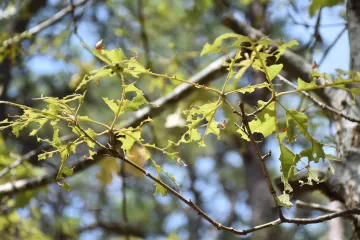
The primary symptom of a spongy moth infestation, which occurs during the spring and early summer feeding period, is tree defoliation. [2][4] Infested trees may appear to have holes in their leaves or, in severe cases, become completely bare, giving the forest a barren, wintry appearance in mid-summer. [2][3] Repeated defoliation stresses the trees, making them vulnerable to secondary pests and disease, and can lead to the dieback of twigs and branches, which impacts both forest regeneration and ecosystem health. [2]
The damage translates into economic, ecological, and social impacts. [2] Economically, heavy defoliation degrades the aesthetic value of forests and urban landscapes, potentially lowering property values and incurring cleanup and replacement costs. [2][4] Ecologically, the thinning canopy disrupts wildlife habitats and reduces food sources for dependent species. [2] On a social level, direct contact with the hairy caterpillars can cause skin irritation or rashes in some individuals. [2] Controlling outbreaks relies heavily on methods aimed at the most destructive stage—the larva—using treatments like the bacterial spray Bacillus thuringiensis (Btk), which is only toxic to the caterpillars. [2]
Related Questions
#Citations
Spongy Moth | Animal and Plant Health Inspection Service
Spongy Moth – Profile and Resource | Invasive Species Centre
Spongy Moth Facts and Information - Pests - Orkin
Spongy moth (Lymantria dispar ) - University of Minnesota Extension
spongy moth (formerly gypsy moth) (Lymantria dispar (Linnaeus))
Spongy Moth and Flighted Spongy Moth Pest Profile