According to modern entomological observation, what does a wider brown band on a woolly bear actually suggest about its history?
Answer
It indicates the caterpillar hatched earlier in the season.
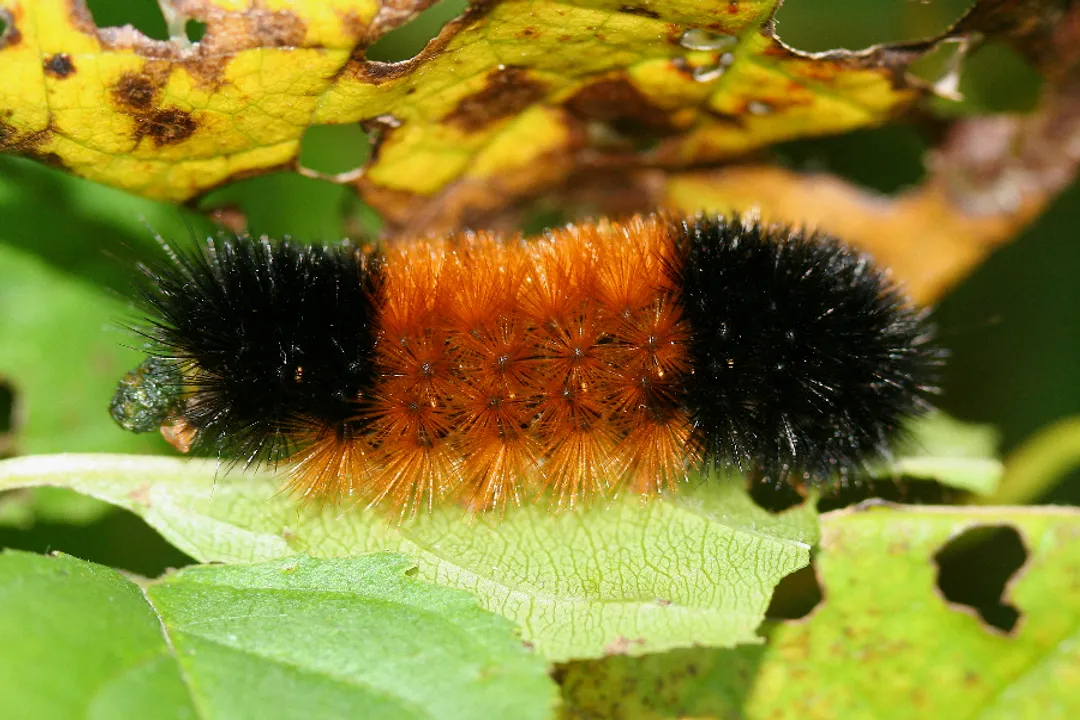
While folklore links the band width to future weather, modern entomological findings suggest that the coloration is more closely correlated with the caterpillar's developmental age and history rather than acting as a direct predictor of forthcoming conditions. Specifically, observations indicate that the brown band tends to widen as the caterpillar ages over time. Therefore, finding a caterpillar with a wider brown band may simply signify that it hatched earlier in the season, perhaps following a winter that was relatively mild the preceding year, allowing for earlier development, rather than predicting what the next winter will bring.
Related Questions
What chemical identified as a cryoprotectant enables the banded woolly bear to survive freezing solid in extreme cold?What common weather folklore predicts if a woolly bear caterpillar exhibits a wider rusty-brown band?What is the immediate, physical defense mechanism utilized by the *Pyrrharctia isabella* larva when it perceives a threat?What distinctive physical characteristic is noted on the forelegs of the adult Isabella tiger moth?Which other fuzzy caterpillar species, whose larva can be entirely black, is often confused with the true banded woolly bear?What proportion of its existence have Arctic woolly bears been observed spending in a frozen state?How long does the transformation period from the *P. isabella* pupa into the adult moth typically last?If a woolly bear prematurely emerges in late February in a northern climate due to an unseasonable warm spell, where should it be sheltered to allow it to re-enter diapause?Besides violets and dandelions, what specific garden vegetable is listed as a preferred food source for the *P. isabella* larvae?According to modern entomological observation, what does a wider brown band on a woolly bear actually suggest about its history?What potential minor health issue can result from contact with the stiff, hair-like bristles, called setae, on a woolly bear?