What traits are characteristic of the Class Mammalia designation for the Wirehaired Vizsla?
Answer
Having mammary glands for nursing young, the presence of hair or fur, and possessing three middle ear bones.
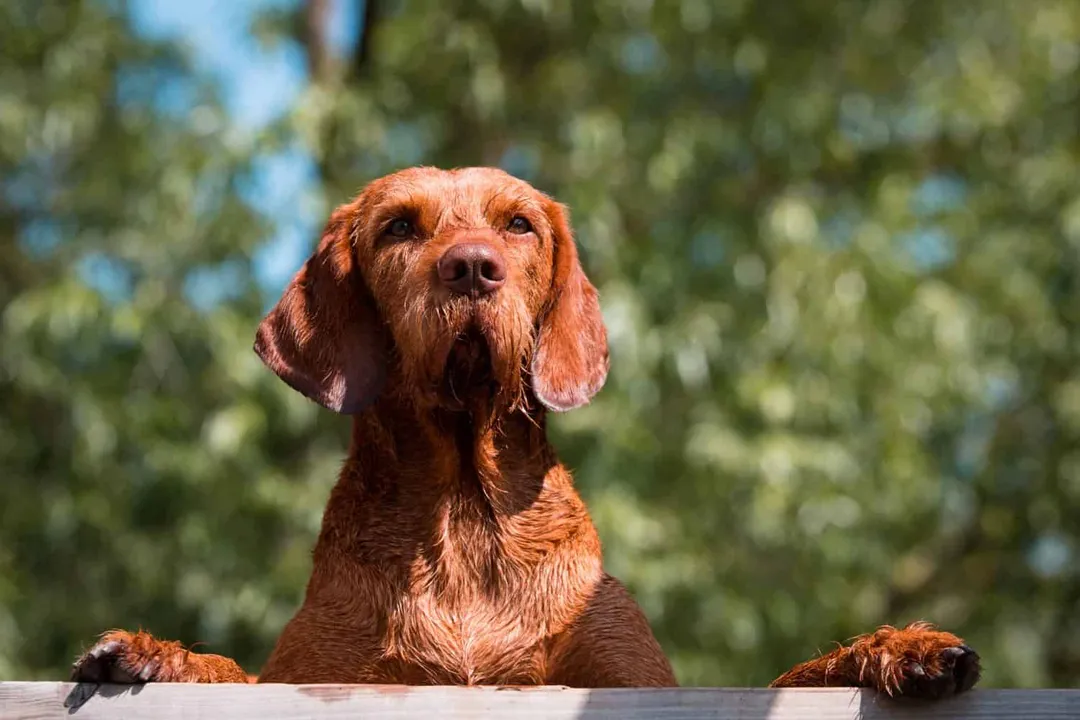
The Class Mammalia signifies a much more specific biological grouping characterized by traits related to reproduction, external covering, and auditory structure. The defining features are the presence of mammary glands, which necessitate nursing the litter, the existence of hair or fur (like the Vizsla's dense coat), and the tripartite structure of the middle ear bones. Furthermore, being warm-blooded is a key mammalian trait that would have aided its ancestors in cold weather or icy water during Hungarian hunts.
Related Questions
What is the broadest taxonomic classification applied to the Wirehaired Vizsla?Which defining characteristics place the Wirehaired Vizsla within the Phylum Chordata?What traits are characteristic of the Class Mammalia designation for the Wirehaired Vizsla?What critical functional adaptation is reflected by the Wirehaired Vizsla's placement in the Order Carnivora?Which shared characteristics define the Family Canidae group, which includes the Wirehaired Vizsla?What specific biological rank confirms the domestication status of the Wirehaired Vizsla relative to the ancestral wolf?Which breed was intentionally crossed with original Vizsla stock to achieve the heavier coat of the Wirehaired Vizsla in the 1930s?How is the hard, dense coat of the Wirehaired Vizsla specifically described in contrast to its smooth-coated relative?By which functional grouping do organizations like the AKC generally classify the Wirehaired Vizsla?What historical gap exists regarding the precise evolutionary path of the wirehaired coat trait?