How is the hard, dense coat of the Wirehaired Vizsla specifically described in contrast to its smooth-coated relative?
Answer
It has a hard, dense, wiry texture accompanied by a waterproof undercoat.
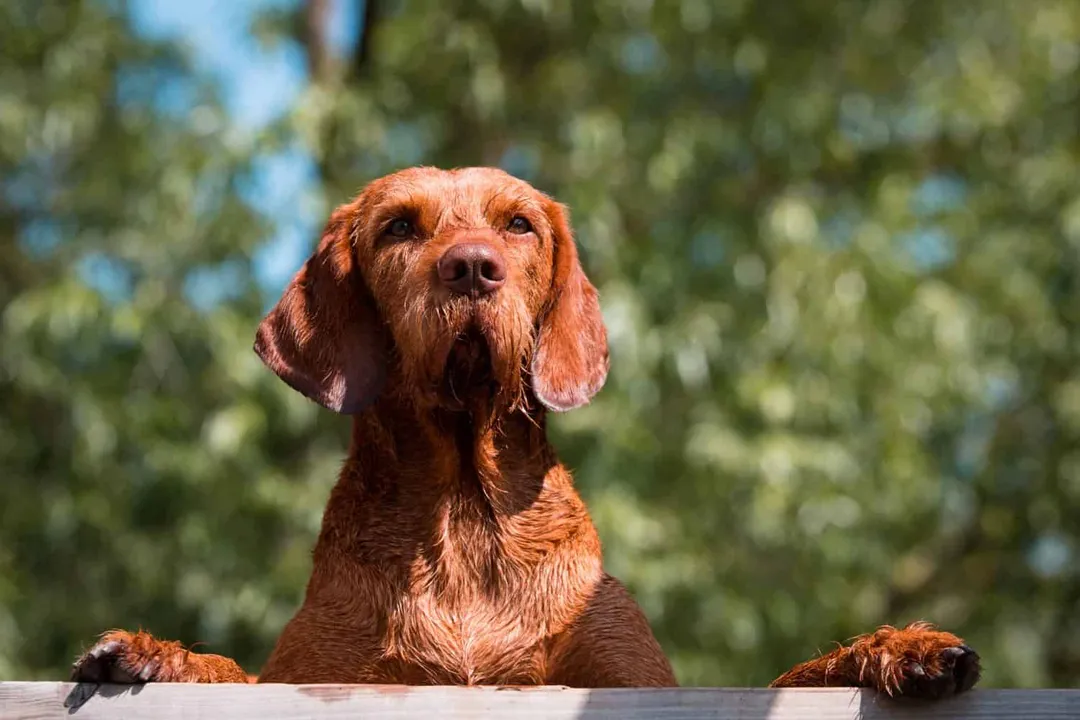
The defining feature separating the two Vizsla varieties is the coat texture resulting from intentional breeding efforts. While the smooth-coated relative possesses a coat described as short and dense, the Wirehaired Vizsla is characterized by a more rugged texture described as hard and wiry. Critically, this wiry outer layer is augmented by a necessary waterproof undercoat, offering superior protection for working in harsh environmental conditions like cold water or dense underbrush.
Related Questions
What is the broadest taxonomic classification applied to the Wirehaired Vizsla?Which defining characteristics place the Wirehaired Vizsla within the Phylum Chordata?What traits are characteristic of the Class Mammalia designation for the Wirehaired Vizsla?What critical functional adaptation is reflected by the Wirehaired Vizsla's placement in the Order Carnivora?Which shared characteristics define the Family Canidae group, which includes the Wirehaired Vizsla?What specific biological rank confirms the domestication status of the Wirehaired Vizsla relative to the ancestral wolf?Which breed was intentionally crossed with original Vizsla stock to achieve the heavier coat of the Wirehaired Vizsla in the 1930s?How is the hard, dense coat of the Wirehaired Vizsla specifically described in contrast to its smooth-coated relative?By which functional grouping do organizations like the AKC generally classify the Wirehaired Vizsla?What historical gap exists regarding the precise evolutionary path of the wirehaired coat trait?