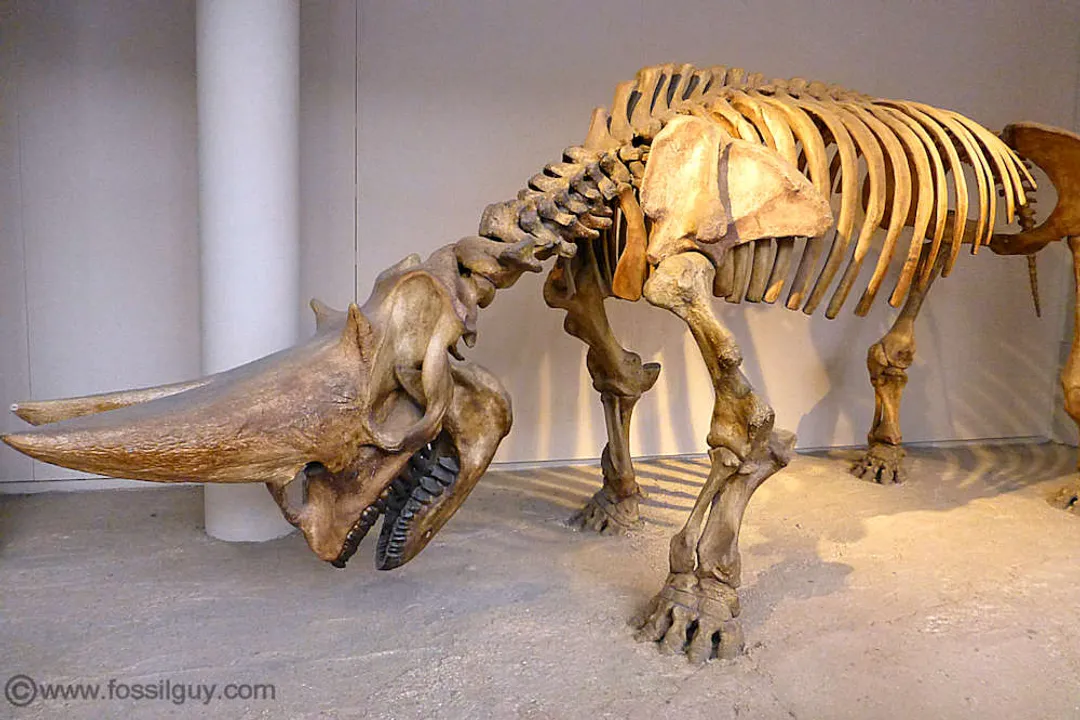
What non-defensive/display function might the basal structure of the horns have provided in its swampy habitat?
Answer
Serving as effective shovels for clearing tough reeds
The sheer mass and structural integrity of the horns suggest they could absorb significant impact, useful for confronting predators like large crocodiles. However, given the environment—charging across soft, muddy ground—the impact transmitted through the horn bases might have been more focused on blunt force trauma than piercing. This physical capability could have been repurposed functionally for foraging purposes, perhaps acting as cumbersome shovels to clear dense, tough reeds and vegetation near the water's edge to access softer food sources below.
Related Questions
What was the maximum estimated weight for the bulky *Arsinoitherium*?To which extinct order does *Arsinoitherium* belong, classifying it separately from true rhinos?During which epochs did *Arsinoitherium* thrive, according to fossil dating?What likely covered the substantial, two-pronged horns of *Arsinoitherium*?Where are the fossils of *Arsinoitherium* primarily recovered, indicating its primary habitat?Which distant mammalian relatives share an evolutionary neighborhood with *Arsinoitherium*?What was the probable dietary preference of *Arsinoitherium* given its habitat and teeth structure?What is the likely origin of the name *Arsinoitherium*?What non-defensive/display function might the basal structure of the horns have provided in its swampy habitat?What primary environmental factor led to the disappearance of *Arsinoitherium* from the fossil record?