What makes the elf owl unique?

The Elf Owl holds a diminutive stature in the avian world, immediately claiming attention not for its power, but for its sheer, almost unbelievable smallness. It is recognized across its range as the smallest owl found anywhere, a title that frames every other aspect of its existence, from its hunting strategy to its nesting requirements. [2][3] This tiny raptor challenges the typical image many hold of owls—large, silent nighttime hunters—presenting instead a bird perfectly adapted to arid, sometimes unforgiving environments in the American Southwest, Mexico, and Central America. [1][4] Its uniqueness isn't just a matter of scale; it lies in the suite of specialized behaviors and physical traits that allow this thimble-sized predator to thrive where larger relatives might struggle.
# Miniature Form
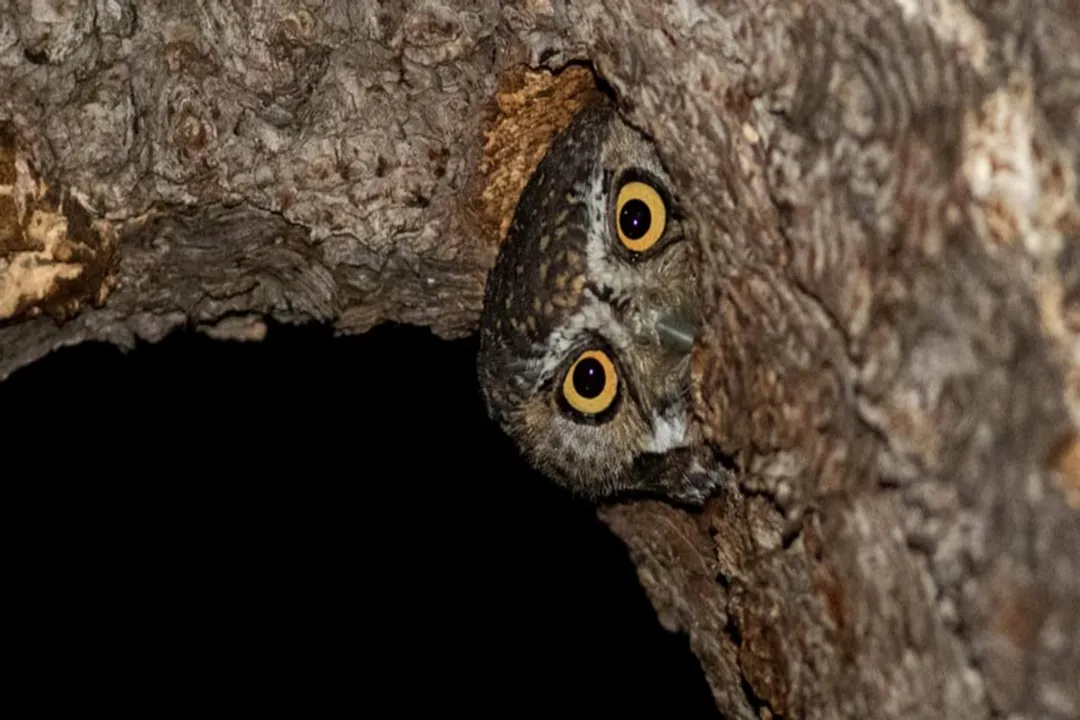
The physical dimensions of the Elf Owl are perhaps its most defining characteristic. Averaging only about five to six inches in length, it is barely larger than a sparrow, perhaps even smaller than some passerines, such as the House Sparrow or the American Robin’s head. [2][6] Weight-wise, they rarely exceed the mass of a couple of standard paper clips, often falling in the range of just two ounces. [2] When observing one, the immediate thought is often one of disbelief that such a small creature possesses the features of a true owl, including forward-facing eyes and sharp talons. [8]
Comparing its appearance across available field guides reveals a consistent description. They possess a compact body, a relatively large, rounded head, and striking yellow eyes that stand out against their heavily patterned plumage. [1][4] Their coloring is primarily dusky gray to brownish-gray on the back and wings, often marked with white speckling or streaks, which offers superb camouflage against the bark of desert trees. [9] The underside is paler, usually whitish or buff, sometimes streaked with dusky markings. [1] A subtle but important feature, often noted in field guides, is the lack of ear tufts, which sets them apart from many other North American owl species. [4][7]
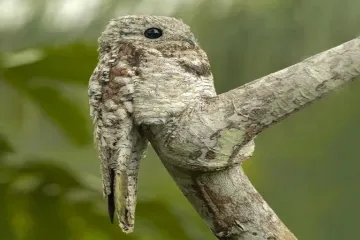
A fascinating aspect of their physical adaptation relates to survival in intense heat. While many desert dwellers are strictly nocturnal to avoid daytime temperatures, the Elf Owl’s small size means it has a higher surface-area-to-volume ratio, making overheating a significant risk during the hottest parts of the day. [2] This physical constraint likely contributes to its observed mixed activity pattern, as discussed later. The sheer density of their feathers, though small, must be perfectly engineered to balance insulation for cool desert nights with heat dissipation during sunlit hours. [9]
# Habitat Niche

The geographic distribution of the Elf Owl paints a picture of commitment to arid and semi-arid regions. They are primarily birds of the desert Southwest of the United States, extending south through Mexico and into parts of Central America. [1][2] In the U.S., their presence is most reliably associated with the lower elevations of Arizona, New Mexico, and occasionally Texas, though these populations are often sparse and localized. [1][4]
What links these disparate locations is a specific requirement for nesting sites: cavities. [1][4] This dependency is where the Elf Owl’s uniqueness truly intersects with its environment. Unlike many birds that excavate their own homes, Elf Owls almost exclusively rely on pre-existing holes, most famously old flicker or woodpecker cavities found in large, dead standing trees or, critically, in the columns of mature saguaro cacti. [1][7][8]
The relationship with the saguaro cactus is particularly defining for the Arizona population. These cacti, often called the "cornerstone" of the Sonoran Desert ecosystem, provide ideal, insulated nesting chambers. [6] The owl selects holes that are often abandoned by Gila Woodpeckers or Gilded Flickers. [4] This obligate use of tree or cactus cavities means that the health and age structure of the local woodland or cactus population directly dictate the presence of Elf Owls. If a forest stand is too young, or if old, dead snags are cleared for safety or aesthetics, the owl population will vanish, regardless of food availability. [9] This reliance on specific structural elements within the landscape is a key vulnerability point.
# Cavity Dwelling
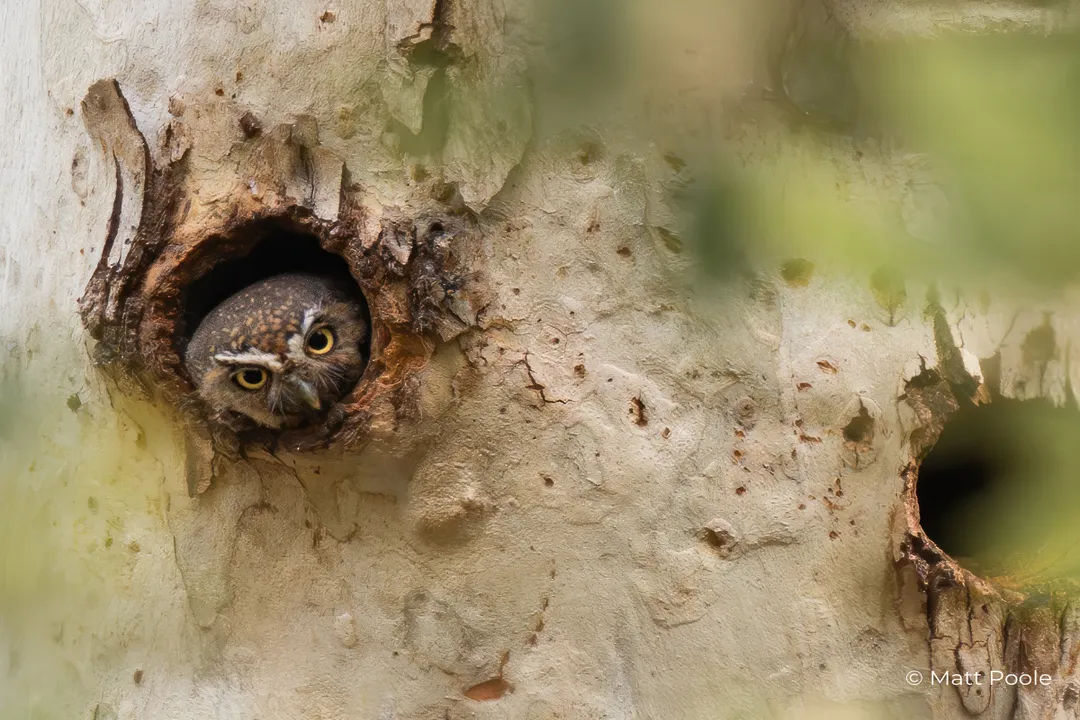
The choice of nesting site is not arbitrary; it is a direct strategy against predation and the harsh climate. Cavities offer protection from extreme temperatures and shield eggs and nestlings from predators that cannot fit into the small entrance holes. [4] A typical nesting area might be located anywhere from 10 to 60 feet above the ground, depending on the host tree or cactus. [1]
An interesting comparative point arises when considering their nesting habits versus those of larger owls. Larger species like Great Horned Owls may use stick nests or natural tree crotches, which are open to the elements and aerial predators. The Elf Owl, by contrast, opts for a secure, enclosed space, an almost mammalian approach to denning. [7] The female typically incubates a small clutch, often two to three white, unmarked eggs, for about 28 days. [1][9]
Observing nesting sites reveals a fascinating detail about resource competition. The Elf Owl is not the primary excavator; it is a secondary cavity nester. This means it must wait for Gilded Flickers or Gila Woodpeckers to do the hard labor of drilling into the tough wood or cactus flesh. [4] If a suitable abandoned hole is not available, the owl simply cannot breed in that immediate area. This constraint often forces them to relocate annually or settle for less-than-ideal spots, highlighting their tight spatial relationship with other cavity-dependent species.
# Active Foraging
Despite being classified as owls, which suggests nocturnal habits, Elf Owls exhibit a behavioral flexibility that sets them apart from many of their relatives. [7] While they are certainly active at night, they are frequently seen hunting during the crepuscular hours—dawn and dusk—and can even be active during the daytime, especially when feeding young. [1][4] This mixed schedule is likely an adaptation to both their small size (requiring more frequent refueling) and the food sources available in their environment.
Their diet consists overwhelmingly of insects and other arthropods. [1] This isn't a diet of occasional beetles; they consume large quantities of grasshoppers, moths, crickets, and scorpions. [9] They snatch flying insects right out of the air, much like a flycatcher, or forage among the foliage and bark of trees. [1] While insects form the bulk of their meals, they are opportunistic hunters capable of taking small vertebrates when the chance arises, such as small lizards or mice, solidifying their place as true birds of prey, albeit tiny ones. [7][8]
When considering local ecology in, say, a Sonoran Desert canyon system, the Elf Owl plays a vital, localized role in insect population control that may go unnoticed compared to the impacts of larger predators. For instance, during a particularly large emergence of a specific desert moth species, a pair of breeding Elf Owls might consume hundreds of individuals over a few weeks to provision their nestlings—a significant, focused pressure on that invertebrate population that a generalized insectivore might not exert. [1]
# Vocal Signature
The vocalizations of the Elf Owl are another area where the species defies the standard "hooting" expectation. Their calls are high-pitched and rapid, often described as a series of sharp, high barks or whistles. [1][4] The primary territorial or contact call is a very fast series of chirps or yips, sometimes noted as sounding like a rapid, sharp tee-yee or kip-kip-kip. [9]
These sounds are thin and carry surprisingly well in the quiet desert air, but they lack the deep resonance of a Great Horned Owl’s call. When multiple individuals are communicating—perhaps a pair maintaining contact while foraging at twilight—the soundscape can be surprisingly busy for an owl. [4] Learning to distinguish these rapid, high-frequency notes from the calls of smaller passerines is often the key to locating a hidden Elf Owl, as their cryptic plumage usually defeats visual detection first. [7]
# Population Dynamics Insight
A crucial, yet often overlooked, aspect of the Elf Owl’s uniqueness is the implication of its narrow habitat requirement for conservation monitoring. Because they are so strictly tied to mature, large-diameter snags or established saguaro cacti for nesting, the overall population size is highly sensitive to land management practices that favor younger growth or "cleaner" landscapes. [9]
If we were to map the distribution of Elf Owls against a regional inventory of tree health, we would likely see a near-perfect correlation with areas exhibiting low levels of snag removal. For example, a 100-year-old saguaro patch that has accumulated dozens of old woodpecker holes represents a critical piece of living infrastructure for the entire local bird community, not just the owl. [4] If a storm knocks down five of those veteran cacti, it could represent the loss of five potential breeding sites, a massive proportional loss for a localized population, whereas a larger owl species might simply find a different tree crown to use. [6] Tracking the density of suitable nesting structures might be a more effective population indicator for this species than traditional territory mapping alone, requiring resource managers to view standing deadwood not as debris, but as vital, non-renewable housing stock. [1]

# Actionable Birding Tip
Spotting an Elf Owl requires a shift in strategy from that used for most raptors. Since their camouflage is excellent and they are often active early or late in the day, successful viewing relies on knowing where to look and when to listen. [7]
If you are in their known range (e.g., the foothills of the Arizona sky islands or desert riparian areas), the best approach is dawn scanning. Arrive just before the sun crests the horizon. Focus your attention not on the canopy, but on the trunks of the tallest, oldest saguaros or cottonwoods. Look for the silhouette of a small bird perched just outside a dark cavity entrance. They often sit motionless at the entrance, surveying the area before flying out for the morning’s insect haul. Bring binoculars with a wide field of view, as you are looking for a stationary target the size of your thumb high up on a trunk. Waiting quietly for their high-pitched calls to betray their location is often more successful than trying to visually scan the whole tree. [4][9]
# Resemblance and Distinction
While small, the Elf Owl is sometimes confused with other tiny birds, though rarely with other owls due to its distinct appearance in the field. [4] Its size naturally invites comparisons to wrens or chickadees until its predatory features become apparent.
One key area of comparison is with the very closely related Ferruginous Pygmy-Owl, which shares much of the same range. [2] While both are small and active, the Pygmy-Owl is typically slightly larger, has a more uniform, rusty-brown coloration (less heavy barring/spotting), and importantly, lacks the distinct white spotting seen on the Elf Owl’s head and back. [1] Furthermore, the Pygmy-Owl tends to exhibit a more distinct bar-like pattern on its tail feathers, which is usually less pronounced in the Elf Owl. [7] Understanding these subtle field marks is crucial for accurate identification, as mistaking one for the other can lead to flawed data collection regarding localized species presence.
# Conclusion
The Elf Owl's uniqueness is a layered phenomenon stemming from its extreme size, its desert-adapted biology, and its specialized housing needs. It is a living contradiction: a fierce predator shrunk down to a near-songbird scale. [3][8] Its entire existence is predicated on the availability of established holes carved by others, linking its survival intimately with the health of older vegetation in arid environments. [4][6] This tiny monarch of the cactus offers a perfect, scaled-down example of how evolution crafts specialized tools—camouflage, diet, and behavior—to permit life even in the harshest of settings. [2][5] The Elf Owl truly is a remarkable testament to nature’s ability to miniaturize might.
Related Questions
#Citations
Elf Owl Overview, All About Birds, Cornell Lab of Ornithology
Elf owl - Wikipedia
Meet the Tiny but Mighty Elf Owl! Did you know the Elf ... - Facebook
Elf Owl | Audubon Field Guide
10 Facts About Elf Owls, the Smallest Owls in the World - Treehugger
Elf Owl Fact Sheet - HawkWatch International
The Elf Owl Is the Smallest Owl in the World - Birds and Blooms
Elf Owl (Micrathene whitneyi) - Information, Pictures, Sounds