What major recurring weather event is linked to the passive transport of *H. platurus* outside its typical thermal range, such as to New Zealand?
Answer
El Niño
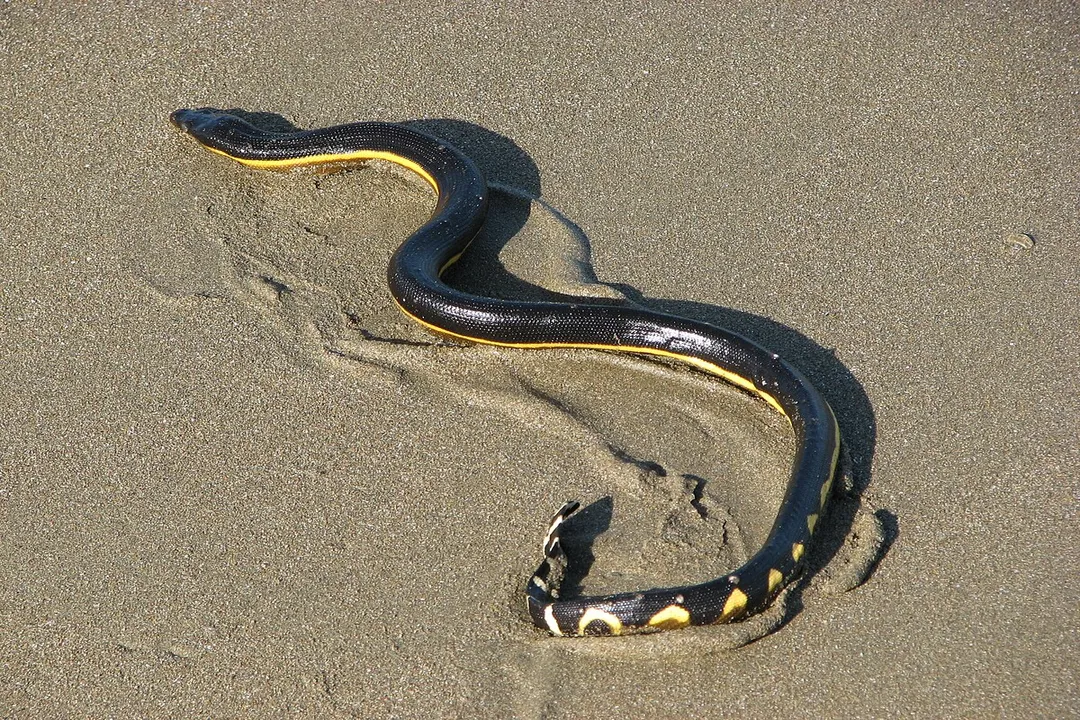
The widespread distribution of the yellow-bellied sea snake is highly dependent on warm water temperatures, requiring at least 16–18 °C for long-term survival. When individuals appear in areas outside this established thermal range, such as southern California or New Zealand, it is almost always due to passive transport via redirected oceanic currents. The major weather phenomenon responsible for strengthening and redirecting tropical currents far outside their usual paths, leading to these atypical strandings, is El Niño. These displaced individuals cannot establish resident populations because the colder temperatures in those zones prohibit foraging and long-term viability.
Related Questions
Why was the genus name *Pelamis* replaced with *Hydrophis* for the yellow-bellied sea snake?What percentage of necessary oxygen can *Hydrophis platurus* absorb directly from the water via cutaneous gas exchange?Why is the yellow-bellied sea snake rendered virtually helpless when found stranded on land?What reproductive mode describes the development of young inside the mother, leading to live birth in *H. platurus*?What high percentage estimate is associated with defensive strikes by *H. platurus* resulting in no venom injection?How does the yellow-bellied sea snake clean accumulated epibionts like barnacles from its body during shedding?How do pelagic sea snakes like *H. platurus* primarily satisfy their hydration requirements without drinking seawater?What major recurring weather event is linked to the passive transport of *H. platurus* outside its typical thermal range, such as to New Zealand?What does the conspicuous black and yellow pattern of the yellow-bellied sea snake function as to warn potential attackers?Why should the public be explicitly warned against returning a stranded yellow-bellied sea snake to the ocean immediately?