What function do relatively large pectoral fins primarily serve for many wrasses?
Answer
Precise maneuvering around corals and rocks
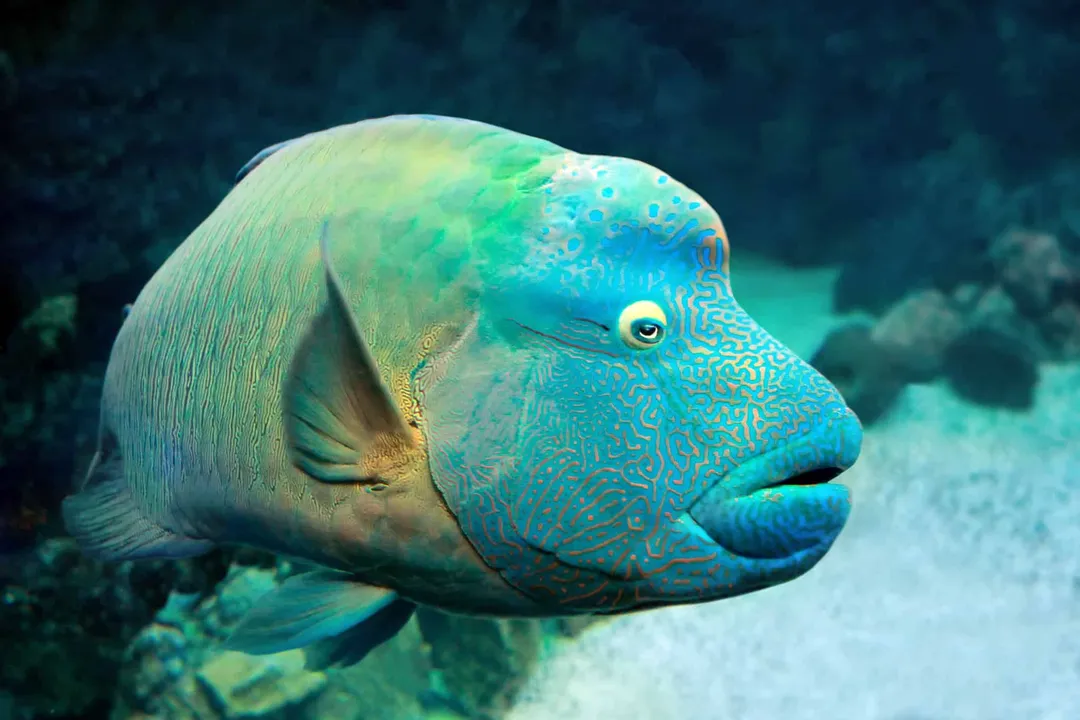
The pectoral fins, situated on the sides behind the gills, are often noted as being relatively large in many wrasse species. This size is not for primary propulsion, which is generally handled by the caudal (tail) fin, but rather for fine control and agility. These large fins are essential tools that allow wrasses to navigate the highly complex and three-dimensional environment of coral reefs with great accuracy. They facilitate precise movements, allowing the fish to dart around obstacles, hold position tightly near crevices, and execute the intricate swimming required for foraging among corals and rocks.
Related Questions
What characteristic defines the scales covering most wrasse bodies?What is the maximum recorded length for the enormous Humphead Wrasse?How do wrasses utilize their generally protrusible mouths?What coloration typically characterizes wrasses in the initial phase?What distinctive pattern marks the terminal phase male Bluehead Wrasse (*Thalassoma bifasciatum*)?What striking physical feature defines the massive Asian Sheepshead Wrasse (*Cheilinus undulatus*)?What two types of rays typically compose the dorsal and anal fins of wrasses?What dietary preference is suggested by a wrasse possessing exceptionally thick, fused teeth?What function do relatively large pectoral fins primarily serve for many wrasses?Color phases in wrasses are directly linked to which physiological/social process?