Color phases in wrasses are directly linked to which physiological/social process?
Answer
Sequential hermaphroditism and complex social structures
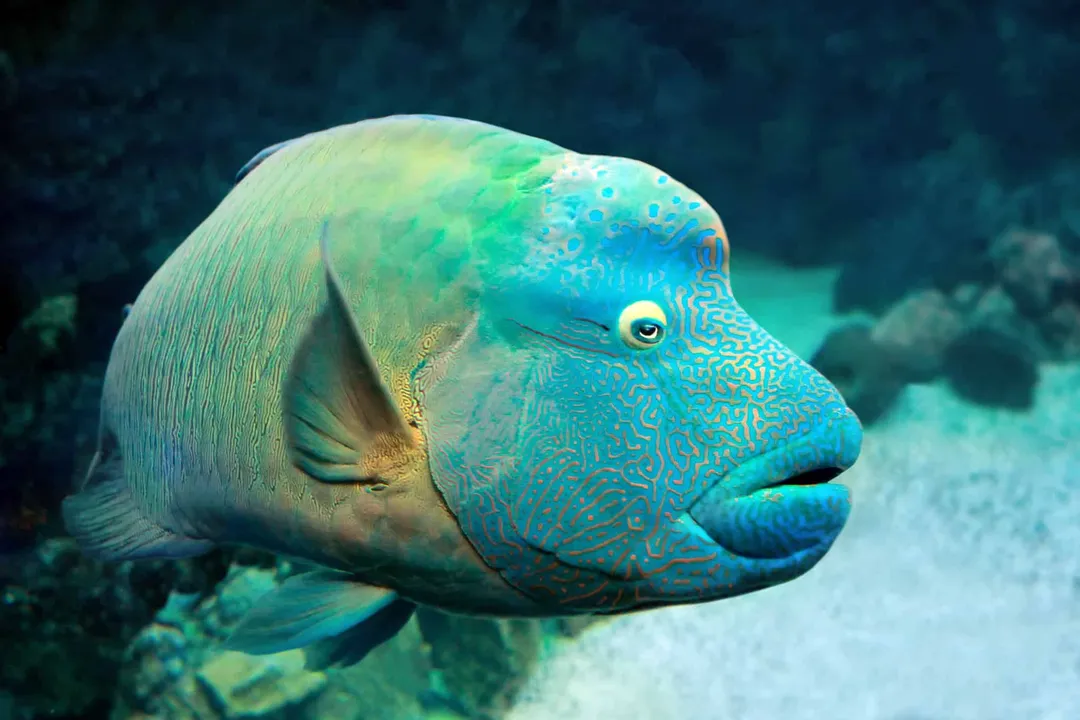
The dramatic variation in wrasse coloration is intrinsically tied to their complex social organization and reproductive strategy, known as sequential hermaphroditism. This means that an individual wrasse has the biological capacity to change its sex during its lifetime. The physical manifestation of this transition is evident in the distinct color phases—the initial phase (comprising juveniles and females) and the terminal phase (comprising dominant males). The shift from the duller initial colors to the intense terminal colors signals a fundamental change in social role, sexual maturity, and dominance hierarchy within the group.
Related Questions
What characteristic defines the scales covering most wrasse bodies?What is the maximum recorded length for the enormous Humphead Wrasse?How do wrasses utilize their generally protrusible mouths?What coloration typically characterizes wrasses in the initial phase?What distinctive pattern marks the terminal phase male Bluehead Wrasse (*Thalassoma bifasciatum*)?What striking physical feature defines the massive Asian Sheepshead Wrasse (*Cheilinus undulatus*)?What two types of rays typically compose the dorsal and anal fins of wrasses?What dietary preference is suggested by a wrasse possessing exceptionally thick, fused teeth?What function do relatively large pectoral fins primarily serve for many wrasses?Color phases in wrasses are directly linked to which physiological/social process?