What does the comparison between the Galápagos populations and mainland populations demonstrate about evolutionary success?
Answer
It requires both the ability to diversify and the capacity to maintain fitness within a changing environment.
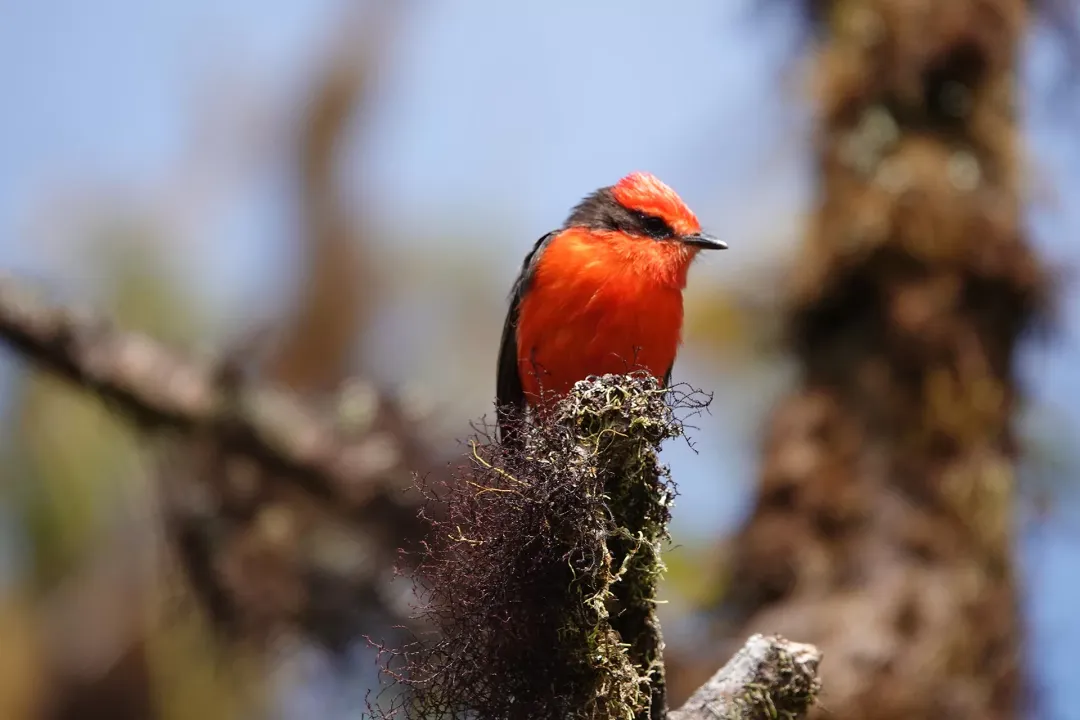
The history of these birds shows that successful colonization and diversification, such as what occurred in the Galápagos, can lead to rapid speciation. However, if the environment changes or the ecological balance shifts, that success is vulnerable to catastrophic failure, as seen in the extinction of island forms. True evolutionary success is not just about the ability to colonize and adapt to new niches but also about the long-term ability to persist and maintain fitness as environments continue to fluctuate.
Related Questions
What is the primary factor driving the ongoing scientific revision of the Vermilion Flycatcher species status?What became of the Vermilion Flycatcher species known as Pyrocephalus nanus that lived in the Galápagos Archipelago?How does evolutionary pressure differ between male and female Vermilion Flycatchers regarding their plumage?Why is the riparian habitat, such as the banks of the Rio Grande, critical for Vermilion Flycatcher populations in North America?What mechanism allowed Vermilion Flycatcher populations to separate into distinct forms across Central and South America?How do the life history strategies of Vermilion Flycatchers in Texas compare to those in more southern regions?What does the study of genetic markers reveal about the physical differences among Vermilion Flycatcher subspecies?Which scientific name has been historically used to group the Vermilion Flycatcher populations of North and South America?How does environmental variation, such as inhabiting high-altitude scrubland, influence the evolution of South American Vermilion Flycatcher subspecies?What does the comparison between the Galápagos populations and mainland populations demonstrate about evolutionary success?