Vermilion Flycatcher Physical Characteristics
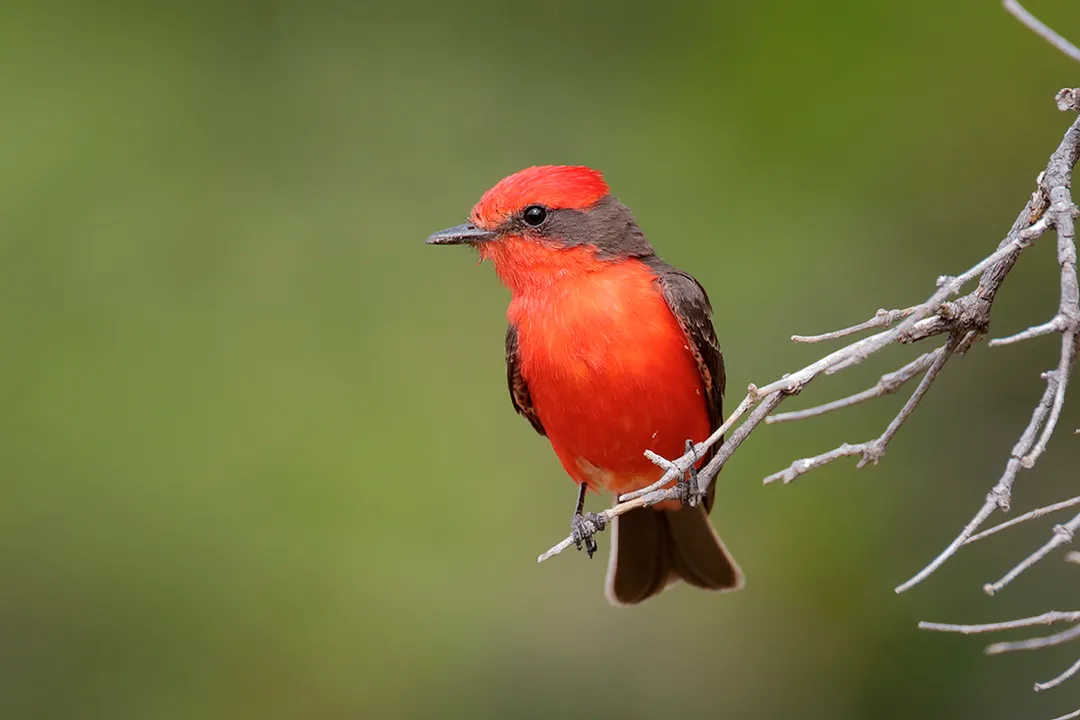
The Vermilion Flycatcher presents one of the most striking visual dualities in the avian world, immediately drawing the eye with the male’s almost unbelievable coloration, which contrasts sharply with the subtle, earth-toned appearance of the female. This difference in appearance between sexes, known as sexual dichromatism, is the bird’s most defining physical characteristic, making field identification often simple—provided you have the male in sight. [2] The species name itself, Pyrocephalus rubinus, hints at this fiery aspect, roughly translating to "fire-headed red". [3]
# Male Plumage
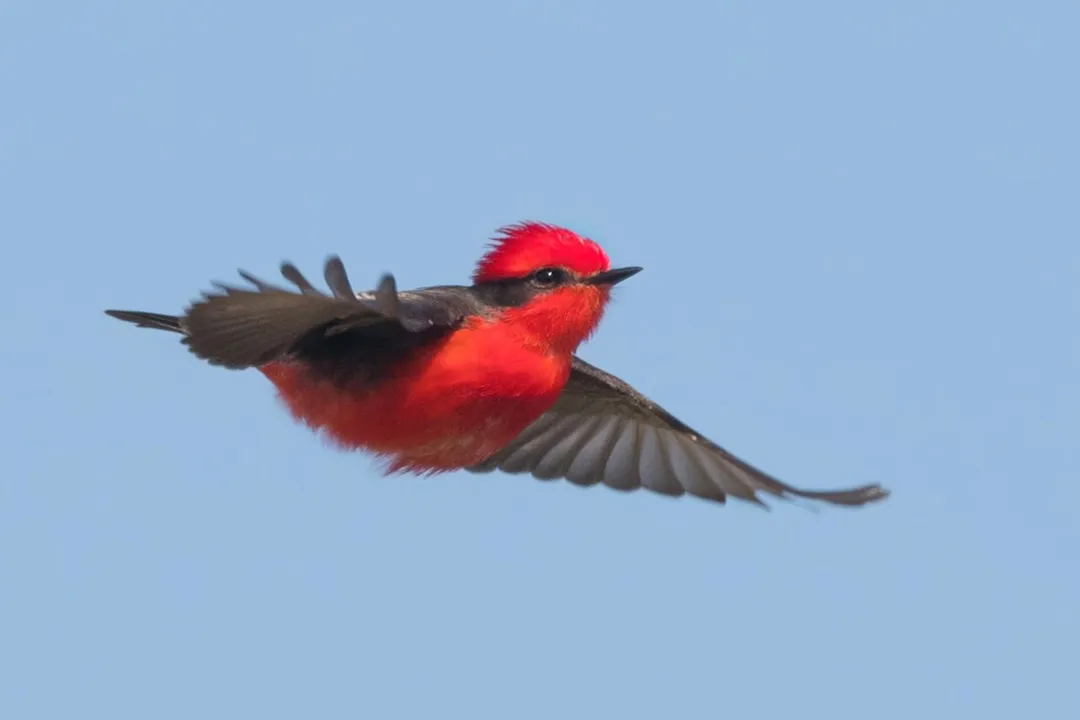
When an adult male Vermilion Flycatcher enters the scene, it is unmistakable. The vibrancy of the male’s plumage is dominated by a breathtaking, brilliant scarlet red that covers his underparts—the throat, breast, and belly—and extends to the rump. [1][4][5][7][8][9] This intense coloration makes him a beacon, especially against typical riparian or scrubland backdrops where these birds are often found. [2]
This fiery hue is set against an equally stark contrast of black on the upper body. The back, wings, and tail are uniformly black, which serves to frame and amplify the brightness of the red sections. [1][3][4][5][7][8][9] Specific details noted across observations include the male possessing a distinct red crown, which sits atop the head against the otherwise black upper plumage. [3] The overall impression is one of a small bird painted in only two, high-saturation colors. [2]
# Female Appearance
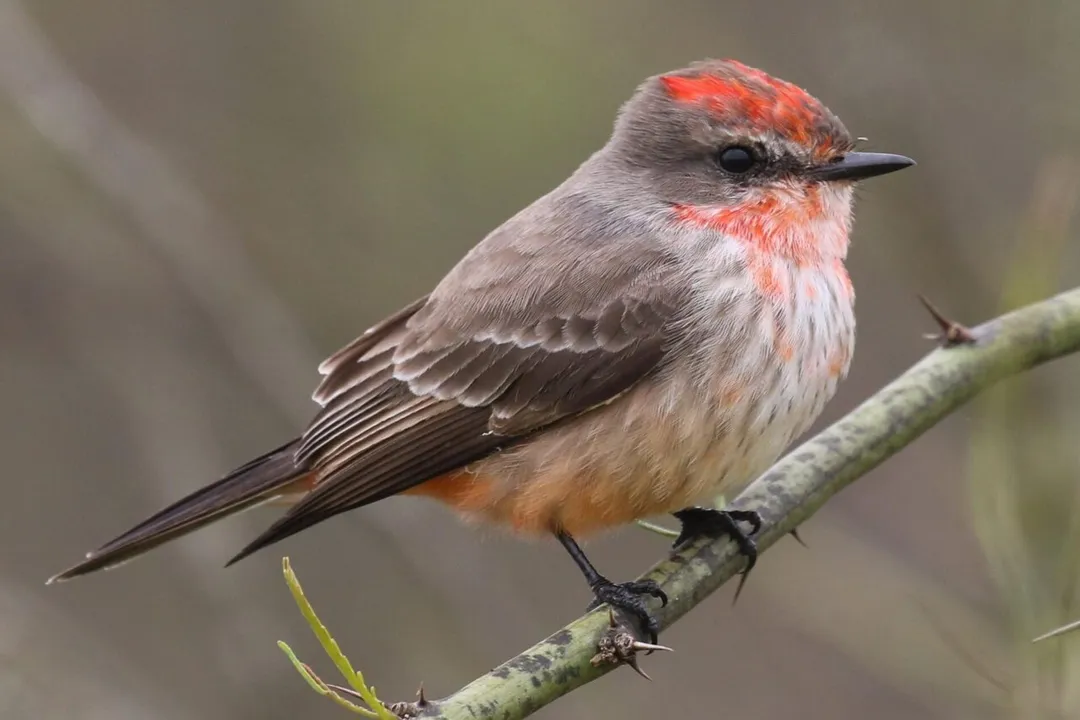
If the male is a living flame, the female is the shadow cast by a passing cloud—subdued yet perfectly adapted to her surroundings. [1] Adult females are significantly drabber, generally presenting as a brownish-gray color across their upper surfaces. [3][5][7][8][9] Their undersides are paler than their backs, though they are rarely pure white or off-white. [1] Crucially, many females exhibit a faint wash or tinge of reddish or salmon-pink coloration on the breast or belly area. [1][2][3][5][7][8][9] This slight blush of color provides the only real visual link to the male's stunning livery and is a key feature to look for when trying to distinguish a female from a non-breeding male or a juvenile. While the male’s plumage is bold and uniform, the female's breast often shows faint streaking alongside this delicate reddish overlay. [1][3]
# Size and Structure
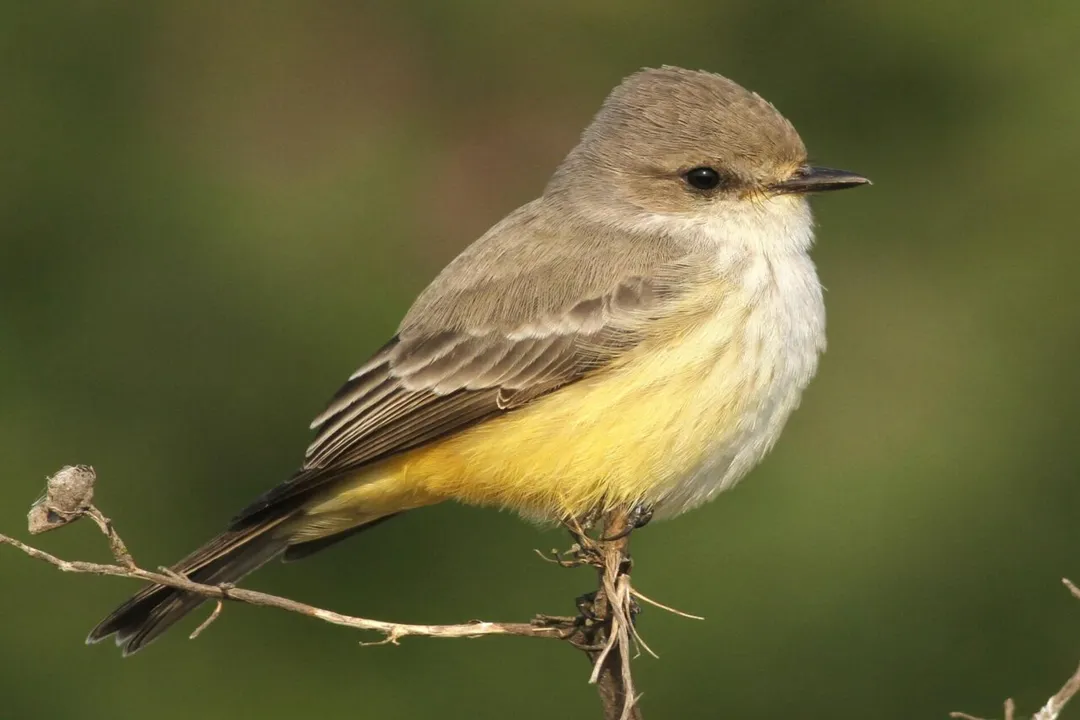
Regardless of sex, the Vermilion Flycatcher is categorized as a small flycatcher. [1][7] Their overall length measures consistently between 13 to 14 centimeters, or roughly 5.1 to 5.5 inches. [3][4] This places them squarely in the smaller end of the songbird spectrum. [1]
Beyond length, their structure contributes to their posture and behavior. They possess a relatively large head in proportion to their body size. [5] Their legs are described as short, and the bill is short and straight—typical features for an aerial insectivore that hawks its prey in short, agile sallies from a perch. [4] When observed, they often maintain an upright stance, which, when combined with their bold coloring, contributes to the impression that they are quite bold or "sassy" birds. [2][6]
Here is a comparative summary of the key identifying features for adult plumages:
| Characteristic | Adult Male | Adult Female |
|---|---|---|
| Underparts | Brilliant Scarlet Red | Paler, often with faint pink/salmon wash |
| Upperparts | Black | Brownish-Gray |
| Head Detail | Red Crown Visible | Uniformly colored with upperparts |
| General Impression | Unmistakable, brilliant | Drab, camouflaged |
| Length | 13–14 cm (approx. 5.1–5.5 in) | Approx. 5.5 inches |
It is fascinating to consider how little variation exists in the pattern of the adult bird—it is always black above and colored below—yet the intensity of that color dictates the sex, suggesting a strong evolutionary pressure favoring visual signaling in the males, perhaps for territory defense or mate attraction, while the females require excellent camouflage while nesting. [1][3] In a habitat where sunlight filters through dense brush, the difference between the brilliant male and the muted female is amplified, making the female’s ability to blend in a critical survival trait.
# Developing Plumage
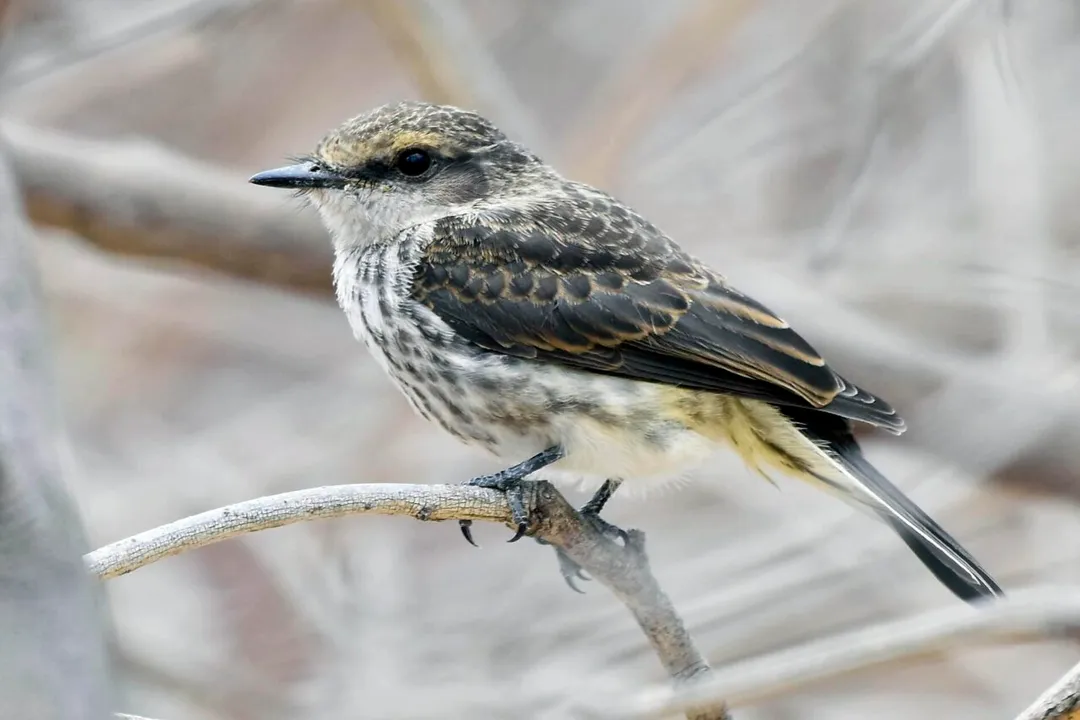
The transition from juvenile to adult plumage also exhibits characteristics worth noting for birders attempting to age the birds in the field. Juvenile Vermilion Flycatchers closely resemble the adult females in their overall coloration scheme: they are brownish-gray above and paler below. [3] However, the juveniles tend to be more heavily streaked overall than the adult females. [3] These streaks are more pronounced on the breast and flanks, giving the young birds a somewhat scaly or heavily lined appearance compared to the relatively smoother appearance of the adult female. [3] As they mature, this heavy streaking fades, and the subtle pink or salmon wash may begin to emerge or intensify, leading toward the definitive female plumage. [1]

# Subspecies Variations
While the core description—bright red male, dull female—holds true across the species' range in the Western Hemisphere, there are recognized subspecies that show subtle variations in the richness of color saturation. [3] For instance, the intensity of the scarlet on the male can differ geographically. Some subspecies might exhibit a deeper, more orange-red, while others might lean toward a purer, brighter scarlet. [3] Similarly, the extent and saturation of the pinkish wash on the female can vary regionally. [3] While these distinctions are fine and require expert observation or geographic context, they confirm that even the defining characteristic of this bird is subject to minor modification across its distribution. [3] For the average observer, recognizing the pattern and basic color intensity is usually sufficient for identification, but appreciating that the exact shade might differ based on location adds a layer of nuance to understanding the species' physical diversity. [3]
For those documenting sightings, focusing on the male's posture—often involving a short, abrupt dart out and a quick return to the same or a nearby perch—is as important as noting the color, as this behavior is characteristic of many flycatchers, but when combined with that specific brilliant red, it confirms the identity definitively. [2][4] The bird's striking visual presence is intrinsically linked to its foraging style, suggesting that the physical characteristics are perfectly attuned to its ecological niche. [4]
Related Questions
#Citations
Vermilion Flycatcher Overview, All About Birds, Cornell Lab of ...
Vermilion Flycatcher | Audubon Field Guide
Vermilion flycatcher - Wikipedia
Pyrocephalus rubinus (vermilion flycatcher) - Animal Diversity Web
Vermilion Flycatcher - Tucson Bird Alliance
Vermilion Flycatcher. Pyrocephalus rubinus. © Daniel ... - Facebook
Bird of The Week: Vermilion Flycatcher - Kern Audubon Society
Vermilion Flycatcher - Celebrate Urban Birds
Vermilion Flycatcher Pyrocephalus rubinus - eBird